Australian Government invests $276 million in a new fleet of 40 Bluebottle USVs. While not to be built here at Henderson near Fremantle, they are fascinating things.
Today, the Albanese Government has announced it will strengthen Australia’s maritime security with a $176 million investment to deliver 40 new Australian-designed and built Bluebottle uncrewed surface vessels (USV) – one of the world’s largest sovereign USV fleets.
The Bluebottle is otherwise well known along Freo’s beaches and most often simply called a ‘stinger’ – proper name Physalia utriculus

These Navy Bluebottles, however, look like this!
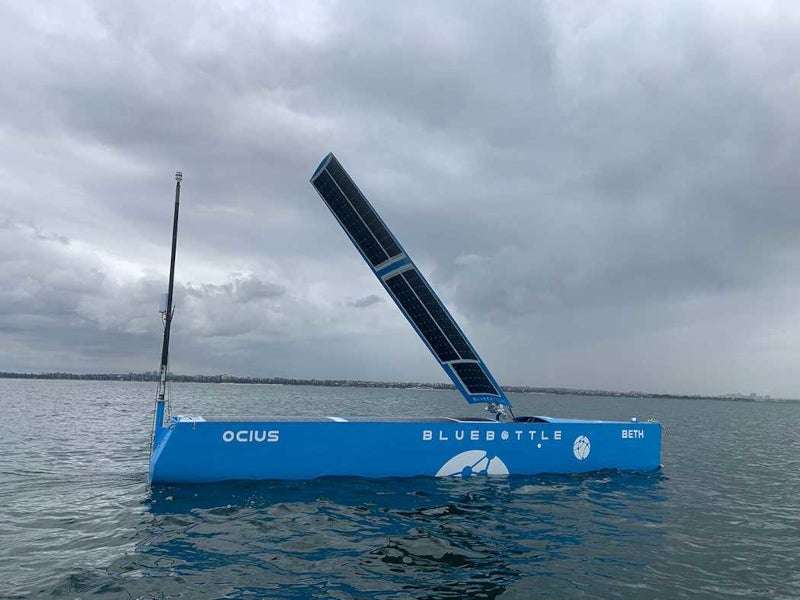
Credit naval-technology.com
The contract – with Ocius Technology – expands Navy’s operational fleet to 55 Bluebottles, significantly boosting long-range intelligence, surveillance and reconnaissance capability across Australia’s vast maritime domain.
The Bluebottle, developed in partnership with Navy and initially funded through the Defence Innovation Hub, is a long-endurance USV powered by solar, wind and wave energy. It provides persistent surface and sub-surface surveillance, can carry payloads and operates as part of a teamed, integrated maritime force.
What is the Bluebottle exactly?
The Bluebottle is a remotely piloted USV designed for persistent maritime surveillance. As you’ll have gathered, it’s named after the stinger — appropriately, since it drifts and patrols vast stretches of ocean autonomously.
How does it move?
The Bluebottle uses a patented rudder-flipper to navigate, direct and propel itself by harnessing the forward momentum created through the vessel’s pitching motion in ocean waves. Combined with solar panels on the sail and deck, and wind energy, it harvests all the weather on the ocean — sun, wind and waves — so it can advance under all conditions and remain at sea for months at a time.
The two main variants
There are two classes in service:
- Bruce-class: 5.6m long, 650kg displacement, top speed of 5.6 knots, can carry 150kg of dry payload and 150kg wet in the keel cassette.
- Beth-class (larger): 6.8m long, 800kg displacement, top speed of 6.5 knots, and can carry 350kg in a dry payload bay and 200kg wet in the keel winch cassette, with up to 1,500W of solar power from cells on the sail and deck. A newer Beth 2.0 variant has also been developed with extra volume for greater capability and presumably is the subject of the extra 50 now on order.
What can it do?
- Maritime surveillance: Four Bluebottles under contract to the Australian Border Force, equipped with 360-degree day/night infrared cameras, radar and satellite communications, are reported to have already successfully completed nearly 23,000 nautical miles of unescorted maritime surveillance patrols off Western Australia.
- Anti-submarine warfare (ASW): Two Bluebottles — Bara and Bombora — are further reported to have been fitted with Thales Australia thin line fibre optic passive and active towed sonar arrays for anti-submarine warfare and surveillance missions.
- AIS vessel identification: The Bluebottle also uses sensor data to determine if a craft has an automatic identification system showing it to be a legitimate vessel. If the AIS is absent or doesn’t match what’s detected, it reports back to a central control base and raises an alarm.
- Communications gateway: It seems that if underwater unmanned vessels need to communicate, a network of Bluebottles can act as a cell network for things operating beneath the surface across the top of Australia.
- Other roles: Mine clearance, environmental monitoring, hydrography, search and rescue, and fisheries protection.
The Royal Australian Navy originally signed a contract worth $4.9m with Ocius to acquire five Bluebottle USVs in November 2022, with all five delivered by June 2023. This latest contract will boost the Bluebottle fleet by another 40mand bring the total operational Bluebottle fleet to 55.
By Michael Barker, Editor, Fremantle Shipping News.
~ If you’d like to COMMENT on this or any of our stories, don’t hesitate to email our Editor.
~ WHILE YOU’RE HERE –
PLEASE HELP US TO GROW FREMANTLE SHIPPING NEWS
FSN is a reader-supported, volunteer-assisted online magazine all about Fremantle. Thanks for helping to keep FSN keeping on!
~ Don’t forget to SUBSCRIBE to receive your free copy of The Weekly Edition of the Shipping News each Friday!