Fremantle’s electric terminal trucks show why fuel security is no longer just about stockpiling fuel. Ports could be a earlystepping stone towards a much larger net-zero freight demonstration.
By Professors Ray Wills and Peter Newman*
Fremantle Port has already provided a useful answer to one of Australia’s biggest energy questions: how do we cut diesel dependence without making freight slower, weaker or more expensive?
We electrify the work that electricity can do. We use renewable power and batteries to support it. And we reserve scarce cleaner fuels for the genuinely difficult residual tasks.
That sounds obvious. But it runs against the way Australian energy policy is often framed: as if fuel security means securing more liquid fuel, and as if heavy freight, ports and industry must remain tied to combustion for decades.
This article draws on our submissions to two recent Australian Government consultations: the review of the Safeguard Mechanism, which determines how major industrial facilities reduce emissions beyond 2030, and the proposed Cleaner Fuels Industry demand mechanism, which would accelerate low-carbon liquid fuels including sustainable aviation fuel.
Together, they raise a common question for ports and freight: will public policy accelerate renewable electricity, batteries and electrified logistics, while reserving scarce clean fuels for the residual tasks where they are genuinely needed? Or will it preserve business as usual by treating every freight task as a liquid-fuel task, even when direct electrification can do the work more efficiently?
Fremantle is beginning to demonstrate the first option.
Fremantle first steps
Patrick Terminals has replaced half of its diesel terminal-tractor fleet at Fremantle with nine battery-electric Terberg terminal trucks. They operate around the clock, move container loads of up to 65 tonnes and recharge to 80% in less than an hour. The project has cut the terminal’s Scope 1 emissions by 15%, reduced energy costs by around 60% and most of all it has reduced maintenance costs by around 30%.
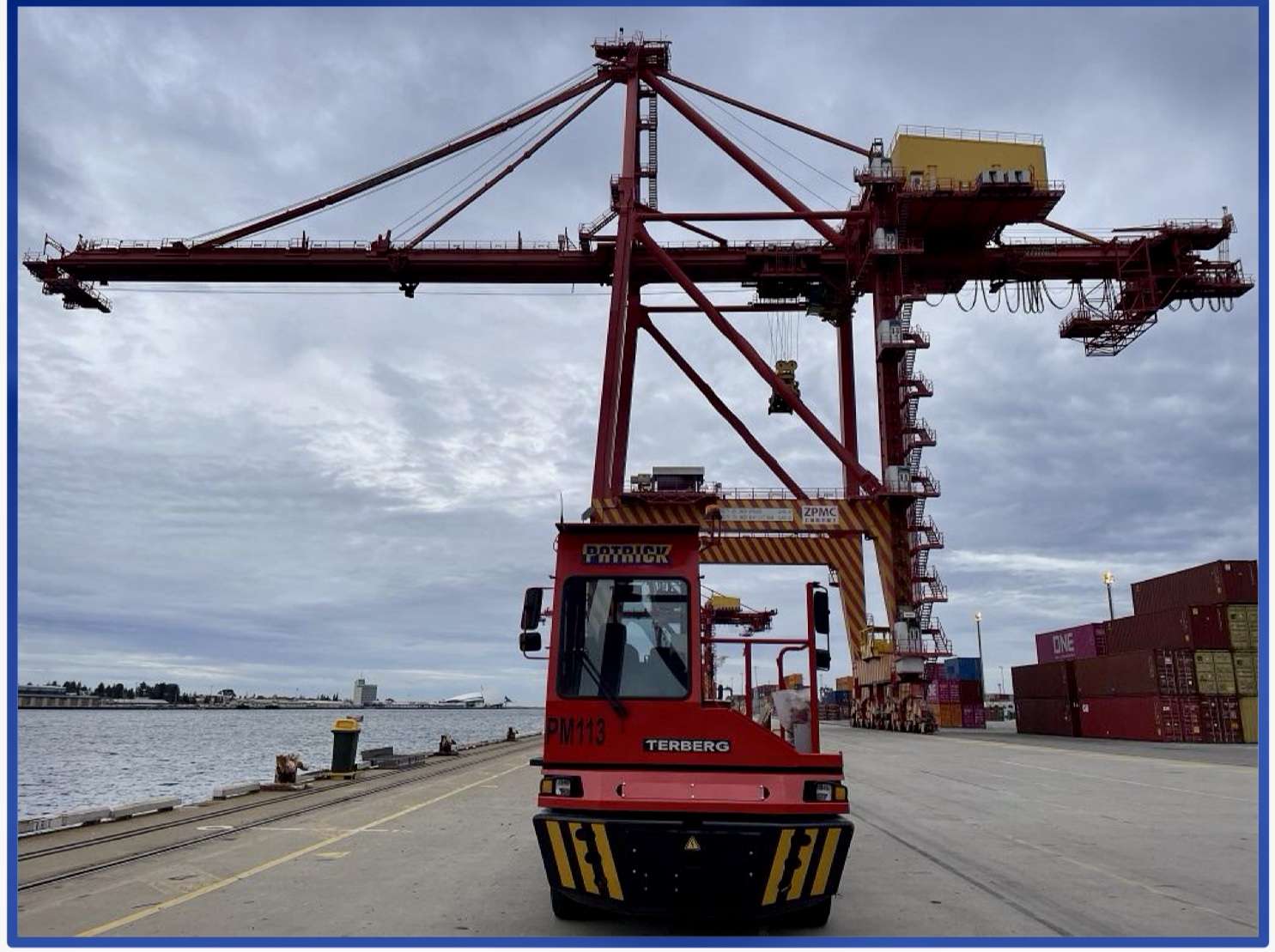
The Fremantle Port operations are not a distant pilot or a glossy concept drawing. It is an operating Australian container terminal. It demonstrates that ports are not merely places where future clean technology might arrive. They are among the best places to deploy it now.
Freight is a system
The lesson is not that every truck, ship, crane, locomotive or machine can be replaced with a battery tomorrow. The lesson is that freight should not be treated as one undifferentiated “hard-to-abate” sector so just make fuels a bit cleaner and keep going as normal.
The transition in electricity to solar, batteries and EVs with households is proving to be not only better for the planet but better for port economics.
A terminal tractor travelling predictable distances inside a port is a strong candidate for electrification. So are forklifts, reach stackers, cranes, port service vehicles, depot equipment, shore-side power systems, short-haul freight routes, rail corridors and many mining and industrial fleets.
These are high-use, repeatable jobs. They have known routes, predictable dwell time and centralised infrastructure. They are precisely the situations where battery-electric equipment, charging systems, shared storage and renewable-power contracts are especially well suited.
The question is not whether a battery can simply replace a diesel tank in an otherwise unchanged operation. It is how the whole operation can change. That means fleet renewal, route design, charging during normal dwell periods, shared charging infrastructure, battery swapping, grid upgrades, on-site solar and storage, and coordination between ports, rail operators, freight companies and energy providers.
Fremantle’s experience shows why that systems approach matters: electric trucks supported by fast chargers, fleet-power management and site electrical works, instead of just buying different vehicles that still run on liquid fuels.
Fuel security means needing less imported fuel
Australia remains exposed to imported petroleum, international oil prices and shipping disruptions. Building ever-larger fuel reserves has a role in managing immediate risk. But it is not a long-term strategy if Australia remains locked into importing vast volumes of diesel.
The most secure litre is the litre no longer required.
Every task shifted from diesel to renewable electricity reduces the amount of fuel Australia must import, store, distribute and subsidise (Figure 1). Renewable generation, batteries and electric equipment are productive assets that keep supplying energy or reducing fuel demand over their working lives. They use local sunshine and wind rather than imported fuel. Whilebiofuels can generally reduce emissions, using renewable electricity directly is more energy-efficient and less costly than choosing a different liquid fuel.
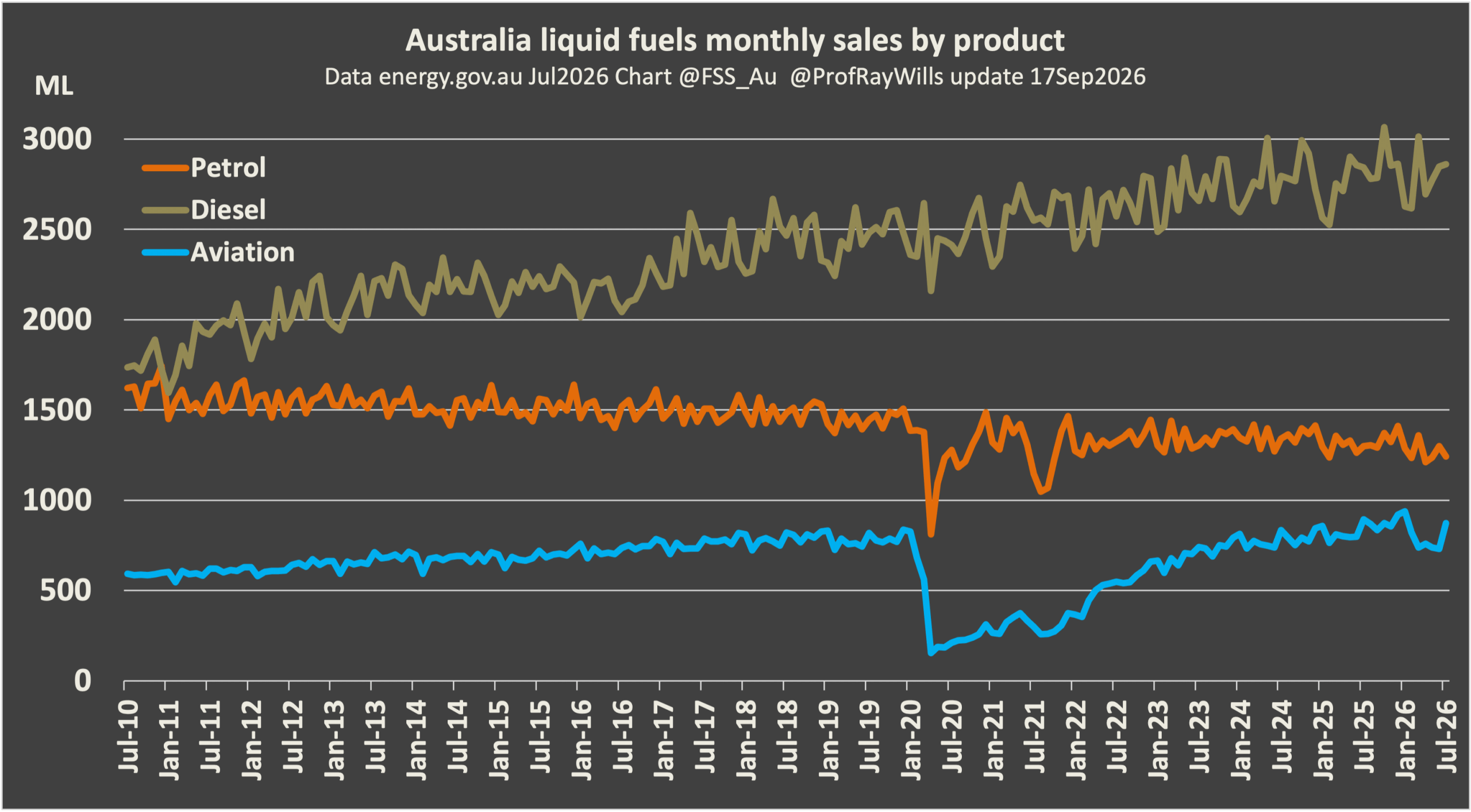
Figure 1. Australian monthly sales of imported petrol, diesel and aviation fuel.
That is why the proposed cleaner-fuels mechanism must not become a blanket subsidy for combustion. Australia should build domestic renewable-fuel capability. Sustainable aviation fuel will be important for long-distance aviation. Low-carbon fuels may also remain necessary for some ocean-going shipping, defence, emergency response, remote operations and legacy equipment.
But renewable diesel, hydrogen and e-fuels should not be treated as default alternatives where direct electrification is more efficient, operationally cheaper, and already practical.
A litre of renewable diesel is valuable. It should be used where it cannot yet be avoided – not burned in a job an electric truck, train, crane or pump can already do the work more efficiently and at lower cost.
The Safeguard test
The same principle should guide the Safeguard Mechanism, which regulates Australia’s largest industrial emitters.
The mechanism should not be judged by how many carbon credits change hands. It should be judged by whether it changes physical assets: less diesel and gas use; more renewable electricity, batteries and electric equipment; lower methane emissions; and cleaner industrial production.
Ports are a practical test bed for this approach. They join global shipping with local road, rail, warehousing, mining, agriculture, industry and energy systems. They can connect shore power, electric terminal equipment, freight charging hubs, rail electrification, battery storage and renewable generation.
Fremantle could become more than a port that handles goods. It could become a clean-freight energy hub creating export value for any green mineral, green wheat or any other net zero product seeking a green market.
That means planning electrified logistics corridors from the port to warehouses, industrial estates, rail terminals and regional supply chains. It means using batteries not only in trucks but as part of the port’s electricity system. It means connecting charging demand with new renewable generation and storage. And it means ensuring that local businesses, workers and communities share in the infrastructure and capability that result.
Don’t lock in yesterday’s fuels
The global energy transition is proceeding at extraordinary speed. Batteries are now scaling faster than solar did at a comparable point in its expansion (Figure 2). Global battery storage added 108 gigawatts in 2025, a 40% increase in a single year; the International Energy Agency describes it as the fastest-growing power technology.
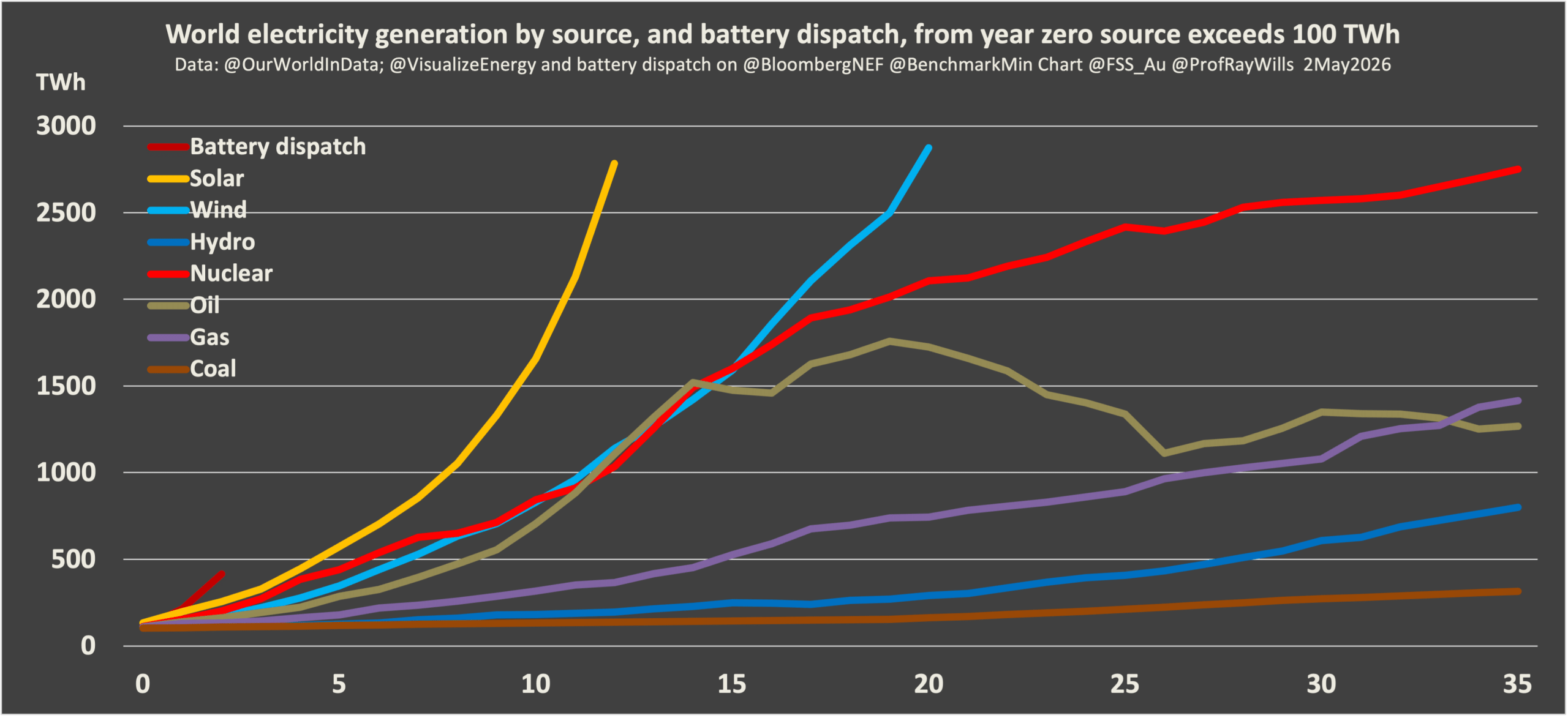
Figure 2. Global electricity generation by source and battery dispatch, indexed from the first year a source exceeded 100 TWh.
For ports and freight operators, this is a warning against underestimating change. The equipment available when a diesel fleet, crane system, freight depot or fuel terminal is replaced in the early 2030s will not be the equipment available today.
The risk is not moving too quickly. It is spending money on infrastructure that locks Fremantle and Australia into imported fuels, high operating costs and future retrofit bills.
Fremantle’s electric terminal trucks have shown what is possible. The next question is whether port operators, governments and freight businesses will treat that success as a small demonstration—or as the beginning of a new freight system.
*Ray Wills is Adjunct Professor at The University of Western Australia and Managing Director of Future Smart Strategies, where he constantly tracks the data on global change – including biodiversity and tech. Peter Newman AO is John Curtin Distinguished Professor of Sustainability at Curtin University.
~ If you’d like to COMMENT on this or any of our stories, don’t hesitate to email our Editor.
~ WHILE YOU’RE HERE –
PLEASE HELP US TO GROW FREMANTLE SHIPPING NEWS
FSN is a reader-supported, volunteer-assisted online magazine all about Fremantle. Thanks for helping to keep FSN keeping on!
~ Don’t forget to SUBSCRIBE to receive your free copy of The Weekly Edition of the Shipping News each Friday!