Welcome back to our regular feature, Rarely a Dull Moment where we report on the highlights of City of Fremantle Council and other meetings. On this occasion we bring you a Special Edition on Trees by our reporter, Jenny Archibald.
Jenny is well known to Freo folk as a former Mayor, Deputy Mayor and Councillor of the City of Fremantle and brings a wealth of knowledge and experience to her RADM reports.
To tree or not to tree? That certainly is the question right now. This special RADM looks at this topic which has been simmering for a few months in one form or another. Thecurrent tree discussion started with questions on two Norfolk Pine trees that had handsomely grown over many decades on the western part of Douro Road. A pedestrian crossing was considered on the west of the roundabout, but to ensure clear views from a traffic management perspective, the trees may have required removal. However, this was only one of several options and ultimately was not pursued.
The case of Hilton Park is perhaps more complex – options are limited if the overall project is to achieve the sought-after junior AFL football oval adjacent the main AFL oval and Brad Hardie club house facilities. Rather, with the current design it will require the removal of 26 trees – detailed below.This was reported in the RADM report of August 2026.
The Hilton Park project was approved by Council on 25thSeptember 2024 and is expected to be implemented over a period of 10 years. With a grant of $3.7M from the Australian Government, Stage 1 – Hilton Park North works began withrefurbishment of the clubhouse – already underway. However,with concerns raised by locals around the removal of the 26trees to accommodate the Junior AFL Oval, the clearing of this area was paused by Council staff to allow further community discussion.
A community petition was then rustled up and submitted to council seeking a Special Electors Meeting, and this was held on 15 September at the Fremantle Town Hall, as reported here.
Community discussion on trees is not new. I was this week reminded of a document – “The Future Fremantle” – which was put out in 1979 by the Fremantle Society Inc. It was a bold document for its time and there were many initiatives put forward which are now “part of the furniture”. But an article in the local Fremantle Gazette at the time noted …” the Society’s lament for the lack of trees lining the streets of Fremantle” and that “Future Fremantle residents could exercise their bicycles on cycleways, walk down tree-lined streets and cul-de-sacs, have their rubbish recycled, live in inner city low-rise housing and have a comprehensive train service”. We have come some way since then – the train service was thankfully reinstated, and recycling facilities have evolved in ways not dreamt of in the 1970’s. Cycleways are gradually happening and some inner housing likewise. And trees???.
Well trees have definitely been on the agenda. For several years now, the City has planned and implemented projects to improve the aesthetics and amenity of our streetscapes and public places. This work has also focused on the reduction of the “heat island effect”, which is expected to increase given global warming forecasts, and to increase biodiversity and accommodate wildlife. And it is still ongoing.
In the midst, the City continues work with sporting communities aspiring to meet their needs on grounds which for decades have been zoned for and hosted sporting facilities of one form or another.
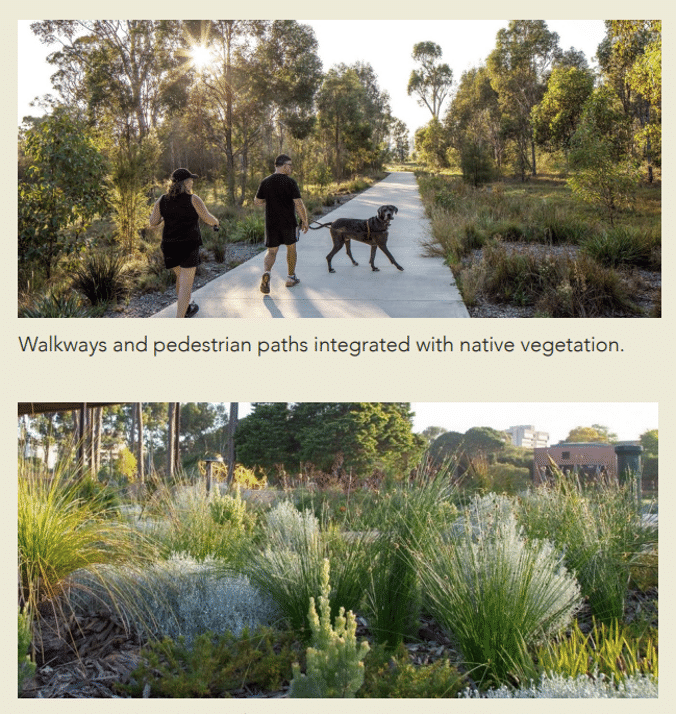
Stage one of the Hilton Park project has sought to deliver on both counts – for the Aussie rules football folk and their goals,while also transforming the NE corner and perimeter areas with plantings and improvements that would provide habitat for fauna and attractive spaces for people.
The City recently released the Hilton Park North Environmental Management Plan March 2026 which now provides a great deal more information on this topic.
It includes a range of assessments, particularly in relation to fauna and flora, as well as reports on environmental analyses, including that for uncontrolled fill with some asbestos. The report relates to Stage One of the plan and covers the northern portion of Hilton Park bounded by Shepard St, Waltham Way, Carrington St and Lefroy Rd over an area of 6.16 hectares, and is zoned as Public Open Space. The total Hilton Park site is around 19 hectares.
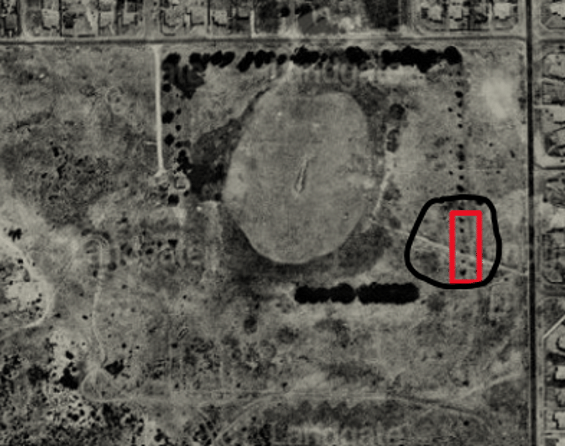
It is interesting to reflect on the changes since1953, in theearliest aerial photograph of the site that we are aware of (photo below). My rough black line is the vicinity of the proposed Junior oval and the red box outlines the six Norfolk Pines proposed to be removed. Interestingly, there are no prominent street trees along Carrington St though a number of trees do surround the main oval onsite, including along Lefroy Rd where, according to Environmental Management Plan, “minimal native remnant trees” were retained along the northern, western and southern boundary of the site.
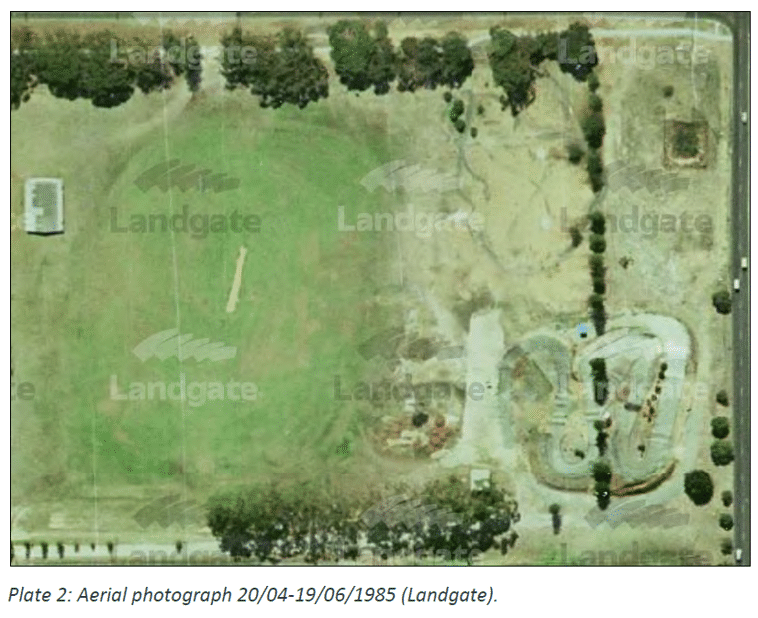
The second photo (below) was taken in 1985 and shows the site as a still relatively sparsely vegetated site, though some trees had been planted in the southeast section of the project area adjacent Carrington St and the BMX track had been installed over the fill site.
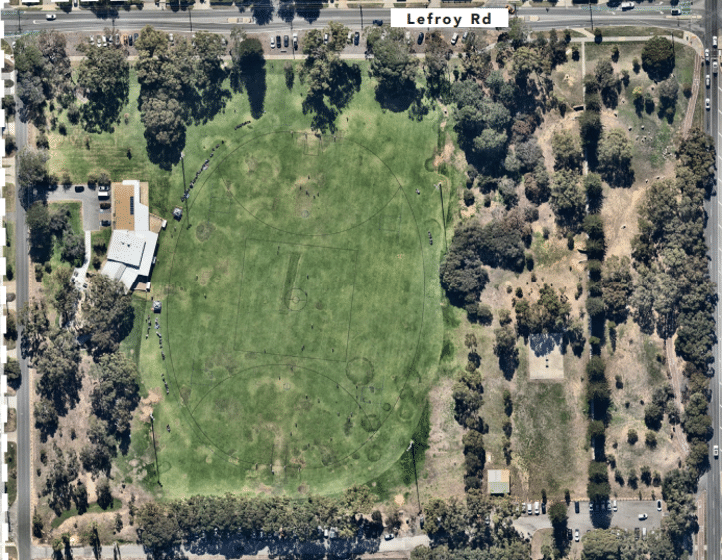
Then an image below from the 2024 Hilton Park Masterplanshowing a great deal more canopy with trees growing along the perimeters and within the northeast part of the site over perhaps some 40 years.
The environmental report notes that within the northern project area there are now 271 trees. These include 133 of species native to the Swan Coastal Plain and 138 of non-native species. 23 of these are classified as of “high retention value” due to ecological or amenity significance and all of these are being retained.
This image shows the trees tagged for removal – they have red crosses. My black line encompasses these – giving a very rough guide to the proposed junior oval location.
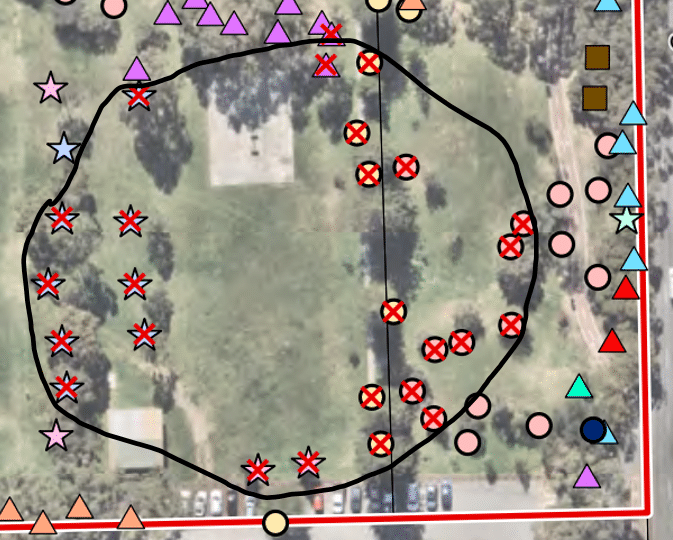
Of the 26 trees proposed to be removed, it would seem (based on my interpretation of the maps in the report) that this includes five species – two trees are Eucalyptus maculata(Victorian Ash), eight are Corymbia citriodora (lemon scented gum), two are Eucalyptus gomphocephalus (Tuart), eight are Agonis flexuosa (Peppermint tree), and six are Araucaria heterophylla (Norfolk Pines). These particular trees were all classified as of “moderate value” based on “useful expected lifespan, health and structural score”.
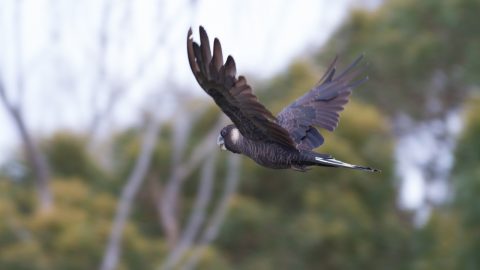
With respect to fauna on the site, 3 conservation significant species are likely to occur. These are the Carnaby’s black cockatoo, the Forest Red-tailed black cockatoo and the Pacific Swift (a rare though beautiful seasonal visitor to WA). With habitat assessment for the cockatoos, no potential breeding sites suitable for the black cockatoos were found given a lack of suitable hollows, though 18 trees with future potential were recorded and all are to be retained. These include marri (1), tuart (16) and Eucalyptus rudis (1). No roosting was evident by these species on site during the assessment.
For foraging habitat of the Carnaby’s black cockatoo, a total of 0.93 ha of potential foraging species were recorded. The primary foraging sources are the Pinus pinea and marri. Secondary foraging species are the peppermint trees and Norfolk Pines. For the Red-tailed black cockatoo, a total of 0.50 ha of foraging habitat was recorded, with no non-native primary foraging habitat recorded. The foraging area for removal is 0.13 ha, less than the area of 1ha which would require further assessment. It comprises of predominantlysecondary foraging tree species, including the 6 Norfolk Pines and 11 peppermint trees. The retention area of 0.84 is based on a combination of the two black cockatoo foraging preferences. Refer to diagram below:
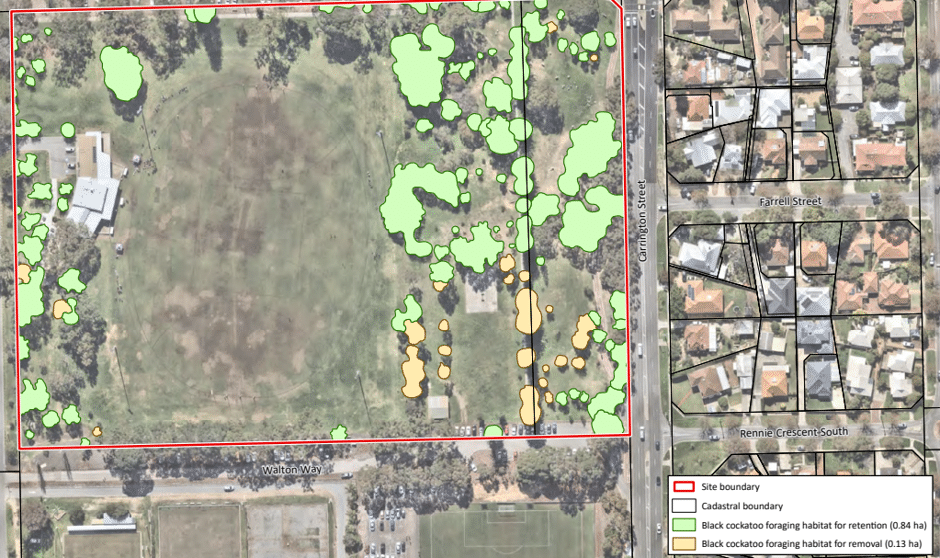
Note: Four additional trees were also to be removed over the northern area but are now to be retained.
In looking at the progress and framework of how this work is planned it is interesting to look back at how the emphasis on trees has evolved. In July 2017, the City endorsed the Urban Forest Plan at a time when it had some 13,629 trees on its register. The plan set the objective to increase the tree cover canopy cover by up to 20%. With a few hiccups along the way (eg Covid, followed by budget constraints and species revision given spread of Polyphagous shothole borer) the plan has still delivered many more trees on streets, in parks and in other green spaces of the City of Fremantle. You can now click on the Council website and order a street tree if you don’t have one.
And reflecting on the Fremantle Society’ desires of 1979 – the Council now has some 23,388 trees in its streets and parks registered in its system.
During 2025/2026, more than 960 trees were planted by the Council. This does not include regeneration programs of the eight “Friends of” and school groups whose supporters planted 10,915 seedlings, nor the 1,100 plants put in by staff on a staff planting day, nor the 30,000+ seedlings that were planted as part of the Green Linkage projects.
In February 2024, the Council endorsed the Public Open Space Strategy for the municipality in which it reviewed use of, and developed a framework for, managing public open spaces. In doing this it also took into account the challenges of a growing population and urban infill.
Within this strategy, Hilton Park was assessed as a district public open space, identified for recreation under the scheme, and classified for sport. Yet in the mix, there are 683 trees recorded within the Hilton Park precinct, with some 61 species overall. On completion of the masterplan there will be at least 718 trees.
Of these, 21 belong to two species of Araucaria – there is asingle representative of Araucaria columnaris or Cook Pine somewhere in the mix, and the remainder are Araucaria heterophylla which is the Norfolk Pine. Twenty Araucaria arein the Northern project area and another one is near the entry to the Hilton Park Bowling Club. Just for info, the Norfolk Pine is endemic to Norfolk Island but now grows in many other parts of the world. The first European known to have sighted Norfolk Island was Captain James Cook in 1774, on his second voyage to the South Pacific. Within the City of Fremantle there are now more than 840 Norfolk Pines planted as street trees and within parks.
Today, the Council manages some 1,270 hectares or 19.3 sq. km of public open space, with 42 hectares of natural areas including beach reserves. Its Greening Fremantle Strategy 2020 provides the overarching strategy for the detailed Urban Forest Plan, but more importantly, it seeks to “develop links that increase the amount of flora/vegetation and increase habitats for native fauna and encourage their movement between green spaces and to increase and improve biodiversity areas”.
The Greening Fremantle Strategy is critical to the retention and growth of our endemic critters – birds and flat footed alike – in that we need to create more effective habitat. Over the years, Fremantle has made good headway on a number of fronts. Places like Cantonment Hill, Booyeembara Park,Clontarf Hill and the like have been witness to quite remarkable regeneration programs, and a great deal of this was done working with community.
With the addition of suitable species, the proposal for the non-sport area of Hilton Park North can no doubt become another important biodiversity habitat and linkage for our wildlife – with or without the 26 debated trees. It will still a great outcome for the park.
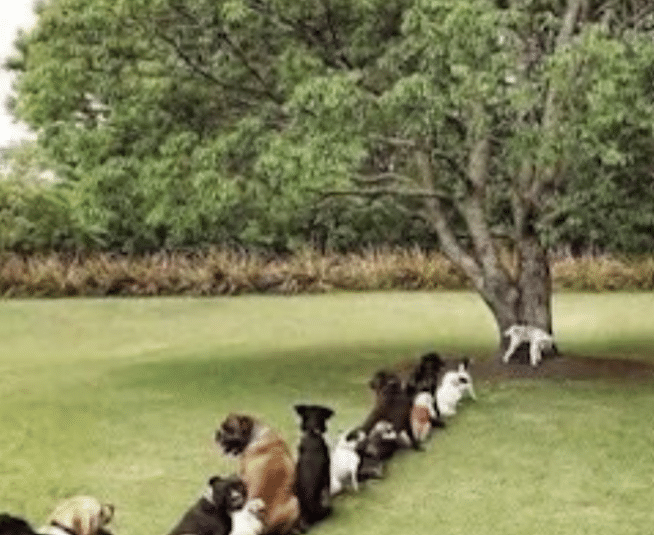
And no …. we don’t want to have this supply problem:
*By Jenny Archibald
~ For earlier RADM reports look here.
~ If you’d like to COMMENT on this or any of our stories, don’t hesitate to email our Editor.
~ WHILE YOU’RE HERE –
PLEASE HELP US TO GROW FREMANTLE SHIPPING NEWS
FSN is a reader-supported, volunteer-assisted online magazine all about Fremantle. Thanks for helping to keep FSN keeping on!
~ Don’t forget to SUBSCRIBE to receive your free copy of The Weekly Edition of the Shipping News each Friday!