International Day of Peace: Mayors, Councillors and Campaigners discuss AUKUS nuclear safety and risks for Cockburn Sound
Alongside the sunlit expanse of South Beach Recreation Reserve in South Fremantle, with happy families supervising children in the nearby playground, a critical conversation unfolded on Monday 21 September 2026, in the International Day of Peace.
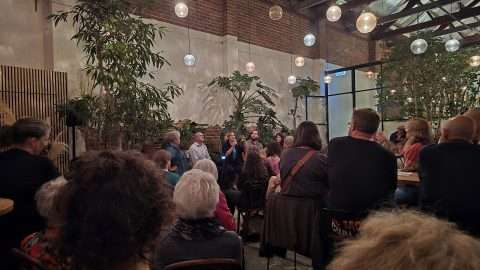
Local government leaders and peace advocates gathered at Bistro 21 for an exclusive round-table discussion convened by Nuclear Free WA. The 90-minute forum zeroed in on the rapidly evolving issue of nuclear safety risks confronting Cockburn Sound and its surrounding communities under the AUKUS pact.
The meeting brought together invited Mayors and Councillors from Perth’s south-west metropolitan region. It served as a platform for voicing urgent community concerns and stripping away the layers of secrecy around the defence agreement.
A Trajectory Toward Conflict
Leading the dialogue was Dr Sue Wareham OAM, President of the Medical Association for Prevention of War (MAPW). She spoke quietly but did not mince words when assessing the geopolitical fallout of the trilateral alliance.
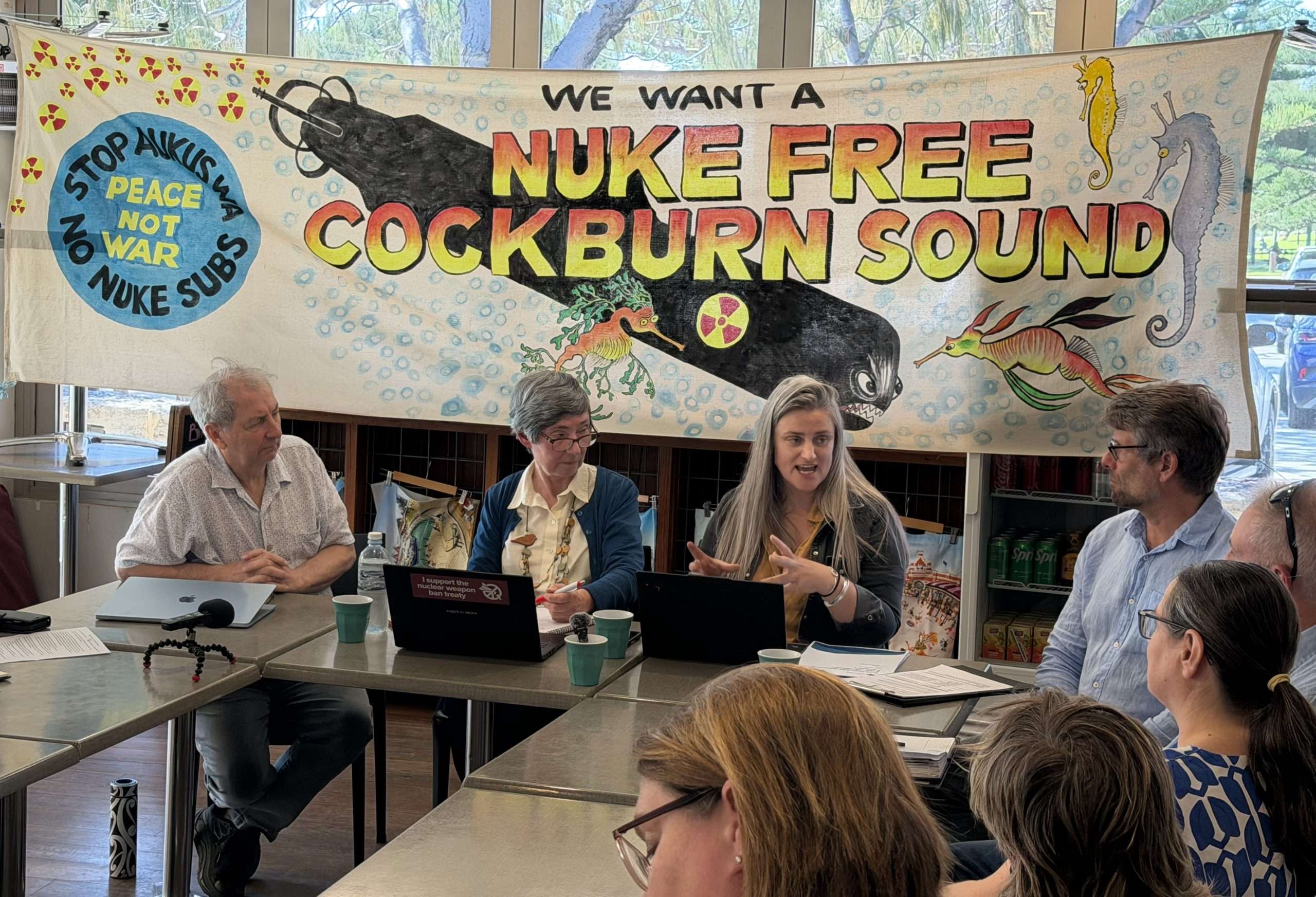
From left to right: Adrian Glamorgan, MAPW president Dr Sue Wareham OAM, Mia Pepper, Sam Wainwright. Photo supplied
“AUKUS has deeply troubling implications for Australians’ safety and security, with particular risks for WA residents,”she said. She contended that the agreement is actively heading Australia toward being enmeshed in a US war on China, which she warned has nuclear implications.
Central to the discussion was the reality facing HMAS Stirling. It was noted as highly likely that post the early 2030’s nuclear powered submarines on rotation at HMAS Stirling will also be nuclear armed. The reality of Stirling basing US submarines drastically increases the likelihood that, in the event of war, the base could be targeted by China, potentially with nuclear weapons.
The Threat of Reactor Accidents
Beyond the macro-threat of global warfare, the round table examined the immediate, tangible dangers of hosting nuclear vessels in local waters. Dr Wareham raised the potential for a naval reactor accident on board a visiting US submarine.
She said that authorities use very careful wording to project the idea that no accidents have occurred on nuclear submarines. In fact, there have been many.
An example was when the USS Connecticut struck an underwater mountain, resulting in 11 sailors being injured. The official US announcement spoke of the sub striking an object in international waters of the Indo-Pacific region Infact, it had ploughed into a mountain in the highly contentious South China Sea. A UK submarine has collided with an iceberg.
She said that a mishap in Cockburn Sound poses severe radiological risks to local residents with the compounding problem of oversight. Under current arrangements, US authorities would help decide exactly how much information would get shared with the Australian public in the event of a crisis. With the United States currently relaxing its domestic radiation protection standards, Dr Wareham warned that the risks from such an accident have significantly escalated.
Not only that but the government’s plan to issue stable iodine salts to the population to protect against radiation is simply a fantasy. Such tablets only protect the thyroid gland, not the rest of the body and to be most effective they must be administered within 2 hours of the radiation exposure. After 24 hours they can worsen the problem.
Dr Wareham asked how the hospital system would cope with the task of administering those tablets at the required scale and timeframe and what would be asked of the local government officials at the roundtable.
The Nuclear Waste Dilemma
The environmental perspective was brought into focus by Mia Pepper, Australian Conservation Foundation (ACF) nuclear free campaigner. She stated that AUKUS is the single greatest nuclear waste threat in the nation’s history.
“After 30 years of failed attempts to secure a radioactive waste site in Australia,” Ms Pepper said, “embarking on a plan that will generate weapons-grade nuclear waste is reckless and to put it under the control of the Department of Defence is deeply troubling.”
Ms Pepper also targeted the legal and ethical contradictions of government policy. She drew attention to the Treaty on the Prohibition of Nuclear Weapons that entered into force in 2021. The Australian government has a formal commitment to sign it, but has still not done so.
“There has never been a more important time for Australia to push for the total elimination of nuclear weapons and sign the treaty,” Pepper urged, pointing to the rotational basing of submarines at HMAS Stirling.
She critiqued the government’s current posture: “Instead of saying no to US nuclear weapons on our shores, Australia adopted a ‘don’t ask, don’t tell’ policy. Australians had a right to know and a right to say no to nuclear weapons.”
Learning From Global Precedents
Veteran peace campaigner Adrian Glamorgan, a former representative of the City of Fremantle Mayor on the International Mayors for Peace Executive and current Secretary for the Friends World Committee for Consultation Asia West Pacific Section, brought international case studies to the table.
He highlighted the specific emergency preparedness and safety procedures currently utilised by municipal authorities in major naval hubs like San Diego (USA) and Subic Bay in the Philippines. He reported stark gaps in local readiness and transparency.
What is more, he said, US authorities refuse to carry out emergency preparedness exercises because they claim there is no danger of a mishap.
Former Fremantle councillor Sam Wainwright, who chaired the event, commented that even if local councils have no power when it comes to regulating these radiological risks, they still have care and responsibility. Just as councils have little power in controlling bushfires they are still expected to mobilise for evacuations and other tasks. It would be the same if an emergency occurred with a nuclear submarine.
He also said that if the US authorities refuse to say if nuclear weapons are present on their submarines, and the Australian Government refuses to ask, then how can a local council even begin to prepare a risk management plan. The essential information about the hazard and the risk is absent.
Demanding Local Transparency
The overall tenor of the round table was that Western Australia remains under-prepared and under-informed about the dangers of the AUKUS arrangement. Many of those present felt that protecting their communities requires moving past military platitudes and securing concrete, publicly accountable safety strategies before the submarines arrive.
By Barry Healy
~ If you’d like to COMMENT on this or any of our stories, don’t hesitate to email our Editor.
~ WHILE YOU’RE HERE –
PLEASE HELP US TO GROW FREMANTLE SHIPPING NEWS
FSN is a reader-supported, volunteer-assisted online magazine all about Fremantle. Thanks for helping to keep FSN keeping on!
~ Don’t forget to SUBSCRIBE to receive your free copy of The Weekly Edition of the Shipping News each Friday!