Here’s something for our Shipee policy wonks – the Executive Summary of the national Productivity Commission’s recent Interim Report on the GST distribution that benefits WA more than it does other States. The PC’s interim conclusion that the system needs to change has got local and federal pollies from WA in a tizz! What do you think? You can make a submission to the PC by the end of September.
Executive summary
Since Federation, the Australian Government has aimed to limit the fiscal gap between the states and territories (hereafter ‘states’). This has evolved into the principle known as horizontal fiscal equalisation (HFE), which holds that the Australian Government should ‘equalise’ the financial capacity of the states, such that they can provide services to a similar standard. The principle is supported by all states, but historically they have held different views about the level of equalisation the system should seek to achieve, and whether this level is reasonable.
Today, the Australian Government pursues HFE by collecting GST and distributing it to the states. Every year, the Commonwealth Grants Commission (CGC) compares the fiscal positions of the states and makes recommendations about how much GST revenue per person a state should receive – which is known as a state’s ‘GST relativity’. States with less fiscal capacity have a higher relativity, as they need more funding per person than the average state to provide a similar level of services, and states with greater fiscal capacity have a lower relativity.
The onset of the mining boom in the early 2000s resulted in Western Australia becoming the fiscally strongest state, sending its relativity, and its GST share, to unprecedented lows. In response to Western Australian concerns and otherlongstanding criticisms of the HFE system, the Australian Government passed a series of reforms in 2018.
The Australian Government has asked the Productivity Commission (PC) to review the 2018 reforms to the GST distribution system and whether alternative arrangements would better deliver on the objectives of equity, efficiency, fiscal sustainability and certainty.
Understanding the 2018 reforms
The 2018 reforms to HFE consisted of 3 measures.
5. A new fiscal equalisation standard, set at the relativity of whichever of New South Wales or Victoria has the greater fiscal capacity (the ‘standard state’). This standard was phasedin over 6 years.
6. A GST relativity floor, set at 0.70 in 2022–23, then increased to 0.75 from 2024–25.
7. A boost to the GST pool through a perpetual yearly increase from the Australian Government.
These changes were intended to make the system more resilient to economic shocks and improve stability and predictability of state revenue, while simultaneously making all states better off from the reforms. Every state other than Western Australia opposed the changes, but their approval was not required for the changes to become law.
At the time the reforms were introduced, the mining boom was projected to moderate. The boom – and especially strong iron ore prices and production – was the main driver of Western Australia’s high assessed fiscal capacity and record low GST relativity. A moderation of the boom would have seen Western Australia’s relativity revert towards its historical average. It would also have meant the GST pool boost – which was $600 million from 2021–22, then $850 million from 2024–25 (indexed to GST pool growth) – would have left all states better off.
However, not all states shared the expectation that the mining boom would ease and that all states would benefit from the reforms. Many argued that the 2018 reforms should be accompanied by a (Australian Government funded) No Worse Off (NoWO) guarantee to ensure that no state was left financially worse off because of the changes. A temporary NoWO guarantee was therefore introduced, although the Australian Government did not expect it to be required. However, it quickly became clear that the NoWO guarantee would be called upon, and in the leadup to its original expiry in 2026–27, the Australian Government and states agreed for it to be extended until 2029–30.
The 2018 reforms are costing more than expected
The 2018 reforms were expected to cost the Australian Government about $5 billion by 2024–25, but have ended up costing almost $23 billion, largely due to payments made under the NoWO guarantee (figure 1). While Western Australia was expected to benefit by a cumulative amount of about $3.9 billion by 2024–25, it has received the majority of the benefit from the $23 billion spent by the Australian Government. Other states were expected to be better off by about $1.1 billion by 2024–25, but have not ended up benefiting from the reforms. Instead, they only remained no worse off due to the NoWO guarantee.
The 2018 reforms have largely not achieved their intent
After reviewing the evidence, consulting with all state governments and reviewing over 60 submissions from the public, the PC has determined that the 2018 reforms have largely not met their intent and have introduced a range of undesirable features into Australia’s HFE system.
The standard state equalisation benchmark is not working as intended
The standard state benchmark has introduced the possibility of the system producing perverse outcomes that invert the logic of HFE. For example, the benchmark means that Western Australia could gain additional GST revenue when New South Wales or Victoria experiences a natural disaster. If New South Wales incurs net fiscal costs associated with a bushfire for example, its relative fiscal capacity decreases, leading to a higher GST relativity and share of GST revenue. While all other states would experience a reduction in their share of the GST pool, Western Australia would have its GST share increased to match the now higher standard state benchmark. In some circumstances, the operation of the standard state benchmark can also mean that increases in Western Australia’s ownsource revenue can lead to an increase in its share of GST revenue.
Figure 1 – The cost of the 2018 reforms has been higher than anticipated
Annual actual and forecast costs (nominal), 2018–19 to 2024–25
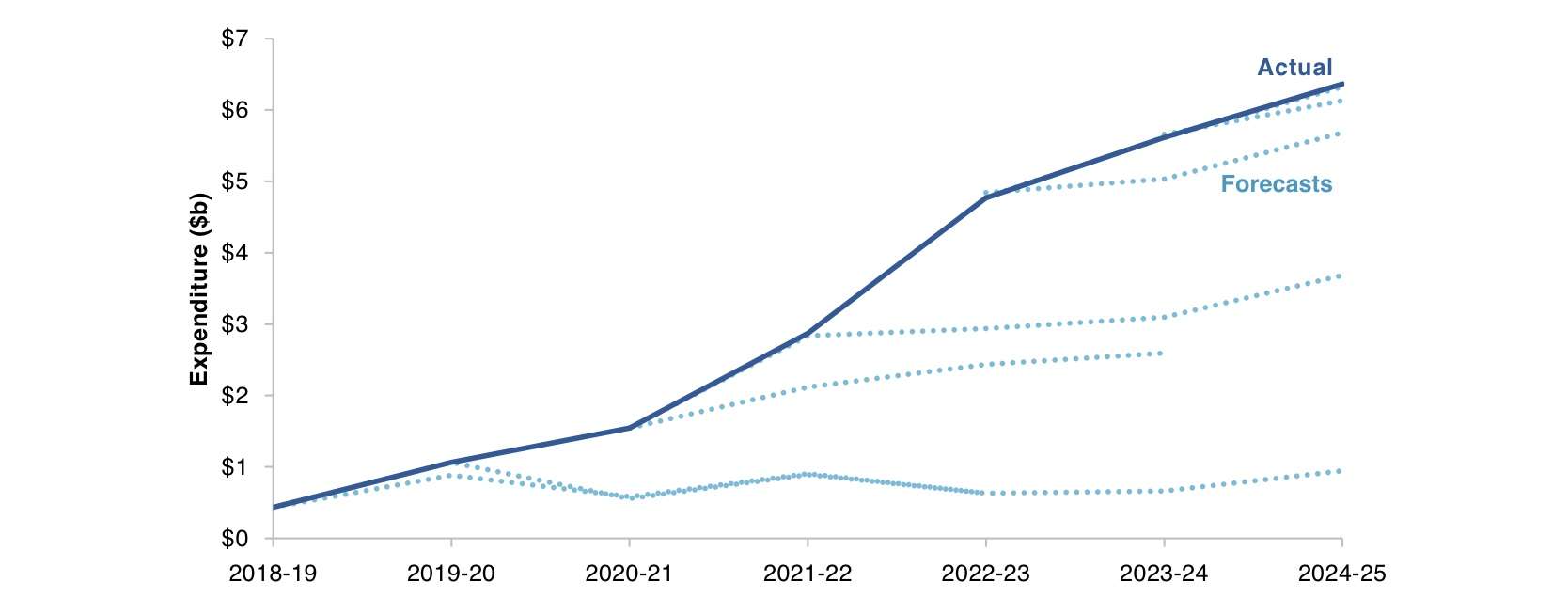
’Forecasts’ includes data from both Budget documents and longerterm estimates from the Australian Government’s interim response to the PC’s 2018 inquiry into Horizontal Fiscal Equalisation. ‘Actual’ data is from Final Budget Outcomes, with 2024–25 being the most recent year of published data.
Source: Australian Government (2018, p. 21) (various years); Commonwealth of Australia (2024a, 2025) (various years).
The standard state benchmark has created a twotiered GST distribution system where a state like South Australia that has a lower fiscal capacity than New South Wales or Victoria does not benefit from the equalisation benchmark. This means that if South Australia improves their financial position, they receive less GST revenue.
On the other hand, a state with greater fiscal capacity, like Western Australia, now has its relativity automatically increased to the same as Victoria or New South Wales. This means that if Western Australia improves its financial position, it can receive the same or even more GST revenue than it otherwise would.
Only Western Australia has benefited from the reforms
The GST pool boost that was introduced as part of the 2018 reforms was intended to make all states ‘better off’ by increasing the amount of GST revenue available for distribution. But the reforms have only materially benefited Western Australia, improving its fiscal position relative to other states.
Prior to 2018, all states received enough GST revenue to meet 100% of their assessed fiscal needs, consistent with the principle of HFE. However, as a result of the reforms, Western Australia received enough GST revenue to meet 113% of its assessed fiscal needs in 2024–25 – compared with 98% for all other states (figure 2). The Australian Government’s $5.4 billion of NoWO payments in 2024–25 ensured all states received 100% of their assessed fiscal needs, but the PC estimates that an additional $47 billion would be required to provide all states with the same fiscal capacity as Western Australia. This calculation illustrates the extent to which the current system has departed from the pre2018 version of HFE.
Figure 2 – GST payments no longer equalise states’ assessed budgets
Assessed 2024–25 fiscal need met, by distribution system and revenue source
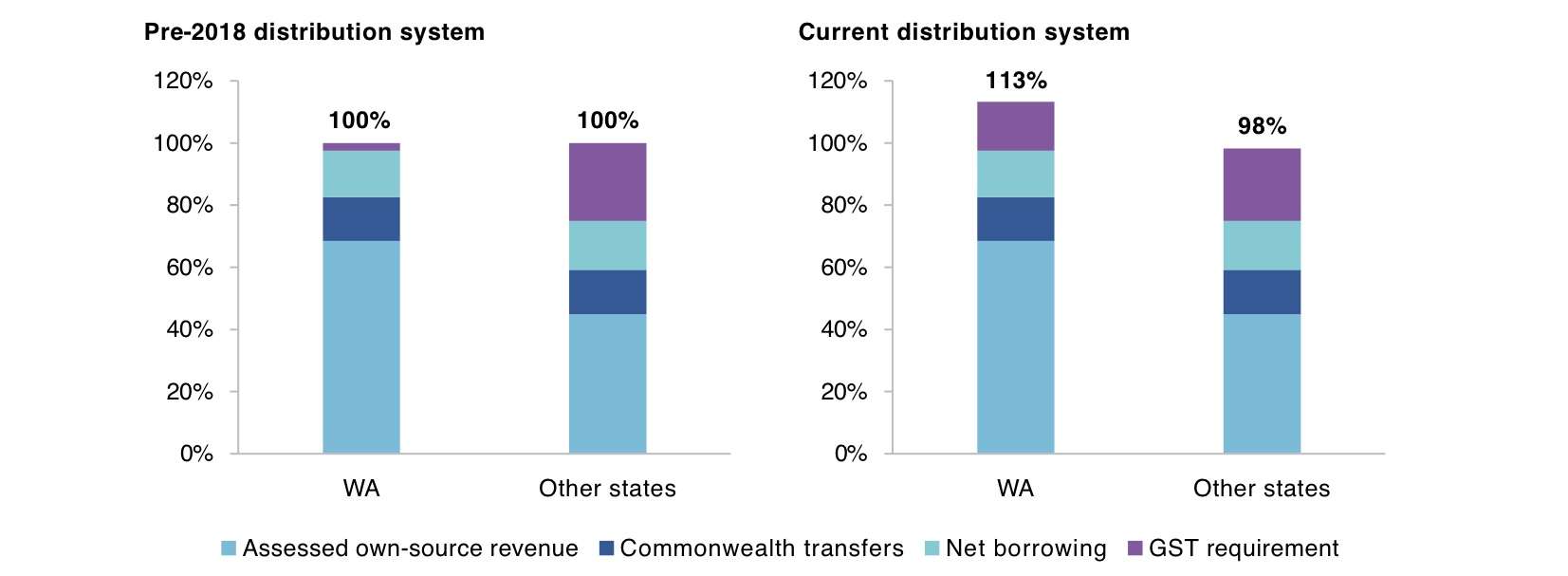
NoWO payments are not incorporated in assessed budgets. States’ GST requirements under the pre‑2018 distribution system were calculated as a residual to balance assessed revenue and assessed expenditure.
Source: PC estimates using CGC (2024); Commonwealth of Australia (2025, p. 67).
A key criticism of the pre2018 system was that it was too volatile – with GST distributions to the states varying widely and unpredictably between years. The 2018 reforms have only decreased this volatility for Western Australia, and they have done this at the expense of the Australian Government. Consequently, the cost of revenue volatility has not been eliminated; it has merely been shifted and spread between governments.
The reforms have imposed a significant ongoing cost on the Australian Government
The need for ongoing NoWO payments has created an openended fiscal liability for the Australian Government that moves in line with commodity prices. These payments are forecast to cost $6 billion in 2025–26, but if iron ore prices or production increase, the payments could reach $12 billion per year.
On the other hand, if the NoWO guarantee is allowed to expire, the $6 billion cost of servicing the current arrangement– which largely goes towards Western Australia will shift from the Australian Government to the other states.
There have been minimal efficiency gains from the reforms
The greater the extent to which a HFE system influences state government policy choices, the lower its efficiency. For this reason, the CGC seeks to prevent a state government’s policy choices from unduly affecting its share of GST revenue. In the past, and during this review, concerns have been raised that the system of HFE creates disincentives for states to reform and grow their economies, because they could lose GST revenue.
New PC modelling for this review has found that the incentives for reform have only been marginally improved as a result of the 2018 reforms, as they reduced dominantstate effects in the mining assessment in an untargeted way through an acrosstheboard GST relativity floor, but have a minimal impact outside those effects.
To the extent disincentives for reform exist, there is limited evidence they have played a role in state policy decisions. Other fiscal tools are available outside the HFE system to mitigate any disincentives.
Overall, the 2018 reforms have made the GST distribution system more complex and less consistent with its core purpose. In doing so, the changes have created ongoing challenges for harmonious and productive federal financial relations and imposed a large and ongoing cost on the Australian Government.
The system needs to change
Taken together, these shortcomings point to a system that needs reform. As requested by the Australian Government, the PC has considered a number of alternatives. The PC has developed an analytical framework to consider alternative arrangements identified through submissions and a review of the literature. Developing such a framework requires clarity on what the HFE system should actually be seeking to achieve.
Consistent with the broad views provided by states and other participants in this inquiry, the PC regards the reasonable level of fiscal equalisation to be that which can be achieved without creating costly challenges to efficiency (policy neutrality), fiscal sustainability and certainty that cannot be managed by other policy tools.
This recognises that the primary goal of the HFE system should be to drive equity – or more precisely, drive equality of fiscal opportunity – between jurisdictions. The other objectives – efficiency, sustainability and certainty – are constraints on the extent to which HFE is pursued and achieved.
The PC applied this framework to consider the strength of a range of reform directions and different policy parameters. This analysis has led the PC to recommend 3 preliminary options for reform (presented in decreasing order of their assessed benefits).
• The firstbest option is for the Australian Government to transition back to the pre2018 GST distribution system, but with a direction from the Australian Treasurer to the CGC to address costly dominantstate effects where they arise. The PC envisages that dominantstate effects in the mining assessment would be one area where a direction from the Treasurer would occur.
• The secondbest option, which is less desirable but would still overcome the major shortcomings of the current system set out above, is to return to the pre2018 system, but with a commitment from the Australian Government to make direct and transparent payments to states it considers to be materially impacted by dominantstate effects (instead of the Treasurer directing the CGC to account for these impacts ‘insystem’).
• The final option, which should be considered if the Australian Government is only minded to make minimal and critical changes to the current system, is to remove the standard state benchmark (which would result in the relativity floor of 0.75 being reactivated). This option would have an enduring detrimental impact on the fiscal position of states other than Western Australia relative to the pre2018 system. Therefore, if this option is adopted – and only if this option is adopted – the NoWO guarantee should be made permanent. The GST pool boost, which has failed to make all states better off, should also be removed. This would ensure that the Australian Government – rather than the states other than Western Australia – continues to bear the ongoing cost of its policy choice to change the system in 2018.
Regardless of whether they pursue any of these reforms, the Australian Government should also take steps to address a number of governance issues to strengthen the stability and productivity of the broader federal financial relations system. These include:
• ensuring that there is crossjurisdictional consultation on any changes to the GST distribution system
• more regular engagement (through the Council on Federal Financial Relations) between the Australian Government Treasurer and their state counterparts, with a focus on future economic and fiscal challenges and how these may be addressed
• more transparency in the treatment of nonGST Commonwealth payments in the HFE system.
The PC recognises that recommendations in this report, if adopted, would substantially change the GST distribution and the broader federal financial relation system. Stakeholders will have the opportunity to share views on the merits of the PC’s interim recommendations and transitional issues through public hearings in September 2026, and we welcome further submissions to the inquiry on the PC’s proposals. This input will inform the PC’s final report, due to be provided to the Australian Government by 31 December 2026.
Here’s how to make a submission.
*By Michael Barker, Editor, Fremantle Shipping News
~ If you’d like to COMMENT on this or any of our stories, don’t hesitate to email our Editor.
~ WHILE YOU’RE HERE –
PLEASE HELP US TO GROW FREMANTLE SHIPPING NEWS
FSN is a reader-supported, volunteer-assisted online magazine all about Fremantle. Thanks for helping to keep FSN keeping on!
~ Don’t forget to SUBSCRIBE to receive your free copy of The Weekly Edition of the Shipping News each Friday!