SEEING RED is an irregular column on Fremantle Shipping News by Barry Healy*. In this piece, Barry is inspired by the Long March and a 90-Year Journey from Revolution to Revival
On 14 October this year, under mild autumn skies, I set out along a path that felt impossibly old.
Narrow enough for only one person to walk comfortably and steep in places, its flagstones were laid during the Ming dynasty, which ruled the region from 1368 to 1644. Three kilometres was enough for me. Yet the people who began walking this route on 16 October 1934, carried heavy military packs, wore woven straw sandals and covered 35 kilometres a day.
I was part of a group of about thirty foreigners trekking a stretch of the Long March, whose completion, on 22 October 1936, China is marking with its 90th anniversary. Many things resonated as I walked.
First, was the age of the pathway itself. That Mao’s Red Army crossed the country on these old trails showed me that their movement was no alien ideology imported into China. It grew out of centuries of endogenous development and, after the Century of Humiliation at the hands of foreign powers, became a fight for national liberation.
Of the 86,000 soldiers who traversed this path – other armies took different routes before establishing their base at Yan’an, in northern China – only some 7,000 survived. The rest died in the 600 battles along the route, in crossing snow-capped mountains or in the hideous Songpan Grasslands, known as “The Sea of Death”, where a misstep meant sinking into quicksand.
As we trekked over the hills on our mini-Long March, we met farmers harvesting from tea bushes beside the path. They were impressed by our interest in their history and perhaps amused by how we coped with the terrain. It occurred to me that the Red Army soldiers would have had many similar encounters as they marched, taking the time to explain their purpose and organise the poor peasants to take control of the land they worked. The epic of the Long March as a strategic retreat, followed by renewed activity coordinated from the Yan’an base and leading ultimately to the 1949 proclamation of the People’s Republic, is one of the grand narratives of human history.
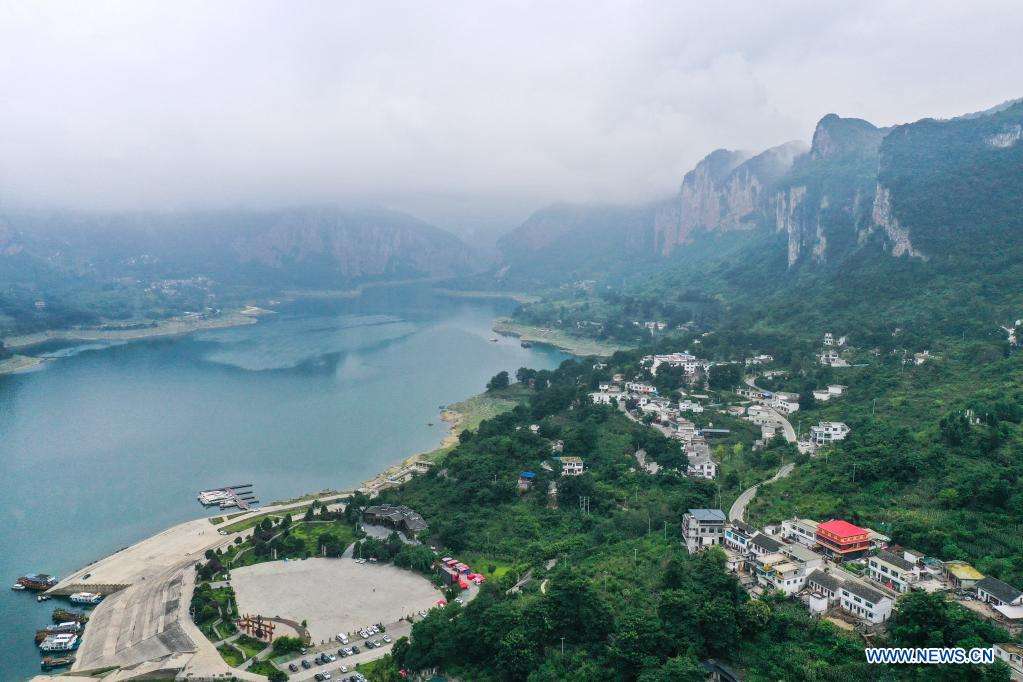
Huawei village. Credit China,org.cn
Yet something else resonated with me that day. Before we set off, we were introduced to the story of the revitalisation of Huawu village, from which 17 villagers left on the Long March. We were led by a grandson of one of these Red Army volunteers. Before departing, each planted a pine seedling for their families to tend until they came back. But none ever returned. The now towering trees are their memorials today.
However, after the revolution, Huawu remained frozen in time, trapped in the same ancient, grinding poverty that had choked the village for centuries. But, beginning in 2012, the central government began its process of rural revitalisation, recognising that people living in places like Huawu still lived in dilapidated houses, lacked clean drinking water and had undependable electricity. They had been bypassed by the prosperity of the coastal regions. The Huawu villagers were among the 100 million Chinese to be raised out of absolute poverty by 2020.
We were shown some of the old houses, kept as museum pieces, with earthen floors and no running water, toilets or power. Right next to them stood new apartment blocks with all modern amenities. Paved roads run to the village, replacing the old muddy tracks. Agriculture has been developed and, using the internet, new markets have opened up. Average income in the village has sky-rocketed. I had read of the people raised out of absolute poverty, but to see it was done in 8 years was stunning.
Australian tourists visiting Shanghai can be astonished at the tall, neon-illuminated buildings and the bustling activity. But it is only by visiting the villages and seeing the distance they have traversed in their Long March that one can really appreciate how far China has come. If you are setting off to tour China, make sure to include Gannan, Ruijin and Huawu in Jiangxi province. Sit with the locals, listen to the quiet rhythm of their stories and witness the enduring spirit of the people who have shaped China’s history.
* Barry Healy is a life-long Marxist who first came to Perth in the 1970s to establish the Resistance young socialist group. He was a founder of the Green Left and currently edits the Culture section of the Red Spark website.
~ If you’d like to COMMENT on this or any of our stories, don’t hesitate to email our Editor.
~ WHILE YOU’RE HERE –
PLEASE HELP US TO GROW FREMANTLE SHIPPING NEWS
FSN is a reader-supported, volunteer-assisted online magazine all about Fremantle. Thanks for helping to keep FSN keeping on!