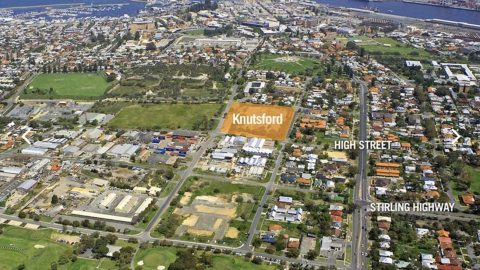
As the new Walyalup Bridge is due to open this coming Sunday, 1 November 2026, Kristi McNulty and Jenny Archibald tell the tale of the others before it, as well as the latest.
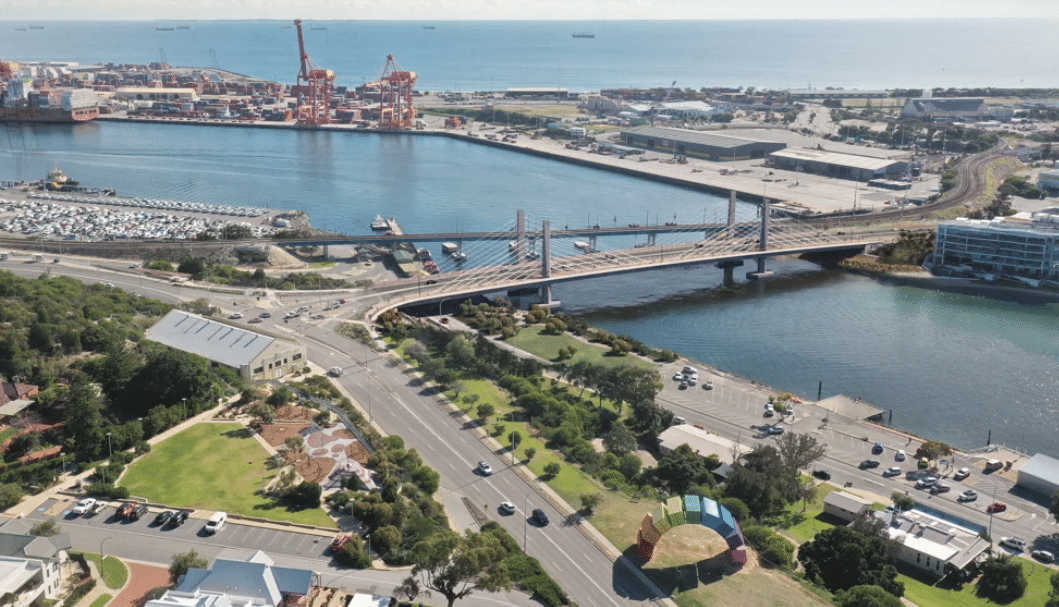
Walyalup has long been a place of firsts, and we are now witnessing another first – the completion of the first extradosed bridge in Australia, which will be opened on 1 November 2026 by the WA State Government and Australian Federal Government.
With the former Fremantle Traffic Bridge no longer fit for purpose, consultation for the replacement bridge commenced in 2019, and quite a journey it was – but more on the “new bridge” later.
There are many stories told of this place spanning thousands of years – where members of the Whadjuk Noongar people regularly crossed the Derbarl Yerrigan. Walyalup, the name used by the first people of this area, referred to land on both sides of this section of the river, which was the home of the Walyo or woylie, a small marsupial that lived in the area. This was a place of shallows, where food was often in abundance, and held cherished cultural significance with many ancient stories of how this land evolved.
In 1829, with the arrival of British colonists, a new way of crossing the Swan River (the name the Dutch captain de Vlamingh had given the river on his charts following his visit in January 1697) was needed. Bridge building did not start until 1843 – some 14 years after the start of the Swan River Colony – and this was not at Fremantle but at the location of the Causeway in Perth. Prior to then, crossing the river in Fremantle was done using smaller boats, as the limestone bar at the mouth of the river prohibited larger vessels from entry.
It took another 20 years before construction of a bridge commenced in Fremantle. This was in 1863, and the new bridge was opened, unfinished, to traffic three years later, in November 1866. The final works were completed in October 1867. However, continuous water transport between the outer harbour and the capital remained a problem.
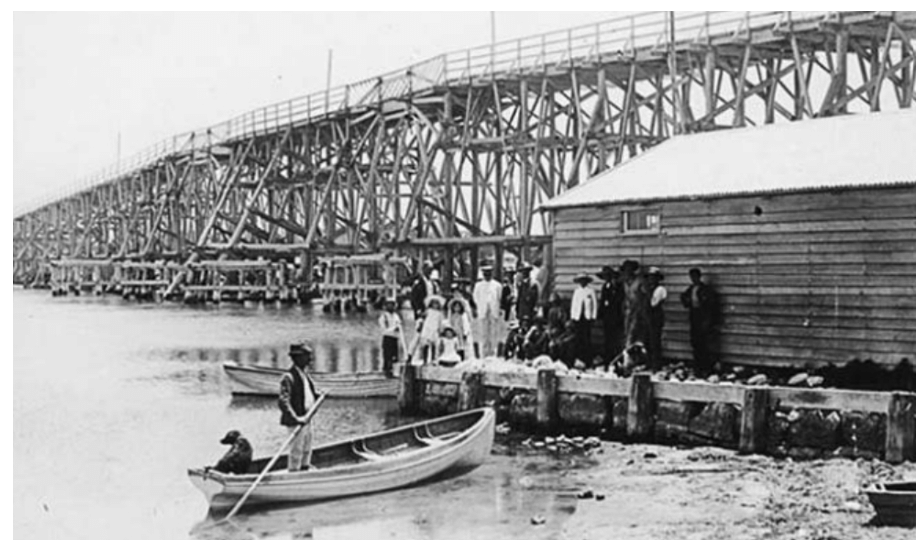
The North Fremantle or “Stick” Bridge
An engineering feat in itself, the North Fremantle Bridge (bridge #1) was also known as the Stick Bridge or Hump-Back Bridge given its distinctive appearance. It was largely constructed by convicts – some in chains and some, because of the difficulty of the work, permitted to labour without chains. The bridge construction required 23,800m of hand sawn timber and an additional 342 timber piles. The middle section rose to an extraordinary 14m to allow the passage of barges up and down the river.
However, in late 1891, after some 25 years of use, concerns were raised about the structural safety of the North Fremantle Bridge. With the discovery of gold in WA, along with a sharp increase in commercial activity in Fremantle, the Government of the day opted for a temporary solution – a lower, wider bridge directly west of the old bridge, utilising existing infrastructure, until a new and “permanent” bridge could be built.
It took another eight years for a second Fremantle bridge, the Fremantle Low Level Bridge(#2) to be fully constructed and this was opened in September 1898. The North Fremantle Bridge was kept open for pedestrian and cycle traffic only and was thereafter known as the High Level Bridge (#1).
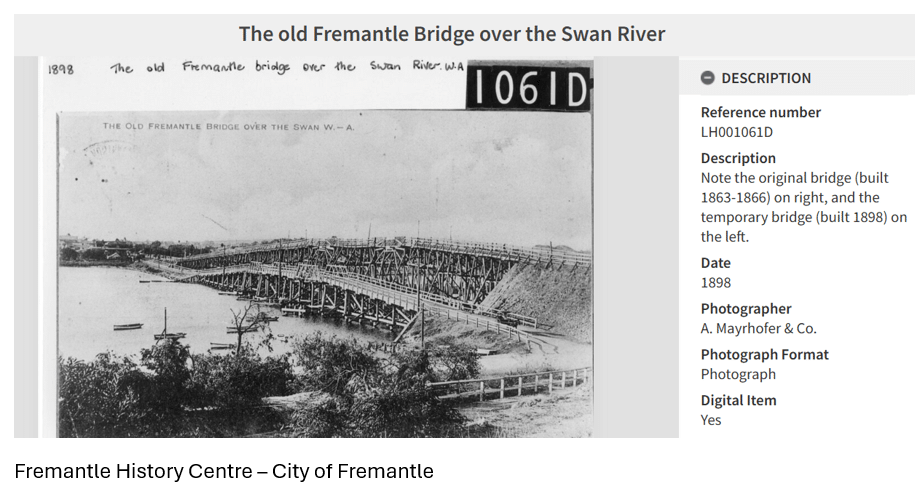
Another ten years on from the opening of the Low Level Bridge (#2), the then seperate Fremantle and North Fremantle Councils wanted to extend the Fremantle tramway system across the river to North Fremantle. However, the Low Level Bridge was not suitable for trams. A proposal to reconsider the old High Level Bridge was put forward, and on inspection, it was found that almost all the supporting piles were in remarkably good condition, with only 13 having slight defects.
The Government then made the decision to renovate the High Level Bridge (#1), adapting it for heavier traffic use. The timber structure was cut down and levelled out to remove the hump. Additional piles were driven into the riverbed so the bridge could be widened to carry both road traffic and tramlines. The decking was replaced. The renovations undertaken were of such a scale that, to all intents and purposes, this was considered a new bridge.
On 18 June 1909 the renovated High Level Bridge (#3) was officially opened. The Low Level Bridge was closed and then demolished over the following months. Some of the material, well weathered after 11 years, was immediately used to build a jetty on the north side of the river to provide a landing place for steamers, launches, barges and other rivercraft.
Some 20 years later, in the 1930s, the piles of the High Level Bridge (#3) had suffered serious deterioration from a marine borer, and the decking constantly needed maintenance. Another new bridge was needed! It was estimated that a concrete bridge could be built for £650,000, but design and construction would take years! Another timber bridge could be built for £75,000, and as there were plans to extend the harbour upstream, the bridge was only expected to be used for 3-5 years, although it would still be built to last 40 years.
Work began May 1937 and the new Fremantle-North Fremantle Traffic Bridge (#4) was officially opened on 15 December 1939, with final completion the following year. Due to concern about possible bomb attacks during WW2, the renovated High Level Bridge (#3) was left standing as an emergency backup and was not demolished until 1947, some ten years later.
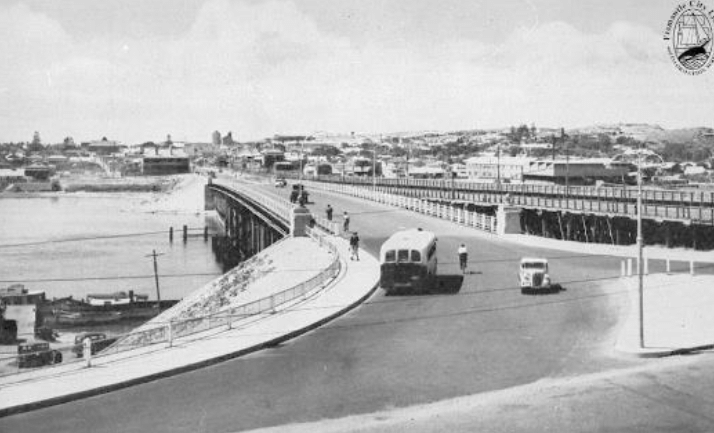
The new Fremantle Traffic Bridge (1939), the old Traffic Bridge still in position (at right) before being demolished in 1947 FHC 2195
Remnants of the piles of the “renovated” High Level Bridge (#3) are still visible today on the north side, upstream of the former Fremantle Traffic Bridge.
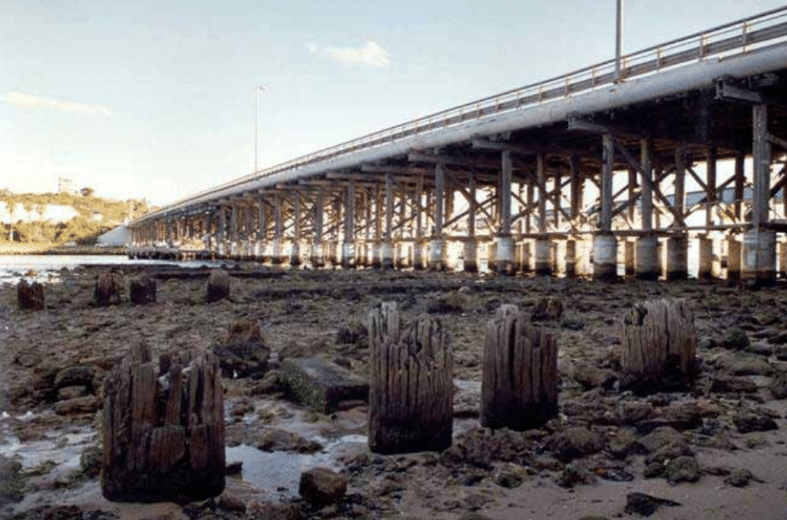
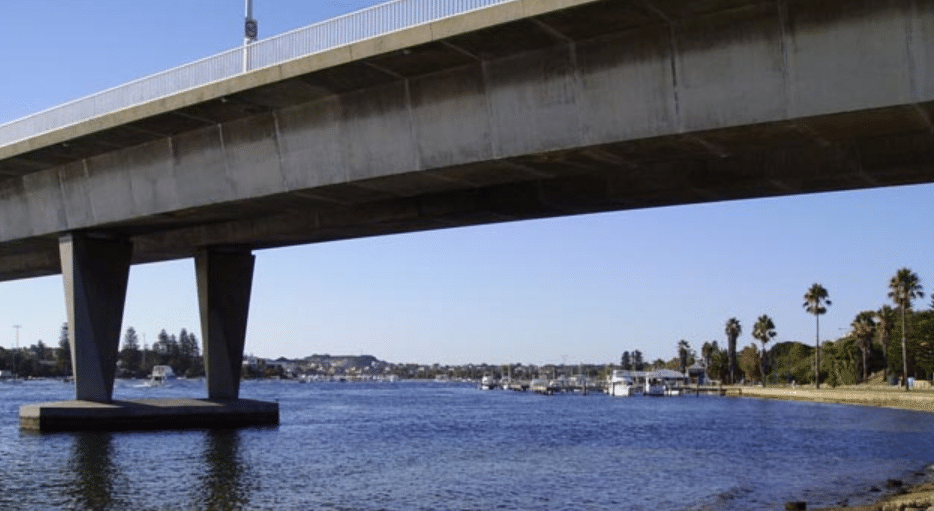
In 1974, Fremantle saw another a new bridge cross the river nearby – the Stirling Bridge. This was constructed at a new alignment well to the east of the Fremantle bridges and was finally a bridge of concrete. It was built as part of the proposed Fremantle Eastern Bypass – a remnant of the 1960’s traffic planning which thankfully didn’t proceed.
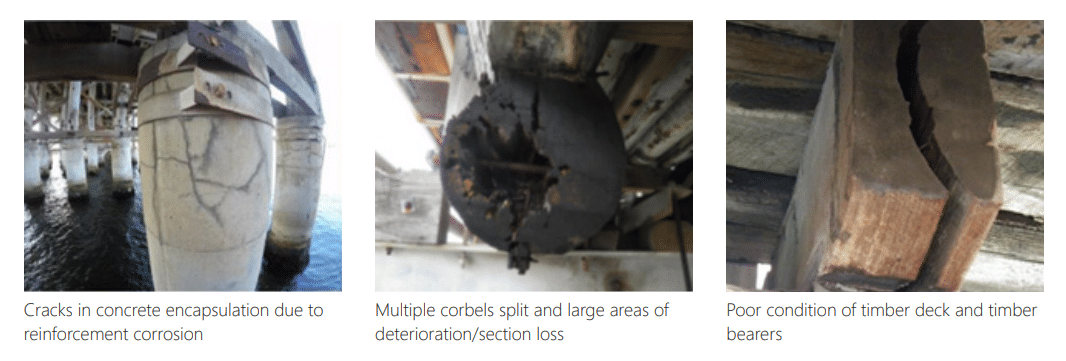
But back to the Fremantle Traffic Bridge (#4) – in addition to regular maintenance, major repair programs and refurbishments were carried out on the timber Fremantle Traffic Bridge in 1973, 1985 and 1991. Yet Main Roads had a number of ongoing concerns about the safety of a bridge that had been in place more than twice as long as intended, along with a far greater traffic load than was ever envisaged in 1939.
In 2019, 80 years after the Fremantle Traffic Bridge (#4) was opened, and with the bridge well beyond its intended life span or 40 years, planning for a replacement began with consultation with community, which continued over some 3 years. Main Roads WA also worked with the Whadjuk Elders and recorded that “they have highlighted the importance of minimising the number of piers in the river to maintain flow of water. Removing obstructions (piers) in the river will renew and enhance the long Aboriginal connection to the area, with unimpeded water flow preserving Aboriginal Songlines and Dreaming Stories, while allowing the Spirits to flow along the river out towards Wadjemup (Rottnest Island)”.
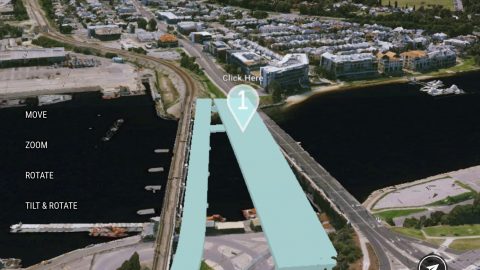
After many meetings and discussions between local community and businesses, Council and State Government representatives, and numerous submissions, three final bridge designs were selected and reviewed in August 2022. These were named the Queen Victoria priority, the Canning Trench and the Canning realignment – and none were adopted. Instead, on 16 November 2023, the Minister for Transport announced the final bridge location and design – and this was to be constructed on the original bridge road alignment. This option also left the much-loved Containbow intact at its current site!
Detailed design development was carried out from July 2021 to November 2023 and construction for the project was started in 2024. The bridge remained open to traffic until 1 February 2026 – a game changer to many traders who were expected to be impacted by the considerable reduction in passing trade for their businesses.
A number of changes were also made to the local transport network to ensure the system worked as smoothly as possible. To take more trucks off the road network, a freight subsidy was put in place to encourage use of train access to the port. This resulted in more than a quarter of all containers being shipped in and out of the port by rail – a new record for the state, and the highest proportion in the country.
The project team built as much of the new bridge as they could prior to closure, using temporary jetties on both the northern and southern sides and from which the four cranes operated.
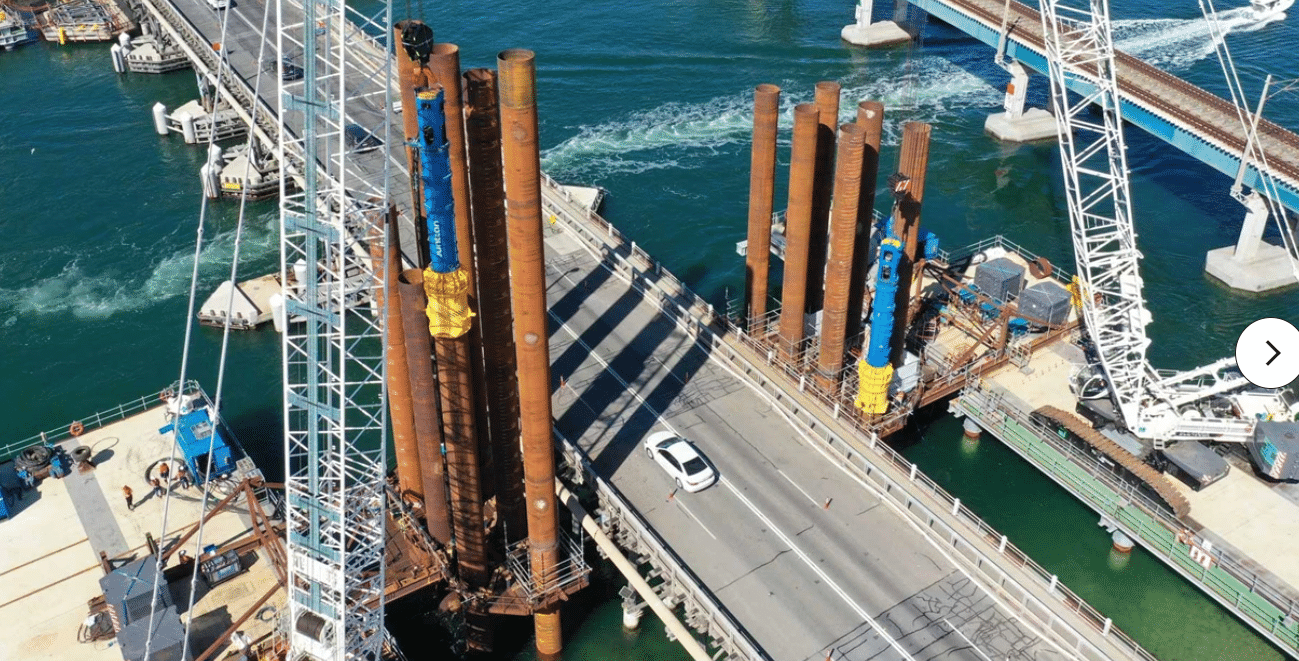
The team then removed the old bridge in sections – using parallel construction with sections of the new bridge built alongside.
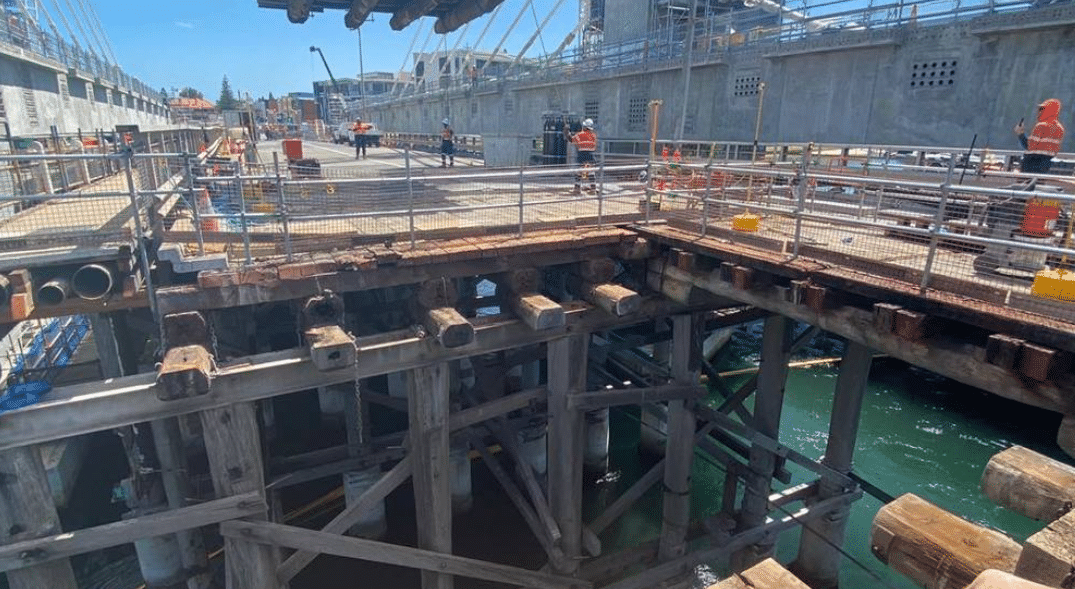
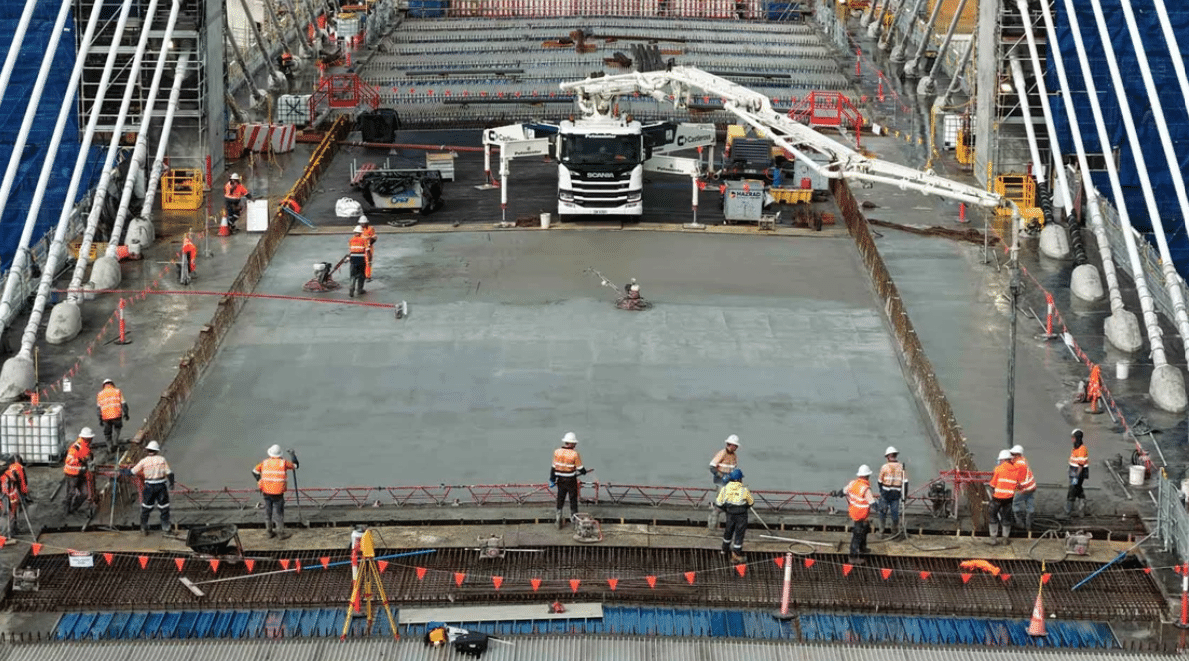
With sections of the old bridge removed, pre-cast beams were lifted into place by the cranes and fixed by post-tensioning bars. The bridge deck was constructed with steel reinforced concrete panels lifted into place and the final deck poured and topped with asphalt.
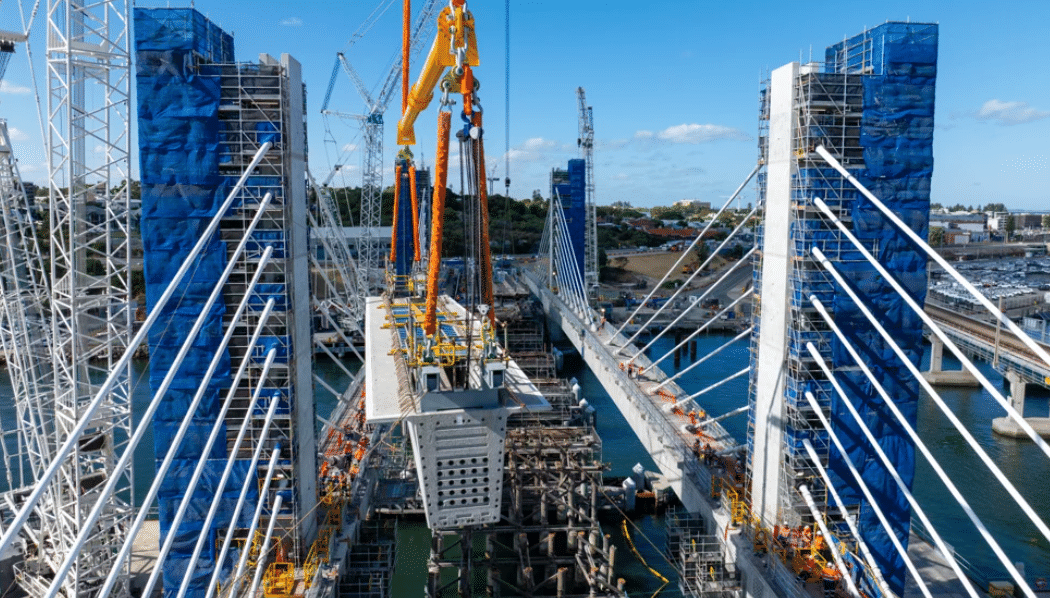
And what a fascinating bridge it is! We have heard that engineers from all around Australia have visited during its construction to see this first “extradosed” bridge being built. In looking this term up on Wikipedia, it “comes from extrados (the exterior or upper curve of an arch). The “stay cables” function less like traditional suspension stays and more like external prestressing tendons positioned right along the upper limit of the superstructure. Unlike cable-stayed bridges where the cables carry most of the live load, an extradosed bridge relies on a stiff girder deck to carry 60% to 70% (or more) of the permanent and live loads in bending. With this the towers (pylons) are significantly shorter than those on a standard cable-stayed bridge—typically about 7% to 13% of the main span length rather than half”.
Costs for the project were shared equally between the WA State Government and the Commonwealth Government. The first cost estimate was $280M, then $430M, then $596M as of 9 August 2026.
Quite a journey for the newly named and very impressive Walyalup Bridge or Bridge #5 – all done in record time. And what a change from 1867 when Bridge #1 (the Sticks, Humpbacked or North Fremantle Bridge) was finally completed nearly 160 years ago! There will be a great deal to celebrate on 1 November 2026!
(Note: we are aware that there are a number of ways in which the Derbarl Yerrigan is spelt).
*By Kristi McNulty and Jenny Archibald, (both members of the Fremantle History Society)
~ If you’d like to COMMENT on this or any of our stories, don’t hesitate to email our Editor.
~ WHILE YOU’RE HERE –
PLEASE HELP US TO GROW FREMANTLE SHIPPING NEWS
FSN is a reader-supported, volunteer-assisted online magazine all about Fremantle. Thanks for helping to keep FSN keeping on!