*Prepared by Claude (Anthropic)
Our Editor posed this set of questions to Claude (Anthropic): Claude, you’ll know all about this. Data Centres are the talk of our times. I know we already have small ones here and there around the world, but the chatter is of course about big data centres here, there and everywhere, including in Australia. Can you tell me just how many data centres currently exist, and where, to support AI; and how many more, especially large ones, are apparently required to facilitate the growth of AI? Here’s Claude’s response.
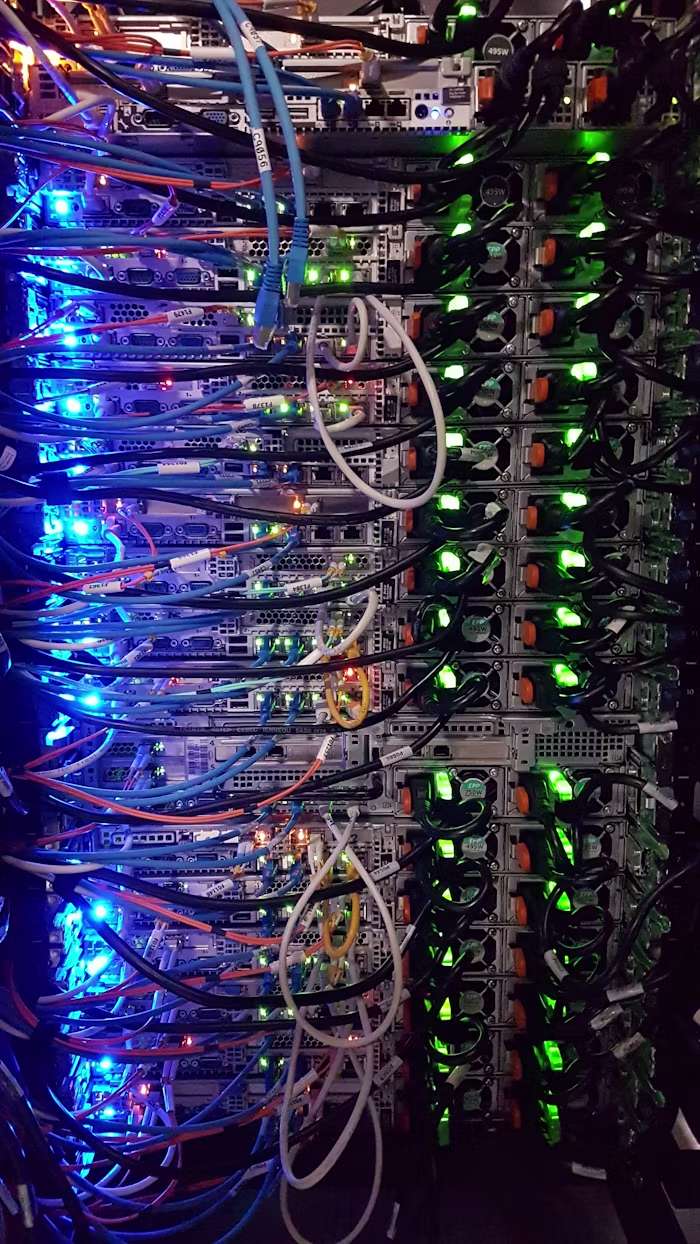
Credit Massimo Botturi for Unsplash
Global data centre numbers vary by source, and that’s normal.
Different trackers put the current global count somewhere between roughly 11,600 and 12,000 operational data centres, spread across anywhere from 109 to 179 countries depending on which database is doing the counting. There is no single authoritative global registry — commercial trackers (Statista, DC Byte, ABI Research, Synergy Research, and others) each apply their own definitions of what counts as a “data centre” and vary in how thoroughly they cover smaller markets. Figures should therefore be read as estimates within a similar range, not precise counts, and any two sources may disagree by a few hundred facilities without either being “wrong.”
The US dominates by sheer count.
Depending on the source, the United States has somewhere between roughly 4,100 and 4,500 data centres — more than the next ten countries combined. The UK and Germany typically follow at 500–560 each, with China (around 370) and France (around 350–395) close behind. China’s relatively low count reflects a more centralised, state-directed infrastructure model rather than lower overall computing capacity.
Most data centres aren’t primarily AI infrastructure — but the AI-specific segment is growing fast and is best measured in capacity, not building counts.
The more informative metric for AI is “hyperscale” facilities — very large, purpose-built campuses run by companies like AWS, Microsoft, Google, Meta, and Oracle. Synergy Research counted around 1,297 operational hyperscale data centres worldwide as of late 2025, nearly triple the number in 2018, with a further 770 in the pipeline at various planning or construction stages.
Australia is in the middle of a significant, capacity-driven buildout.
Australia currently has around 162 operational data centres, but only three exceed 100 megawatts of capacity — the shift underway is toward far fewer, much larger sites rather than more small ones. The country’s data centre pipeline represents roughly six gigawatts of potential capacity, about four times 2025’s operational capacity, with an estimated $150 billion in investment by 2030. Around half of this is planned for New South Wales, a quarter for Victoria, with growing interest from South Australia, Western Australia, Queensland, and the Northern Territory. Nvidia has separately announced work with local firms (Firmus, CDC, NEXTDC, AirTrunk) targeting up to 2 gigawatts of new AI-related capacity by 2027, which would more than double Australia’s current 1.6 GW load.
How much more capacity is genuinely “needed” for AI is the least certain figure in this space.
One widely cited estimate (McKinsey) puts global AI-related investment needs at roughly $5.2 trillion and 156 GW of additional capacity by 2030. Across the broader data centre sector, global investment could reach nearly $7 trillion by 2030, with total demand nearly tripling. These are modelled projections based on assumptions about AI adoption and chip efficiency, not fixed targets, and are likely to be revised as the technology and market evolve.
The real constraint isn’t capital — it’s power.
Global data centre electricity use was about 415 TWh in 2024 (roughly 1.5% of global consumption) and is projected to reach around 945 TWh by 2030 (near 3%). In Australia, data centres are projected to consume about 6% of national electricity by 2030. Access to grid connections, water, and suitable sites — not investor appetite — is increasingly what determines which announced projects actually get built.
Bottom line: There’s no single clean number for “how many data centres exist” or “how many more are needed” — the industry itself tracks growth in gigawatts of capacity rather than building counts, because a handful of new hyperscale sites can add more compute than hundreds of older, smaller facilities combined. Any figure quoted publicly should be treated as a snapshot from a particular tracker at a particular date, not a settled fact.
*Posted by Michael Barker, Editor, Fremantle Shipping News
~ If you’d like to COMMENT on this or any of our stories, don’t hesitate to email our Editor.
~ WHILE YOU’RE HERE –
PLEASE HELP US TO GROW FREMANTLE SHIPPING NEWS
FSN is a reader-supported, volunteer-assisted online magazine all about Fremantle. Thanks for helping to keep FSN keeping on!
~ Don’t forget to SUBSCRIBE to receive your free copy of The Weekly Edition of the Shipping News each Friday!







)