Welcome back to our regular feature, Rarely a Dull Moment where we report on the highlights of City of Fremantle Council and occasionally Committee meetings and other activities. We would have titled the feature Never a Dull Moment, but didn’t want to overpromise!
In 2026, we are very pleased to welcome Jenny Archibald to the RADM desk. Jenny will be well known to many Freo folk as a former Mayor, Deputy Mayor and Councillor of the City of Fremantle. Jenny brings a wealth of knowledge and experience to her new role as our RADM reporter and we are sure Shipees will look forward to her regular RADM reports.
Welcome readers to our RADM report for the Planning Services Committee of 13 July 2026.
First to our valued public question time…only one resident asking a question of the Committee, Ian Brayshaw was keen to ensure that the new Town Planning Scheme, subject of this meeting, had sufficient “flexibility or intent to address housing shortage” and to explore all forms of housing variety, citing medium density and laneway developments as earlier tools used.
But with no Petitions, Presentations nor Elected Member Communication, we move on.
THE HEADLINE STORY – or really 4 headline stories about the new Town Planning Scheme
All four items on the agenda related to the development of the new Town Planning Scheme. While it was a short meeting, this has followed a great deal of discussion and thinking by staff, elected members and the general public and it still has a long way to go. Below we provide a brief summary of the topics but for anyone interested in the broader discussion of the future of our City, and in particular the success of the City Centre, it is well worth having a read of these documents (in the Planning Services Committee agenda). Please note that all of these items will also go to the full Council meeting next week – Wednesday 22 July 2026 – and be considered further, so we will report here on the detail and next week on the comments of elected members.
ITEM PFC2607-1 ENGAGEMENT UPDATE ON NEW LOCAL PLANNING SCHEME: It was noted that “The current Local Planning Scheme No. 4 (LPS4) is 19 years old and has been subject to over 80 amendments. Since the inception of the Scheme, state planning has progressed to the extent that many provisions are outdated, redundant or no longer work well together. Additionally, the scheme is required to be reformatted to fit the Model Scheme Text provided in the Planning and Development (Local Planning Schemes) Regulations 2015 (the Regulations). In early 2026, the WAPC endorsed the City of Fremantle Local Planning Strategy. The Strategy sets out the intended direction of the new scheme and references other strategic documents such as the City Plan prepared in 2025”. It is planned that a draft replacement scheme will be completed by the end of this year. The public engagement program reached more than 450 people via online and other means, and it also received 31 formal submissions by way of feedback.
Overall, the engagement identified six recurring themes:
• Heritage and neighbourhood character.
• Tree canopy and climate resilience.
• Housing diversity and affordability.
• Walkability and cycling.
• Parking and transport.
• Planning controls, development outcomes and future growth.
Here’s a very brief summary:
Community Engagement Findings
The top three community priorities for the new planning scheme were heritage protection, neighbourhood character, and, you guessed it, tree canopy/urban greening – just noting the community is keeping this on the agenda! Other recurring themes included:
• Support for housing diversity (especially “missing middle” density) near transport/activity centres, but concern about height and character loss
• Strong interest in walkability, cycling and active transport
• Mixed views on parking provision
• Calls for more consistency and transparency in planning decisions
• Support for mixed-use activation, provided it fits neighbourhood character
• Interest in unlocking vacant/underutilised sites before pressuring established areas
• Climate adaptation concerns (urban heat, tree loss, sea level rise).
Additional input came from email submissions, one-on-one meetings, a Design Advisory Committee roundtable, and community/stakeholder workshops — raising issues like heritage flexibility, simplifying the scheme, incentivising adaptive reuse and housing diversity, and various West End/height concerns. A separate North Fremantle transport consultation (Feb 2026) found strong opposition to connecting Curtin Avenue to Stirling Highway, along with concerns about delivery timeframes, railway station relocation, coastal risk, and traffic impacts.
Themes identified
Officers grouped feedback into eight themes: Identity, Climate resilience, Housing, Strategic density, Access, Parking, Simplification, and Flexibility — each with a corresponding planning response outlining what the new scheme can realistically address (e.g., parking rules moving to a local planning policy; social/affordable housing needing state partnerships rather than scheme mechanisms).
Next Steps
Officers aim to bring a draft scheme to Council by year’s end. From there, the approval pathway (DPLH/WAPC review, Ministerial approval, advertising, public submissions, final gazettal) is estimated to take roughly 15–25+ months. Concurrently, the City will develop a City Centre Precinct Structure Plan and update local planning policies.
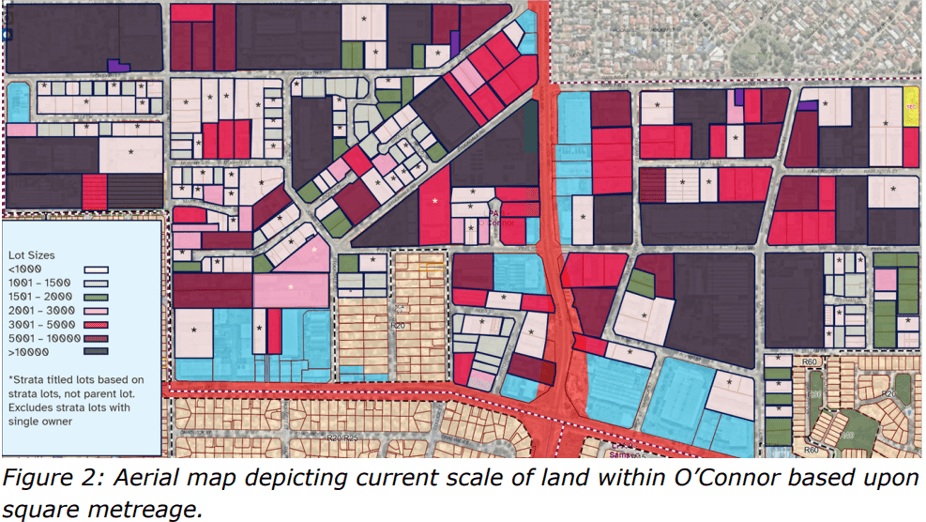
ITEM PFC2607-2 O’CONNOR INDUSTRIAL AND COMMERCIAL AREA REVIEW
Key issues identified:
• Noise, odour and traffic conflicts between industrial operations and adjoining residential/commercial land
• A wide range of permitted non-industrial uses in the Industrial zone (offices, hospitals, restaurants, taverns, places of worship, etc.) that conflict with industrial activity
• Land fragmentation through subdivision, causing permanent loss of larger industrial lots
• Need to align local controls with State Government requirements
Three main themes identified:
1. Land use permissibility – many currently allowed non-industrial uses are incompatible with industrial operations and generate ongoing compliance issues
2. Buffer Zone – gaps in the current buffer between residential and industrial areas create amenity and viability risks for both sides
3. Subdivision – no controls currently prevent fragmentation of large lots (freehold or strata), even though larger lots are increasingly scarce and valuable for major manufacturing/warehouse users; smaller subdivided lots also generate higher parking/traffic demand
Recommendations:
• Expand and improve the buffer zone (land use and built form controls)
• Restrict non-industrial uses in the Industrial zone
• Normalise zoning along the buffer to reflect existing service-commercial uses on major roads
• Consider introducing subdivision controls to curb land fragmentation
• Explore a new “Light Industry” zone (based on the State Model Scheme Text) as a transition zone between General Industry and Residential, potentially paired with a Special Control Area
All of this will feed into the new planning scheme, but the direction is clear: hold the line for industrial land, before there’s none of it left to hold.
ITEM PFC2607-3 HERITAGE PROTECTION AND WEST END
Key points:
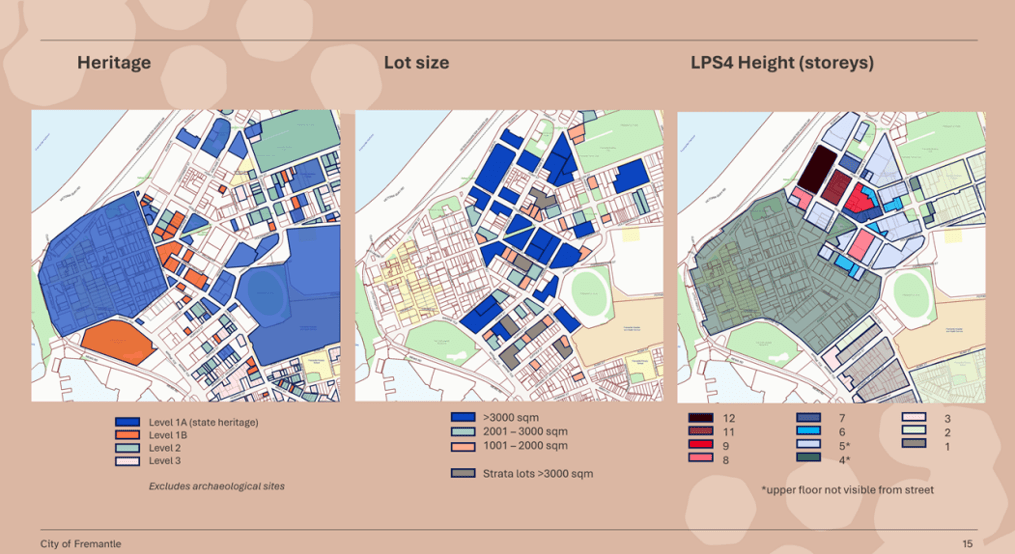
• Purpose: To focus on heritage protection and the West End Heritage Area (a well-preserved, mostly late 19th–early 20th century precinct in central Fremantle).
• What stays fixed: Certain heritage frameworks (State heritage listing, Heritage Act, individual listed places, heritage policies like LPP 3.6 and 3.21) won’t change under the review.
• Height controls: Current rules cap the West End at 3 storeys (with discretionary 4th storey if not visible from the street), but there’s growing concern this is too loosely defined or overridden by discretion. Questions on whether height limits are meaningful, whether they should align more tightly with the State-designated West End boundary, and whether “visible from the street” is an adequate/precise enough test (it ignores intersections and roofscape views).
• Demolition controls (Clause 4.14): Retention of this clause is encouraged, restricting demolition of buildings with cultural significance. The controversial Elders Woolstores adaptive reuse case highlighted the need for clearer policy on applying discretion, recognizing broader forms of significance (not just façades).
• Strategic context: The City aspires to grow density (~10,000 people) in the CBD but wishes to direct that growth outside of the West End in order to preserve its heritage character.
ITEM PFC2607-4 CITY CENTRE
Key points
• Context: The work to date builds on the City’s Local Planning Strategy (endorsed by WAPC in Feb 2026) and the City Plan: City Centre (adopted 2025), both of which guide the vision for a denser, mixed-use, “7-day economy” city centre.
• Why change is needed: Previous attempts (like Scheme Amendment 49) to boost development on key sites were well-intentioned but proved overly complex, and most sites haven’t actually been redeveloped. Barriers include fragmented land ownership, small lots, heritage constraints, and external cost/market pressures.
• Proposed approach:
o LPS5 will set simplified interim controls for the City Centre.
o A separate Structure Plan (~12 months to develop, starting once LPS5 goes to the Commission) will follow with more detailed, finer-grained controls.
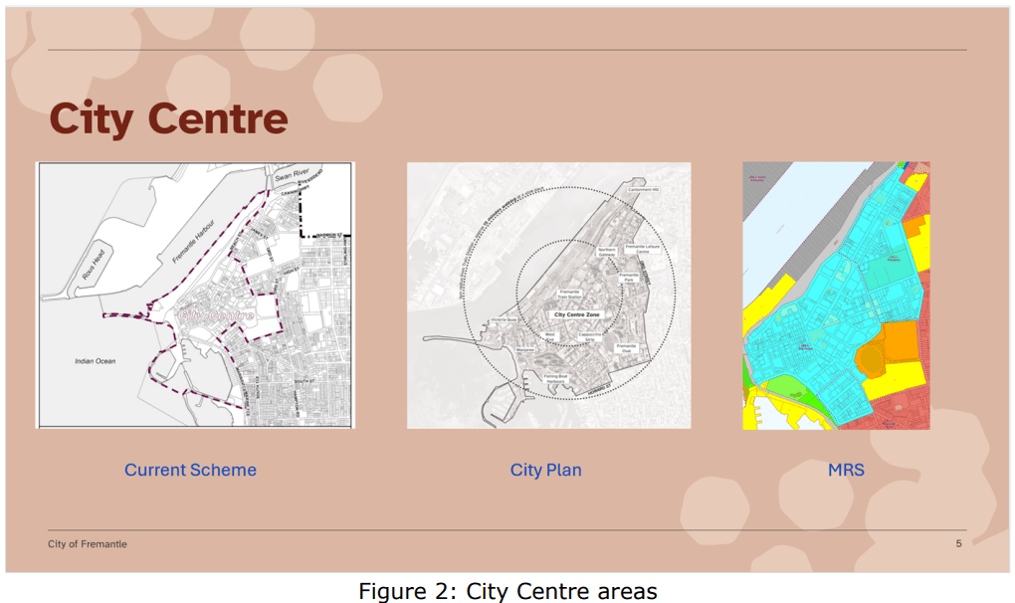
o The City Centre zone boundary will likely be realigned to match the MRS City Centre zone.
• Spatial findings: The area north of Parry Street is seen as best suited for greater height/density with minimal heritage impact. Key streets like William Street and Queen Victoria Street were flagged for targeted (not blanket) redevelopment. Underused sites (car yards, City-owned land) are seen as redevelopment opportunities.
• Other considerations possible: boundary extension, translating City Plan opportunities into actual planning rules, transitional built-form buffers around the heritage-significant West End, density near transport, simplified height controls, and land use settings that support entertainment/hospitality and ground-floor residential in appropriate spots.
And everything else – well thankfully there were no other items! There was a great deal to digest and much more work is yet to be done – but it will be so interesting to watch this unfold.
Our RADM report on the Council meeting next week (Wed 22 July) will fill in on the thoughts of elected members and that of the public – where these items will be discussed again.
Signed off at 18.35pm. Goodnight Freo.
*By Jenny Archibald

~ For earlier RADM reports look here.
~ If you’d like to COMMENT on this or any of our stories, don’t hesitate to email our Editor.
~ WHILE YOU’RE HERE –
PLEASE HELP US TO GROW FREMANTLE SHIPPING NEWS
FSN is a reader-supported, volunteer-assisted online magazine all about Fremantle. Thanks for helping to keep FSN keeping on!
~ Don’t forget to SUBSCRIBE to receive your free copy of The Weekly Edition of the Shipping News each Friday!