A media release issued yesterday by Pat Conroy, Australia’s Minister for Defence Industry has shed some light on the future of Australia’s 6 Collins class conventionally powered submarines.
The media release states –
The Australian Government today convened the third Product of Concern Summit in Canberra, reaffirming its commitment to improving the sustainment performance of Australia’s Collins class submarines.
Minister for Defence Industry, the Hon Pat Conroy MP led the summit alongside Minister for Finance, Senator the Hon Katy Gallagher, and senior representatives from government and industry.
This summit builds on progress made since Collins class sustainment was listed as a Product of Concern in December 2024. Defence and ASC Pty Ltd continue to work collaboratively under the Australian Submarine Enterprise to implement a comprehensive remediation plan.
Key achievements to date include workforce initiatives and productivity enhancements. These efforts are critical to ensuring the Collins class remains among the world’s most capable conventionally powered submarines.
The Product of Concern framework has proven effective in driving accountability and collaboration across government and industry.
Minister Conroy said:
“These summits bring together government, industry and Defence officials to collaborate and agree on plans to improve the sustainment performance of Collins class submarines.
“Regular Product of Concern summits ensure that Defence and industry officials are coming together to improve capability delivery for the Australian Defence Force.
“These efforts are critical to ensuring the Collins class remain among the world’s most capable conventionally powered submarines.”
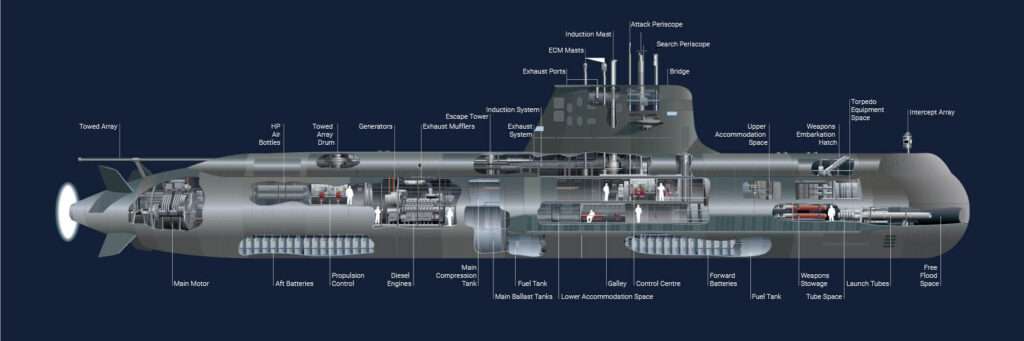
Collins class submarine innards courtesy asc.com.au
The Collins class sub fleet
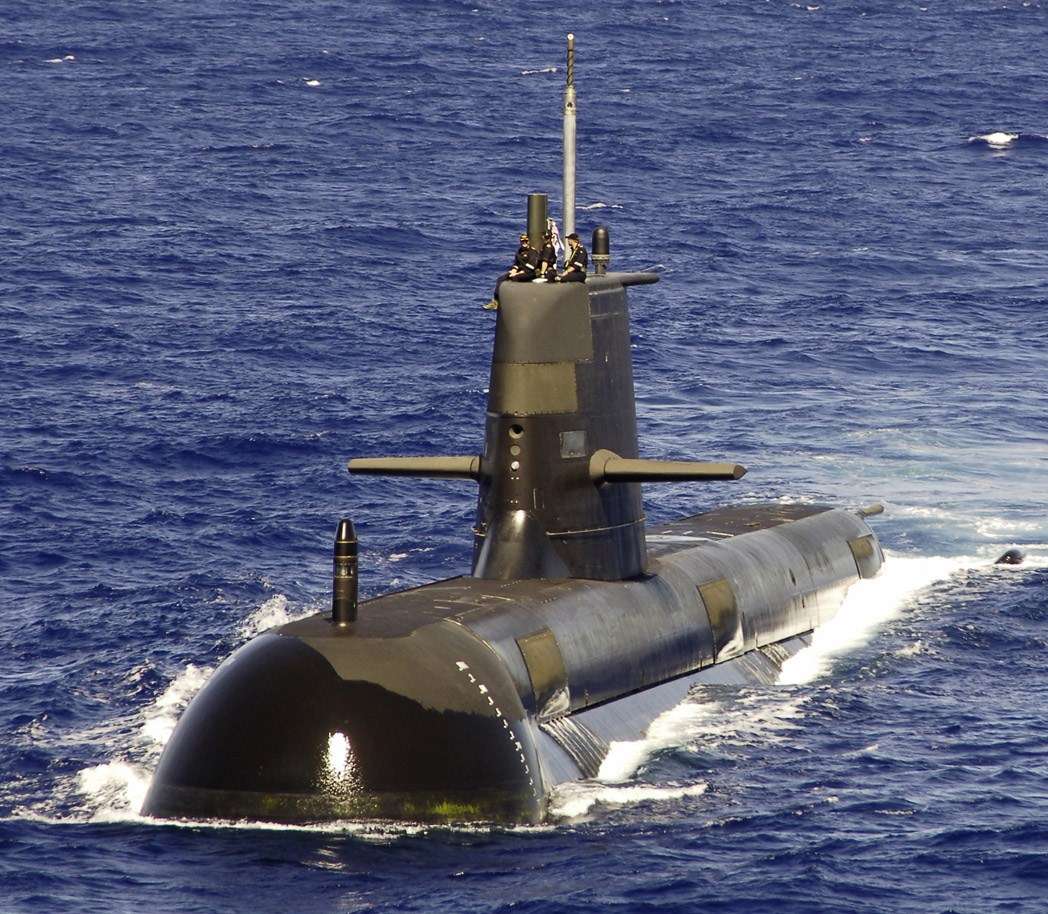
Australia has six Collins class submarines:
• HMAS Collins
• HMAS Farncomb
• HMAS Waller
• HMAS Dechaineux
• HMAS Sheean
• HMAS Rankin
The life span of the Collins class subs
They were commissioned between 1996 and 2003, all built at ASC’s facility in South Australia. They represent Australia’s entire conventionally-powered submarine fleet and are expected to continue serving until they’re eventually replaced by nuclear-powered submarines under the AUKUS agreement.
The LOTE Program
The Collins class submarines are currently expected to remain in service into the 2040s following their Life-of-Type Extension (LOTE) program.
Here’s how the timeline has evolved.
Original Design Life
The submarines were originally designed with a 28-year life span, meaning they would have started retiring in 2024 . With the fleet commissioned between 1996 and 2003, they were initially expected to retire between 2024 and the early 2030s.
Current Extended Timeline
The LOTE program will keep the Collins Class submarines operationally capable and available into the 2040s , supporting Australia’s transition to nuclear-powered submarines under AUKUS. Each submarine will undergo a two-year refit providing an additional 10 years of life .
According to analysis, the first Collins class submarine is now scheduled to retire in 2038 based on the LOTE timeline, though some could remain in service well into the 2040s .
Why the Extension is Necessary
The delay in replacement submarines—whether the cancelled Attack-class or the current AUKUS nuclear submarines—has forced this extension. With the first boat needing retirement by 2026 under the original schedule, and subsequent boats following on a two-yearly cycle, all Collins would have been gone by 2038 without life extensions .
The reality is that Australia’s first AUKUS nuclear submarine won’t arrive until the late 2030s at the earliest, making the LOTE program essential to avoid a critical capability gap in Australia’s submarine force.
Collaborative options available
Based on the recent Product of Concern Summit held for Collins class submarines, there’s a broad range of collaborative options available to government, industry (particularly ASC Pty Ltd as the lead contractor), and Defence officials to improve sustainment performance:
Workforce and Capability Building
Growing the submarine sustainment workforce and enhancing productivity at key facilities in South Australia and Western Australia represents a critical area for improvement. This addresses one of the fundamental constraints on maintenance capacity.
Financial and Contractual Solutions
The government has already demonstrated willingness to adjust funding approaches. A new four-year sustainment contract with ASC valued at $2.2 billion was signed without a detrimental efficiency dividend , reversing previous budget cuts. The $4-5 billion commitment over the next decade provides scope for enhanced investment in sustainment infrastructure and processes.
Technical and Operational Improvements
Given that the submarines are required to operate beyond their original design life , collaboration could focus on:
• Life extension programs and capability enhancements
• Improved maintenance scheduling and cycle efficiency
• Supply chain optimization for parts and components
• Technology upgrades to maintain operational effectiveness
• Enhanced diagnostic and predictive maintenance systems
Process and Governance Enhancements
The Product of Concern framework itself provides structured ministerial oversight and accountability mechanisms. The remediation plan developed since the December 2024 listing likely includes specific performance metrics, timeline commitments, and governance structures to track progress.
Knowledge Sharing and Innovation
Collaboration could extend to sharing best practices from international partners operating similar submarine classes, implementing innovative maintenance techniques, and potentially bringing in external expertise to address specific technical challenges.
The fundamental challenge is maintaining Australia’s conventionally-powered submarine capability until the transition to nuclear-powered submarines under AUKUS, making these sustainment improvements critical to national security.
What lies ahead
Australians will watch the sustainment program with interest, especially as many doubt, for a variety of reasons, that the AUKUS subs will ever materialise. If they are right, it makes the sustainment of the Collins a matter of pressing defence need.
* If you’d like to know what it’s like to be a submariner and command a Collins class submarine, don’t miss our podcast interview with COMMODORE PETER SCOTT CSC, RANR – AUTHOR OF RUNNING DEEP
By Michael Barker, Editor, Fremantle Shipping News
~ If you’d like to COMMENT on this or any of our stories, don’t hesitate to email our Editor.
~ WHILE YOU’RE HERE –
PLEASE HELP US TO GROW FREMANTLE SHIPPING NEWS
FSN is a reader-supported, volunteer-assisted online magazine all about Fremantle. Thanks for helping to keep FSN keeping on!