SEEING RED is an irregular column on Fremantle Shipping News by Barry Healy*. In this piece, Barry considers the effects on Australia of China’s trade with Africa and elsewhere
In October, Bloomberg Business News headlined that “Trump’s Global Trade Chaos Creates an Opportunity for African Famers”. The sub-heading said: “The continent is positioning itself as a pivotal player in the future of global agriculture, and investors are taking notice.”
The headline does not mention it, but in this fast-emerging, brave new world, Australian agriculture is missing out.
While the Chinese food import trade is growing across all continents, there is in particular a developing alliance between China and African farmers. This is totally different to the pre-existing relationship between US and European Union (EU) market operators and Africa, which has been largely disrupted by Donald Trump’s mad tariff policies.
For decades, the EU and US have enforced unfair mechanisms in which trade secures capital and market penetration for their corporations, products and services in Africa. But African products (and African migrants) face significant barriers at European and American borders. The EU and US preach “free trade” to African countries while using protectionism and market strategies to impose “economic and political reforms.”
Credit carnegieendowment.org
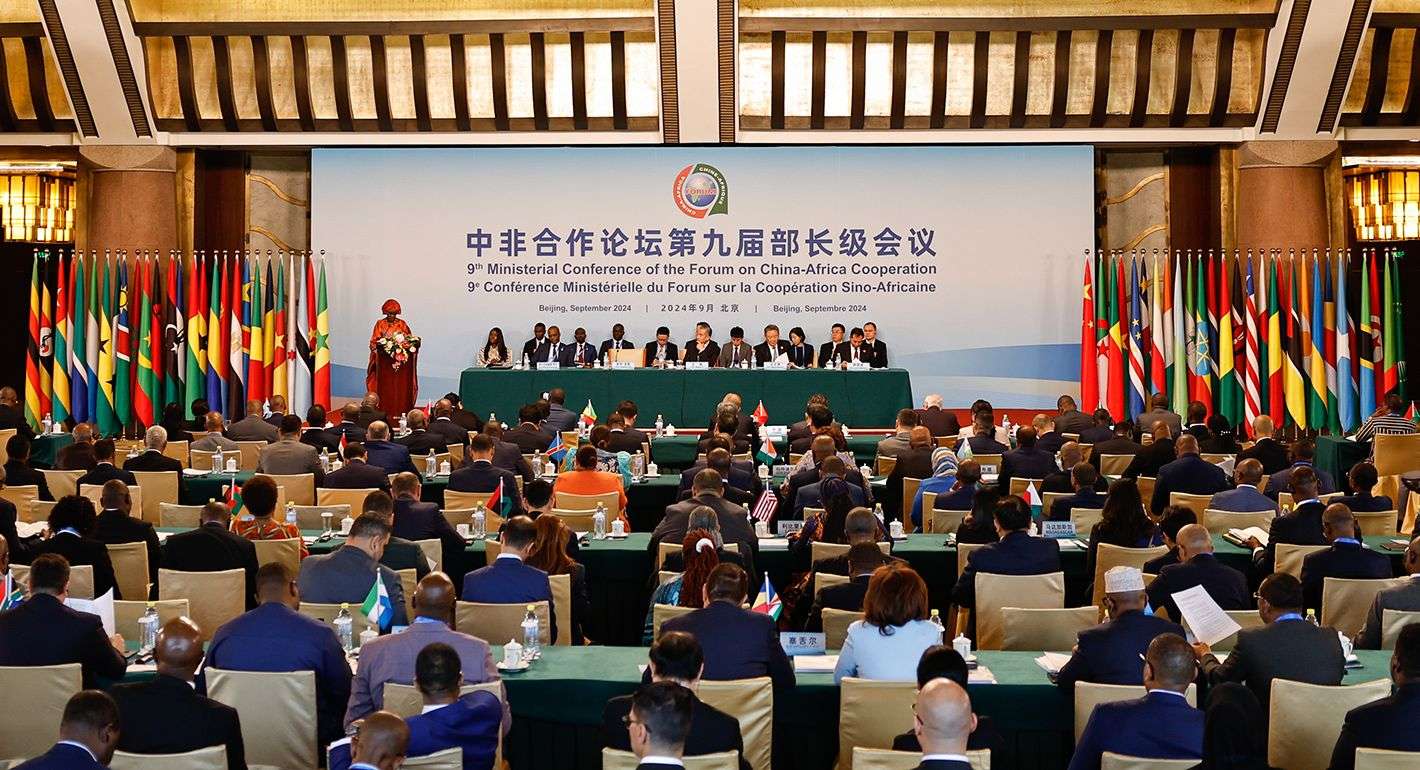
China’s zero-tariff policy is part of a broader expansion of China–Africa economic relations, based on mutual respect and shaped by the Forum on China–Africa Cooperation (FOCAC). There is a commitment to strengthening economic ties and promoting industrial investment and local production in Africa.
FOCAC aims to generate mass employment and raise incomes by expanding Africa’s participation in both regional and global markets. It integrates the continent more fully into global supply and value chains. It is both free and fair trade.
The operating practice is this: Chinese firms deal directly with local farmers, paying higher prices to guarantee Chinese access to the market. African farmers make more money, Chinese buyers have guaranteed supply and the middlemen on Wall Street and in London don’t get a look in.
China has been trying to get away from buying food from the United States as rapidly as it can. As early as January this year, another Bloomberg article reported that Chinese firms were “scouring the globe” to source new supplies of everything.
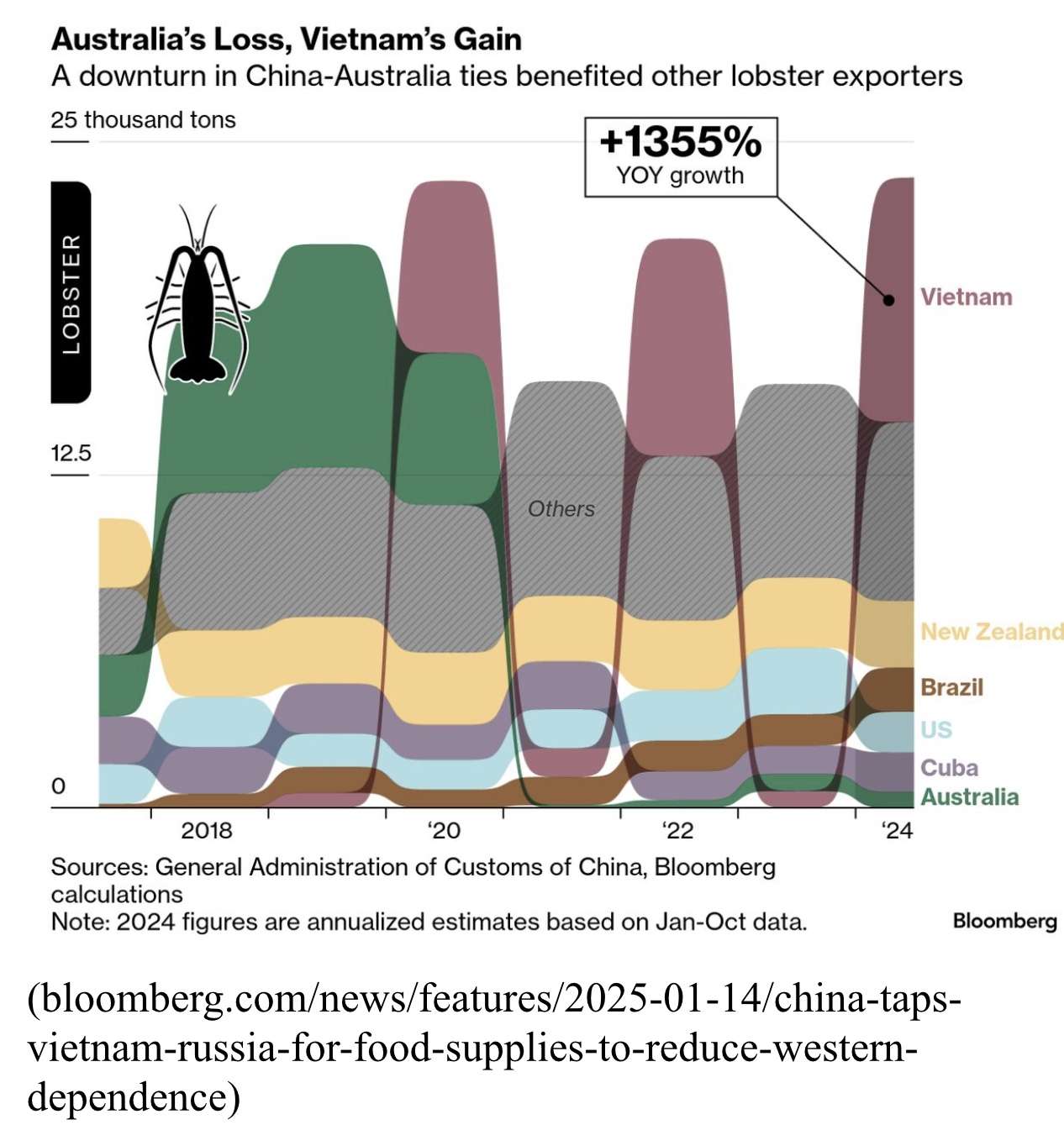
An example of this is the boom in lobster exports from Vietnam to China. This has definite implications for the WA rock lobster industry. Quite simply, Australia has missed the boat. (But never mind, the dredging of Cockburn Sound for the nuclear submarines will eliminate the local industry anyway!)
China is locking up supply chains in South America for beef and more. In July, Trump slapped 50 percent tariffs on Brazilian coffee beans to pressure the Brazilian government about Trump’s co-thinker, disgraced ex-president Jair Bolsonaro, who has been sentenced to prison for plotting a coup.
Within weeks, Chinese buyers swept in and bought up the entire coffee crop of 183 Brazilian companies with five-year long agreements. So, even though Trump has now backed off his tariffs, that product is locked out of the US, increasing coffee cup prices there.
But it is in Africa that China is particularly showing up looking for food. And the Chinese approach is vastly different to that of US and European traders, who are really speculators. The speculators’ business model is to drive down the prices farmers get and then use their monopoly position to drive prices up in the supermarkets they supply. China is signing contracts with farmers themselves, ensuring fair prices for them and development packages for their nations.
This stands in stark contrast to the approach of the USA’s Generalized System of Preferences program, which demands that African countries “establish or make continual progress toward establishing a market-based economy,” and “must eliminate barriers to U.S. trade and investment.” The European Union’s Economic Partnership Agreements (EPAs) are similar and are particularly galling. Many of the countries at the receiving end of these programs were pillaged as European colonies.
Zimbabwe is now exporting avocados and Tanzania honey to China. Lamb and mutton is going from Madagascar to stores and restaurants in Hunan province. Macadamia nuts, which you would expect Australia to be leading the pack in producing, are a special favourite in China. But again, Australia is missing the trading boat.
A single company in Kenya, Edited Facta Nuts & Fruits has 12,000 farmers under contract now with plans to have twice as many, just to serve the Chinese market. Kenyans now refer to macadamias as “green gold”, since the Chinese buyers pushed prices up seven-fold.
Do you remember when US soybean growers complained about Trump disrupting their trade with China? Things are not about to get better for them. The Chinese firm CITIC is establishing a 103,600-hectare soya bean farm in Angola. Sixty percent of the eventual production, 500,000 tonnes will be exported to China with the rest consumed locally, improving nutrition.
The Angolan Agriculture Minister says that Angola is happy to have a guaranteed customer for the soy. They are taking advantage of the geopolitical situation, the trade wars and disrupted markets.
The Angolans may be pleased but the US is not. According to The Elements of the China Challenge, a publication of the Office of the Secretary of State, China is practicing “predatory development program and debt-trap diplomacy” and “authoritarian goals and hegemonic ambitions.”
That is quite a mouthful coming from the nation that has a massive flotilla in the Caribbean murdering people on the high seas in an attempt to overthrow Venezuela’s government and seize its oil!
Australia appears to have made an unfortunate choice regarding China, missing out on economic opportunities while sinking our government expenditure into the mythical AUKUS submarines. Still, when the chilly winds blow, we will have all that nuclear waste down at Henderson to keep us warm.
By Barry Healy
* Barry Healy is a life-long Marxist who first came to Perth in the 1970s to establish the Resistance young socialist group. He was a founder of the Green Left and currently edits the Culture section of the Red Spark website.
~ If you’d like to COMMENT on this or any of our stories, don’t hesitate to email our Editor.
~ WHILE YOU’RE HERE –
PLEASE HELP US TO GROW FREMANTLE SHIPPING NEWS
FSN is a reader-supported, volunteer-assisted online magazine all about Fremantle. Thanks for helping to keep FSN keeping on!