SEEING RED is an irregular column on Fremantle Shipping News by Barry Healy*. In this piece, as Anthropic ponder an IPO to test out just how investors are feeling about AI, and data centres were an issue in the US Midterm elections, Barry considers how Australia should be approaching a beckoning AI future.
In AI terminology, the milliseconds taken for a request to travel to a data centre and for a response to return is known as latency. In ordinary internet use a few milliseconds is barely noticeable. But in automated manufacturing, autonomous vehicles, financial trading and military operations, latency matters.
The closer a data centre is to its users, the less the latency. Building enormous data centres is not enough, they must also be in the right places.

Credit Getty Images for Unsplash
While American corporations are pouring trillions of dollars into a speculative AI boom, China and its regional partners are building low-latency infrastructure.
US AI infrastructure is geographically disadvantaged, financially overextended and vulnerable to Chinese competition. Australia’s defence, economy and ecology is tied to this American gamble through a combination of AI investment and AUKUS.
The Trillion-Dollar Gamble
A recent Brookings Institution paper shows that US AI-related investment could reach US$10.3 trillion between 2025 and 2032. That is around 3.63 per cent of annual US GDP, dwarfing the previous American infrastructure booms. But it is based on unrealistic profit projections.
The AI infrastructure commitments of big tech companies exceed their cash flows. Financially, they rely on borrowing, leasing arrangements, joint ventures and private credit, which obscure their risk. The US economy is over-exposed to AI profitability growth.
The United States has experienced spectacular bubbles before, like the dot-com crash and the 2008 financial crisis. But the AI boom is more dangerous because it connects to the financial system. If AI revenues fail it would trigger aneconomic contraction world-wide.
Additionally, technology corporations are competing with the US government for capital when Washington is already struggling with enormous public debt and military expenditure. The same financial system is being asked to fund an AI revolution and an expanding military-industrial complex, which inflates interest rates.
The Geography of the AI Race
Building the world’s largest collection of data centres in the USA does not mean winning the AI race. Powerful US computers cannot eliminate the distance separating its infrastructure from the markets it hopes to dominate.
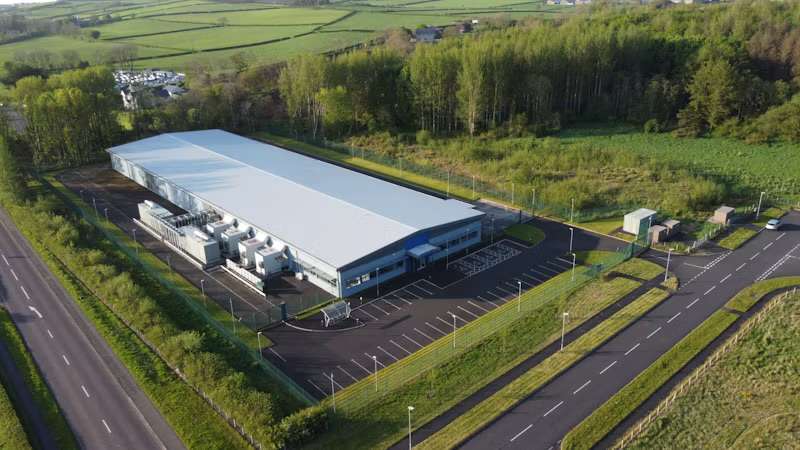
Credit Geoffrey Moffett for Unsplash
The competitive edge is with data centres close to the industries, populations and businesses using them. An illustration of this geographical reality is the so-called Yuxi Circle, a 4,000-kilometre radius centred on the Chinese city of Yuxi. It encompasses approximately 55 per cent of the world’s population and a substantial proportion of global manufacturing and automated logistics.
While US infrastructure is subject to the tyranny of distance, China is developing infrastructure close to where it is needed.Malaysia is emerging as an important part of this.
Malaysia’s Strategic Advantage
A 30 October, New York Times article titled “How One Country Became the Unlikely Crossroads of the Global A.I. Boom“, described Malaysia’s emergence as a data-centre colossus through developing 27 data centres worth more than US$55 billion.
Malaysia has maintained relationships with both China and the United States. It has benefited from Trump’s ban on advanced computer-chip exports to China, which exempts Malaysia. Chinese companies are circumventing the ban by opening in Malaysia.
This exposes the contradiction in the American AI strategy. The United States treats AI dominance as a question of its financial clout. China and its regional partners are exploiting geography, industrial capacity and proximity to markets.
Malaysia demonstrates that countries do not have to choose between Washington and Beijing. Its approach contrasts with Australia’s unquestioning commitment to the United States.
Australia’s Dangerous AI and AUKUS Connection
Australia is inviting US companies to establish data centres here. But whose economic interests will be served? What happens if the AI bubble bursts? Can Australia’s ecology cope? And what are the implications of locating militarilyimportant computing facilities in Australia?
The United States uses AI in military planning, intelligence analysis and target selection. That resulted in the approximately 120 Iranian girls killed in the bombing of the Shajareh Tayyebeh school. AI-generated information is only as reliable as the data and assumptions fed into it, but US military planners treat it as objective intelligence.
Communications facilities at Pine Gap and Exmouth are important in the US military network. Developing low-latency data infrastructure in proximity to them in central Australia and WA implicates Australia in future US military operations.
Data centres and communications facilities are not neutral commercial assets if part of a military information system. In war they become targets.
The Australian government presents AUKUS as essential to national security and technological advancement. But AUKUS integrates Australia’s military into the strategic and military priorities of the United States. The accompanying technology investment risks extending that dependence into the digital economy with extra ecological risks of water and land degradation.
We are caught in the American China-containment strategy while Malaysia reaps the advantages of non-alignment.
Australia could develop its own technological capabilities, invest in infrastructure that serves the Australian economy, respects our ecology and builds regional relationships. We could benefit from the Asian economic transformation without being an adjunct of American military strategy.
I once worked in a mental hospital in New Zealand, where I encountered a patient with a crude prison tattoo on his neck. It was a dotted line running from one side of his throat to the other, with the words “cut here” written above it.
I am reminded of that tattoo whenever Australian political leaders boast about our AI future, our American technology partnerships and the wonders of AUKUS.
* Barry Healy is a life-long Marxist who first came to Perth in the 1970s to establish the Resistance young socialist group. He was a founder of the Green Left and currently edits the Culture section of the Red Spark website.
~ If you’d like to COMMENT on this or any of our stories, don’t hesitate to email our Editor.
~ WHILE YOU’RE HERE –
PLEASE HELP US TO GROW FREMANTLE SHIPPING NEWS
FSN is a reader-supported, volunteer-assisted online magazine all about Fremantle. Thanks for helping to keep FSN keeping on!