Bruce Menzies* ponders the pain of impermanence as the Nepal/Tibet tragedy unfolds
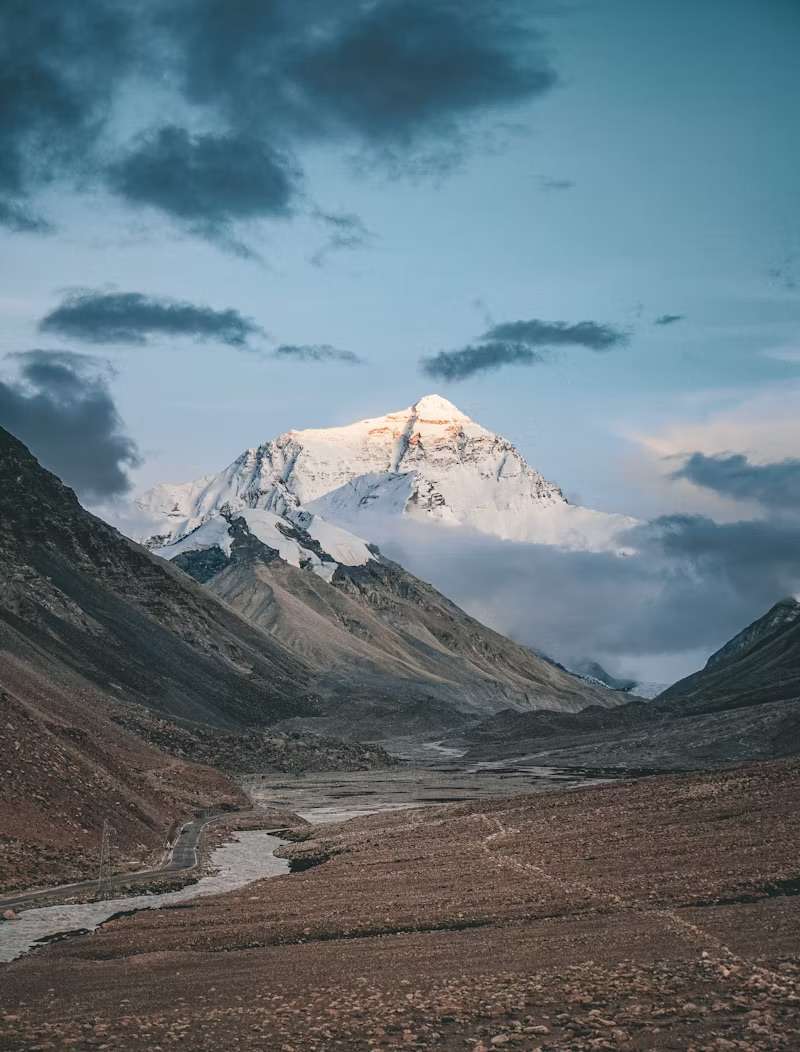
Himalayas. Credit Mauricio Manzato for Unsplash
In the hours and days following the recent tragic events in the Himalayas, I scrolled through video clips of the unfolding disaster. A rushing river flooding through a narrow valley, engulfing all that stood in its path. People running, riding, driving, as they attempted to find safety. From vantage points on higher ground, horrified watchers held phones aloft and captured the carnage below.
To mangle the words of Marshall McLuhan, the medium begat the message – a message delivered to those of us in other places, securely glued to our screens.
And what was that message? What is that message? Well, perhaps it is not a singularity. Akin to Russian dolls, perhaps there are messages within messages. Teasing them out, attuning our antenna and making sense of it all is another matter. Yet one thing’s for certain: opinions will differ, especially around causation. There will be technical explanations around an ice sheet breaking off the mountain, and there will be broader explanations around the impact of a changing climate. Amidst the handwringing, the grief, and the after-shocks reverberating in human hearts, there is also opportunity to pull back and reflect.
This came home to my voyeuristic self as I stared at the screen. On Facebook, up popped a quote from the late and decidedly great, Leonard Cohen:
‘We don’t write the play, we don’t produce it, we don’t direct it, and we’re not even actors in it. Everybody eventually comes to the conclusion that things are not unfolding exactly the way they wanted, and that the whole enterprise has a basis that you cannot penetrate. Nevertheless, you live your life as if it’s real. But with the understanding: it’s only a thousand kisses deep, that is, with the deep intuitive understanding that this is unfolding according to a pattern that you simply cannot discern.’
Readers may question the relevance of Cohen’s words to the Himalayan tragedy. These sentiments may come across as abstract and lacking empathy for what we actually experience over the course of a human life. The rollercoaster of joy and suffering. Times of happiness and hope. Times of disillusion and despair. The full enchilada that awaits us from the moment of birth. Cohen’s words may be seen to remove the fullness of that experience from the table, leaving us in a kind of fatalistic limbo. A place where we lack agency and are mere bystanders to what he describes as ‘the whole enterprise’ that we ‘cannot penetrate’.
But I don’t see it that way. I think we are invited to absorb and embody the thrust of what is being offered. Too often, if we look at human behaviour throughout recent history, we are enculturated to believe we can write, produce, and direct the entire play. In other words, we can exercise control over the course of our lives. Such a deep-seated belief may act as a reassuring balm. We can find meaning, comfort, stability, and security in what we do and achieve. Yet this can obscure another reality – that we are here, each of us, in a particular form, for a limited time span. If we are moved to explore a little deeper, we may discover that the balm of apparent control is a chimera – a tenuous smokescreen that keeps us functioning yet stranded.
We may have some sense this is so. But we don’t want to feel helpless. Action keeps us occupied. As Cohen suggests, we live our incarnated lives within a certain passage of time as if that is our only reality. Fair enough. After all, it seems to fall under the God-like rubric of common sense. And for those of us inhabiting an increasingly secular society, where material wealth and status and performance are desired and valued above pretty much everything else, we seem to be stuck on the flypaper of cultural entrapment whether we realise it or not.
None of this diminishes or devalues the pain and suffering flowing from Tibet and Nepal. Even as bystanders, even without direct links through family and friends, we are invited to feel that pain, not to turn away in numbness. This invitation and what we may enact is not tokenistic. It’s a manifestation of our connection with others, no matter how tenuous it might seem. In this sense, we do have choice about how we respond, as we do in the plethora of situations we encounter day by day. To be clear, Cohen does not imply we are puppets on the grand stage of life. We have agency and choice, as long as we are also aware of our personal limits. In so doing, we accept and value that we are an integral part of the vast panorama but not the conductor of the orchestra, no matter how much we might desire that role, consciously or otherwise.
In so doing, we may rejoice in a life that may be ‘only a thousand kisses deep’ and intuit an understanding that it unfolds in a pattern we cannot foretell or discern. Simultaneously, we can offer a prayer for those whose lives have been lost in the Himalayas, and for those who mourn. A moment of compassion, as the pain of impermanence tears us asunder.
*By Bruce Menzies. Based in Fremantle, most of the time, Bruce Menzies is the author of three novels, a family history, and a recent memoir, as well as be8ng a regular contributor to FSN. Details at BruceJamesMenzies.com If you’d like to read more of Bruce Menzies’ work on Fremantle Shipping News or listen to a fascinating podcast interview with Bruce, look here.
~ If you’d like to COMMENT on this or any of our stories, don’t hesitate to email our Editor.
~ WHILE YOU’RE HERE –
PLEASE HELP US TO GROW FREMANTLE SHIPPING NEWS
FSN is a reader-supported, volunteer-assisted online magazine all about Fremantle. Thanks for helping to keep FSN keeping on!
~ Don’t forget to SUBSCRIBE to receive your free copy of The Weekly Edition of the Shipping News each Friday!