Westport, in the Westport Business Case published in 2024, identified the preferred design for the $7.2 billion future container port – to replace Fremantle – and the related supply chain. It includes a new port terminal in the Kwinana Industrial Area and marine infrastructure in Cockburn Sound, supported by an upgraded road and rail freight network and logistics hub. Westport is currently in the process of optimising the port layout and marine infrastructure, refining construction planning and developing reference designs to a level that supports reliable cost estimates, approvals and future investment decisions. Here’s an artist’s impression of how it might eventually look from up above.
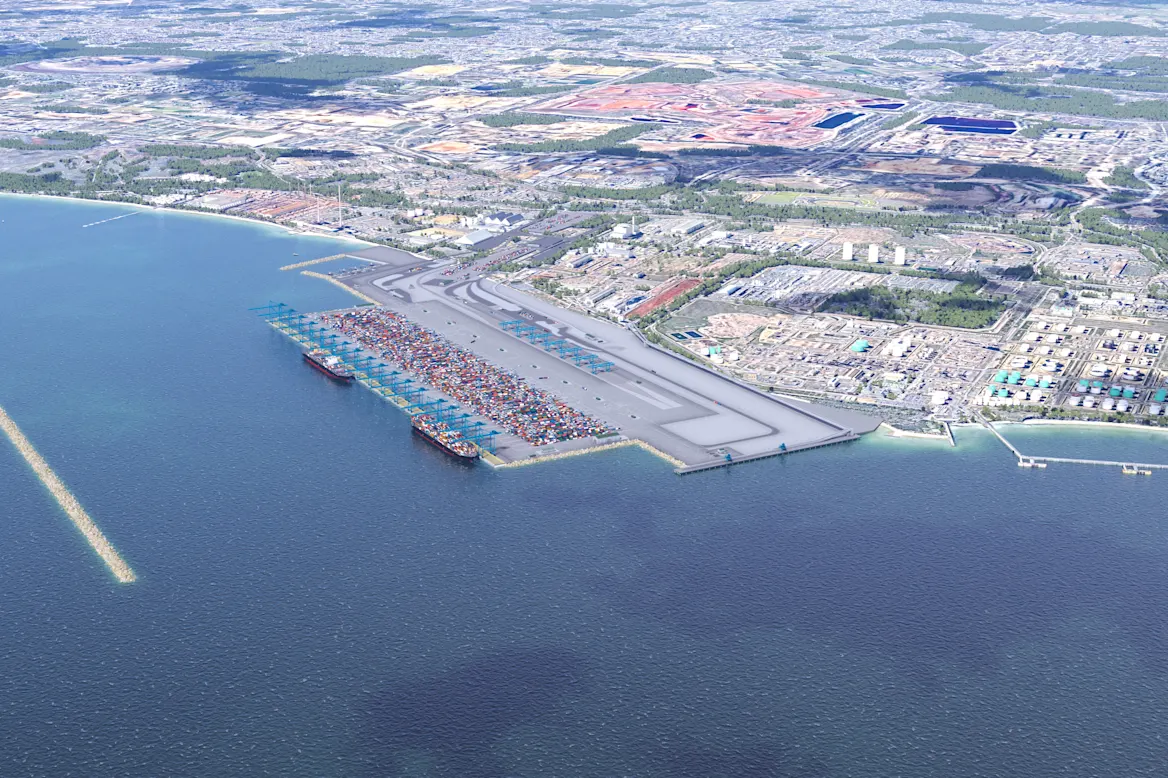
Westport says the preferred design will provide a modern and efficient port and freight network to future proof trade in Western Australia, enhancing Kwinana’s status as a world-class industrial hub, and minimising environmental impacts to support the long-term health of Cockburn Sound.
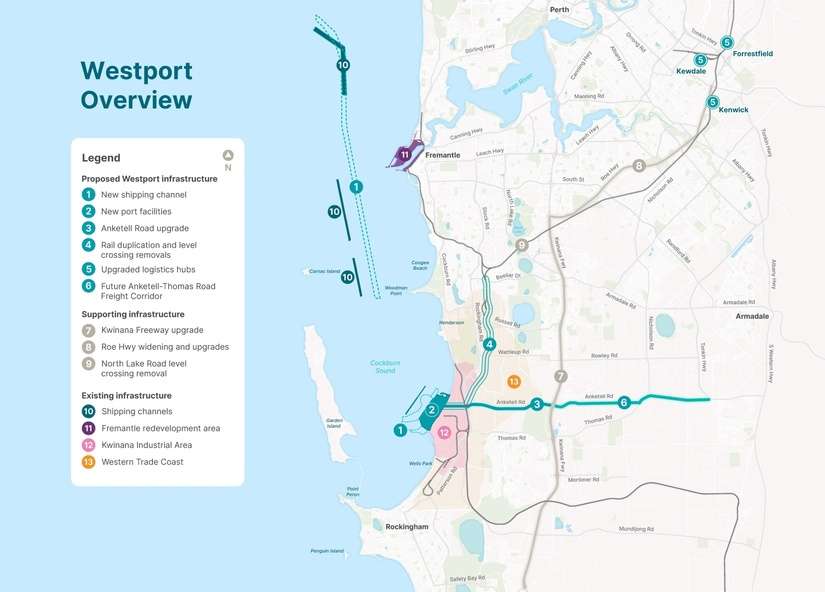
What’s included in Westport’s preferred design?
- A new port in Kwinana between the end of Barter Road and the end of Mason Road.
- A new freight corridor along Anketell Road and Thomas Road.
- Road upgrades along Anketell Road, Kwinana Freeway, and Roe Highway. Ultimately, the Anketell-Thomas Road Freight Corridor will connect the port with Tonkin Highway in Byford.
- Upgrades to the existing freight rail network between Kwinana and Cockburn, connecting the port with a logistic hub in Kenwick, Kewdale, and Forrestfield.
- A new shipping channel to accommodate larger ships expected in the future.
The process for identifying the best design for the port
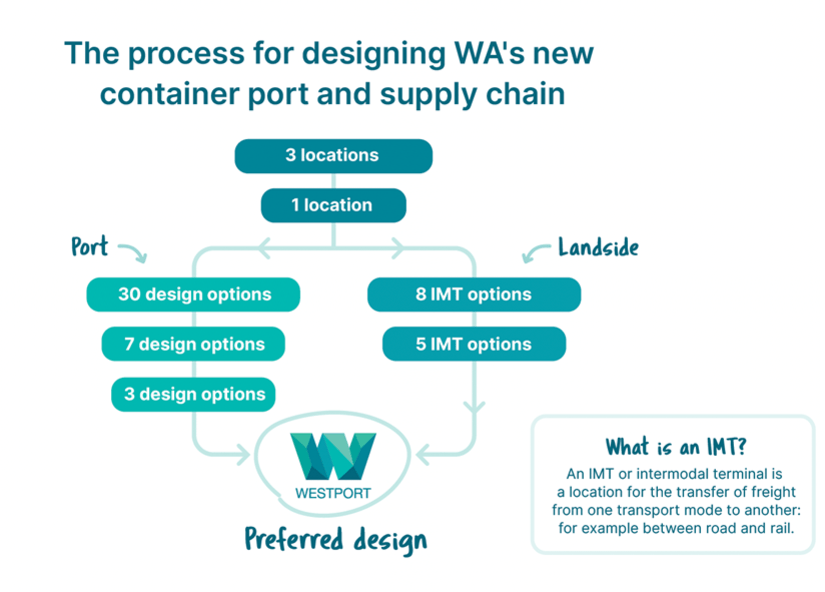
Between 2018 and 2020, the previous ‘Westport Taskforce’ looked at 25 different locations between Fremantle, Cockburn Sound and Bunbury for the new container port. This led to the Kwinana Industrial Area as the best location for a new port, serviced by an upgraded Anketell Road.
In 2021, after undertaking a range of additional studies on operational and sustainability needs, Westport identified a long-list of seven port design options. This long-list was narrowed to a short-list of three options using a multi-criteria analysis (MCA) process.
The MCA considered environmental impacts, long-term sustainability, efficiency of the supply chain and port, and financial value. Assessment criteria used in the MCA were based on Westport’s goals and subgoals, with scoring criteria and measures.
As part of the evaluation process, Westport also held a series of specialist stakeholder workshops, who helped to identify gaps in the assessment criteria, evaluate the goal weightings, and provide general feedback.
The preferred design was the best choice for protecting the environment and avoiding disruption to important services in the area. While some other options had small advantages in certain areas, these came with bigger environmental impacts that made them less suitable overall.
The process for determining the landside design
In 2022, through the Landside Logistics Opportunities Study, Westport identified three network options for the freight and logistics network. The options included a combination of existing and new intermodal terminals (IMTs) to be established, as required by growing demand. In total, eight IMT options were identified across the three network options.
Through the MCA process and targeted stakeholder engagement these options were further tested and refined to reach a preferred option for the supply chain, including road and rail corridors, and intermodal terminals.
Taking into consideration the forecast traffic growth, the preferred design proposes
upgrades to Anketell Road, Kwinana Freeway, and Roe Highway. This will be followed by the full development of the Anketell Thomas Corridor to follow.
In order to ensure a high rail share for containers, the preferred design includes rail duplication and level crossing removals between the port terminal and Cockburn Triangle.
Just now
Westport is currently in the process of optimising the port layout and marine infrastructure, refining construction planning and developing reference designs to a level that supports reliable cost estimates, approvals and future investment decisions.
We look forward to learning more about the design features as time goes by!
*By Michael Barker, Editor, Fremantle Shipping News
~ If you’d like to COMMENT on this or any of our stories, don’t hesitate to email our Editor.
~ WHILE YOU’RE HERE –
PLEASE HELP US TO GROW FREMANTLE SHIPPING NEWS
FSN is a reader-supported, volunteer-assisted online magazine all about Fremantle. Thanks for helping to keep FSN keeping on!
~ Don’t forget to SUBSCRIBE to receive your free copy of The Weekly Edition of the Shipping News each Friday!