Local Federal Freo MP Josh Wilson, who is also Assistant Minister for Climate Change and Energy, and Emergency Management, was interviewed on ABC Radio Perth ‘MORNINGS WITH NADIA MITSOPOULIS’ program this morning, 20 JANUARY 2026 about a 3 year pilot programme to recycle rooftop solar panels, when they’ve passed their use-by dates. Here’s a transcript of the interview.
NADIA MITSOPOULIS (HOST): There’s been a few companies that, as I mentioned, have been trying to recycle solar panels, but financially it’s not very viable. And you might have missed this, but the Federal Government is going to spend $25 million on a three-year pilot programme to recycle rooftop solar panels. Now there’s been concern for quite some time about our inability to recycle solar panels and it was a key recommendation in a recent Productivity Commission report where they looked at the circular economy. So how will it work? I did speak to Fremantle MP Josh Wilson, who is also the Assistant Minister for Climate Change and Energy. We had a chat a little earlier this morning.
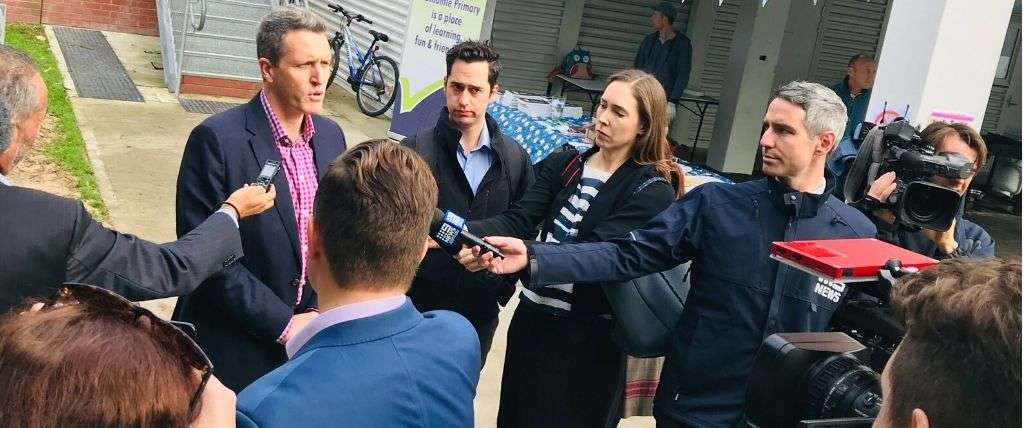
JOSH WILSON: Good morning. Nadia, good to be with you.
MITSOPOULIS: What happens to solar panels at the moment? Is anything recycled?
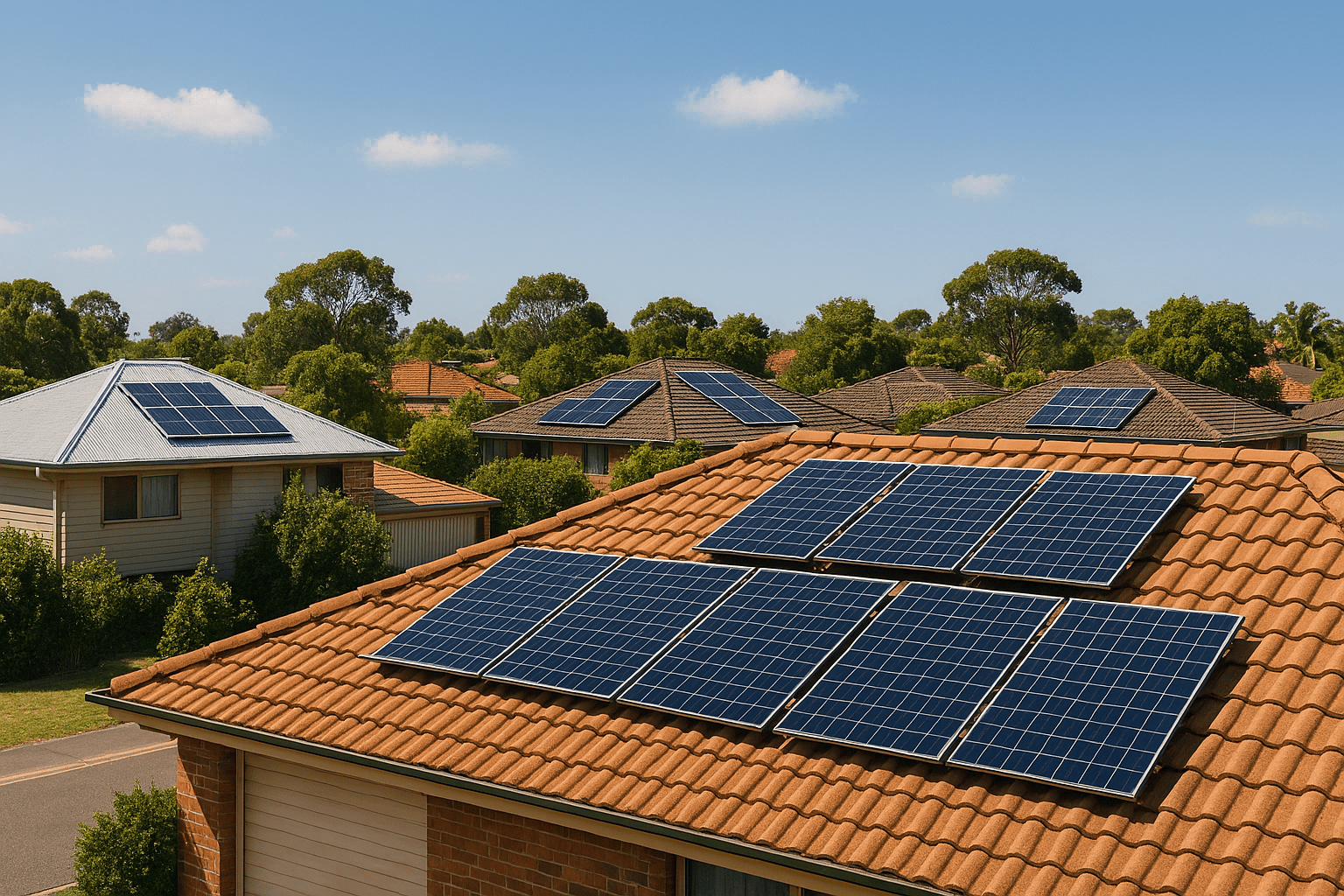
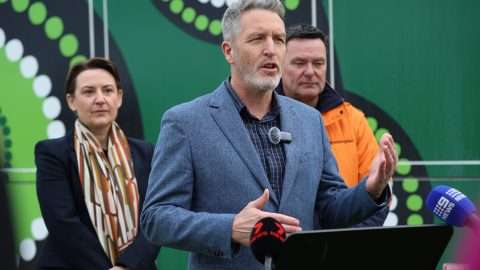
File photo
WILSON: Yes, we do have some limited recycling of solar panels. There are a few e-waste outfits in WA, for instance, that do it, and around the country, Pan Pacific in Queensland, does it to a pretty impressive degree, but it is far too low at the moment, considering the enormous value that exists in the materials in solar panels and the great kind of economic and job opportunities, plus the fact that, of course, as in every area of life, we don’t want to send good quality material to landfill wherever we can avoid it.
MITSOPOULIS: So how will this scheme work?
WILSON: The Australian Government is investing nearly $25 million over three years to deliver a new national pilot for recycling solar panels, we need to lift the effort in the way that we coordinate recycling. You’ve got a few small outfits doing it, but part of the problem for them is literally the supply, like how solar panels are collected when they are taken off people’s roofs and then transported and all of those parts of it. So this will set up over three years as a pilot scheme administrator, and ideally create around 100 different collection points and just start to really lift the scale of that effort, being mindful of the incredible value that exists in solar panel recycling, when you think about the materials in solar panels – silver, silica, glass, antimony, all of those good things that we don’t want in landfill, we want to reuse.
MITSOPOULIS: So those that are already recycling solar panels will be part of this? This is about providing more solar panels for them to recycle?
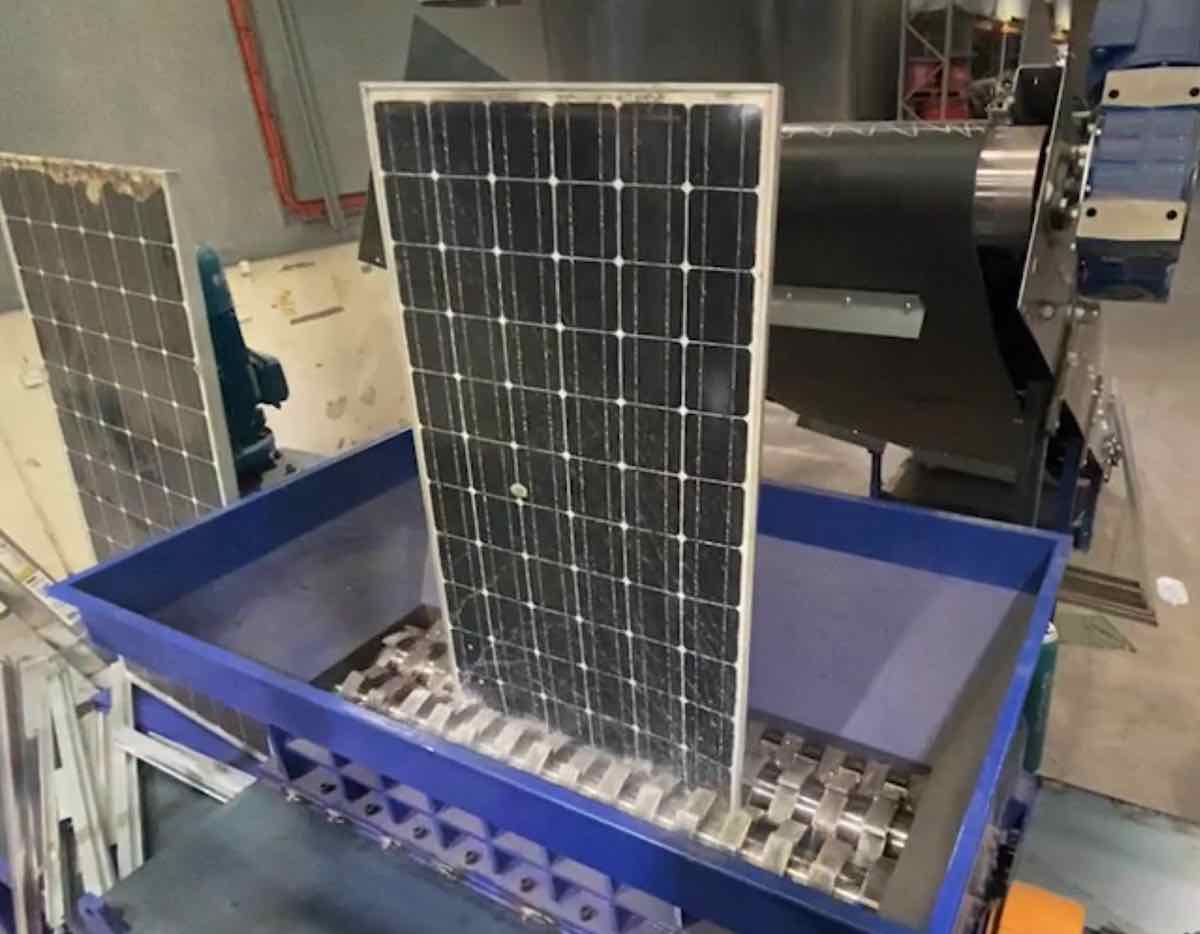
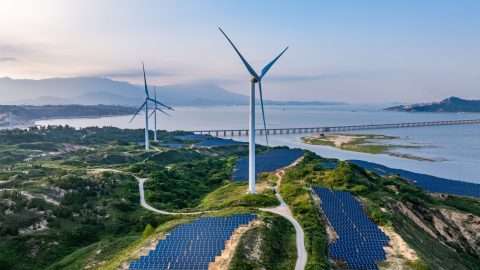
Recycling solar panels. Credit Reneweconomy.com.au
WILSON: That’s right and providing them in a way that helps them to be more cost effective. I mean, when you don’t have a network that sees the collection and transport of them, if any particular provider needs to do that themselves, that really adds burden to the whole process. And as in any area of economic life, when you when you lift the scale, when you turn the volume up, the per unit cost decreases. And over time, of course, we want to move towards a proper circular economy when it comes to solar panel and lots of other products, where we start to see the design of the products themselves and the responsibility of the manufacturers and the installers connected up to the obligation to see recycling occur.
MITSOPOULIS: I want to talk more about the cost of this, but just on the actual scheme you talk about 100 collection sites across the country. How many will be in WA and do you know where they’ll be?
WILSON: I don’t. We’ve got to appoint a pilot scheme administrator, and those details will be worked out. As a Western Australian, I tend to operate on the sort of 10% rule, because that’s our population share. So, if there were 100 nationwide, I imagine that there would be something like 10 in Western Australia. But having said that, Western Australia is also the biggest state geographically, and sometimes we actually end up with a few more than our population share might suggest, just in recognition of the scale of the state.
MITSOPOULIS: You’re on ABC Radio Perth in WA, you’re listening to Josh Wilson, who is the Assistant Minister for Climate Change and Energy, talking you through the $25 million pilot program to recycle rooftop solar panels. Because one in three homes in Australia now have solar panels, do you know how many will be able to be recycled under this scheme?
WILSON: What we’re hoping to do through this pilot is to collect and recycle up to 250,000 solar panels, using those 100 collection points and then feeding them into the solar recycling outfits as I described before. We know that is just the start. There are 4 million solar households with many more panels, because each household has multiple panels. And as time goes on, even though we’re still at the relatively early stage of the deployment of solar panels – and more households are taking up both solar panels and cheaper home batteries all the time, with significant focused government support – in time to come, that will mean a larger and larger waste stream. We don’t want to see it as waste. We want it to be part of a circular economy where we’re recapturing that really significant value in the materials that are in solar panels.
MITSOPOULIS: So those are critical minerals, things like copper, silver, lithium, cobalt, nickel?
WILSON: Yes, certainly silver, silica, antimony, which is a which is a pretty rare mineral that the United States have taken a real interest in. But just to give you an example, the Smart Energy Council estimates that within solar panels on people’s roofs at the moment, if you just take silver, which has actually been increasing in value in recent times, there’s $4.5 billion worth of silver in all of those solar panels on all of those rooves. So, to think that we would have a system that would just see them go to landfill is obviously not sensible, not economically sensible. We want to see the jobs and the economic opportunities that come from better recycling as well as the better environmental outcomes.
MITSOPOULIS: So there’s absolutely a market for all those minerals?
WILSON: Absolutely.
MITSOUPOULIS: You talked about the economies of scale, if you like, because there are a couple of companies that have tried and failed to recycle solar panels. I appreciate there are a few still doing it that you’ll tap into, but they are struggling to stay afloat. So, are you saying that the more you can supply them, the more financially viable it will be, because it’s so expensive at the moment?
WILSON: Well, that’s right. I mean, if you’re a business and you’re setting up to do any particular thing, but you don’t have the supply of the basic material – in this case, end-of-life solar panels – then you’re going to struggle. I mean, you want that scale of supply to justify whatever capital investment that you might make, and then you get further and further marginal benefits as the volume increases. So, we recognise that we think it’s appropriate for government to step in, put its hand on the scale, as we did with solar panels under the Rudd Gillard Government, as we’re doing currently with smarter batteries. And when government leans in, you can kind of kick start a process that ultimately will build up enough momentum and be self-sustaining.
MITSOPOULIS: Where’s the cost? Is it getting the solar panels to the recycling plants?
WILSON: That’s a significant part of it. At the moment, there aren’t collection sites, there’s not the transport network. There’s not that logistics. The transport part of it is really considerable. I mean, solar panels are quite a bulky kind of item, I guess, broadly speaking, and they need to be transported in a particular way if you’re to look after them and capture the minerals that they contain, and if you were an e-recycler currently, or an outfit like Pan Pacific in Queensland, it’s pretty difficult for you to be responsible for providing all of that related infrastructure, and that’s something that that we think that this pilot will help deliver.
MITSOPOULIS: So then, after the three years, will this require ongoing government funding?
WILSON: Well, we’re not looking at it that way. We hope that as we make progress over the three years through the pilot program, that the scale will start to be self-sustaining, but it will inform our thinking about policy and programs to support this particular part of the circular economy. You always learn as you go, one of the things we take heart from is that the estimations made in relation to solar panels themselves and batteries, have in every case been exceeded by the momentum and the appetite for that kind of shift. In almost every case where government has looked at the sort of renewable energy transition, we’ve been pleasantly surprised by how fast and how well it has gone forward. And that’s something we should have some confidence in.
MITSOPOULIS: So could this then be expanded to household batteries and electric vehicle batteries?
WILSON: Well, we need to see the circular economy in every area of Australian life. There are similarly valuable materials in batteries and in other kinds of products, too. We see the circular economy, as a whole, as something that needs to develop and advance, because it doesn’t make sense to take valuable materials and see them used once and then go into landfill, and it’s not environmentally responsible.
MITSOPOULIS: Josh Wilson, you mentioned the Smart Energy Council, and it does support this, but it also says there needs to be a mandatory product stewardship scheme where the manufacturer is responsible, solar panels for instance, at the end of its life. Is that something you’ll need to commit to at some point?
WILSON: Well, that’s certainly part of the thinking. One of the reasons for having the pilot over the three years is to look at all of those circumstances and the Minister has made it clear that that we will be considering what a responsible product stewardship scheme would mean. And for your listeners, product stewardship means that you want to involve everyone in the circle when we talk about the circular economy. And people who are manufacturing products, whatever it might be, it could be a can or a bottle or a household item or a solar panel, the manufacturers themselves at the outset should have in mind the way in which that product can be recycled. When that occurs, it means that the work at the other end by companies that are trying to extract valuable substances like silica or silver or glass, that their job is easier and less costly, and that makes the circular economy turn.
~ If you’d like to COMMENT on this or any of our stories, don’t hesitate to email our Editor.
~ WHILE YOU’RE HERE –
PLEASE HELP US TO GROW FREMANTLE SHIPPING NEWS
FSN is a reader-supported, volunteer-assisted online magazine all about Fremantle. Thanks for helping to keep FSN keeping on!
~ Don’t forget to SUBSCRIBE to receive your free copy of The Weekly Edition of the Shipping News each Friday!