Quite often just now, in our clearly troubled world, people take a tipple, sigh and say, “Why can’t we just have peace?”, as though peace were the natural human setting, briefly interrupted by the odd scuffle.
Earlier this year I spent time on the tranquil Greek Island of Samos, just across the water from Türkiye, and found myself reflecting on the reality that even on this quite idyllic island, despite some periods of peace, conflict and war has punctuated its history for millennia.
If you take even a casual stroll through the world’s great literature — or our daily news sites — the point is made constantly. Peace isn’t our baseline. It’s our miracle.
From the moment Cain struck Abel our stories have been soaked in conflict. The ancients didn’t pretend otherwise. Gilgamesh fought his way to wisdom. Achilles fought his way to glory. The Hebrew prophets begged their people to beat swords into ploughshares precisely because swords were always at hand. War wasn’t a deviation. It was the weather.
The classical historians were no more sentimental. Thucydides wrote as if conflict were the natural language of states. Rome declared a “Pax Romana,” but only after conquering half the known world. Peace, in that formulation, was simply the quiet that follows overwhelming force.
Fast‑forward a millennium and the pattern doesn’t soften. Augustine, Machiavelli, Hobbes — none of them imagined humans as gentle creatures tragically led astray. They assumed we were combustible. Their political theories weren’t blueprints for harmony; they were fire‑safety manuals.
Even the Enlightenment, that great age of optimism, couldn’t quite believe in peace. Kant’s famous essay on “perpetual peace” reads less like a prediction and more like a plea. Clausewitz, writing soon after, dispensed with the niceties altogether: war is politics by other means. Tolstoy, surveying the wreckage of Napoleon’s campaigns, fused “war” and “peace” into a single title because he knew the two were inseparable.
And then the 20th century arrived to prove the pessimists right. Two world wars, the Holocaust, Hiroshima, the Cold War — a century that industrialised violence and globalised fear. We built the United Nations not because peace had dawned, but because we were terrified of what would happen if it didn’t.
Even today, in what some analysts call the “long peace,” the evidence is hardly reassuring. Yes, the great powers have avoided direct war – so far. But civil wars, insurgencies, proxy conflicts, and mass displacement continue unabated. The map is littered with hotspots – and they’re not just Ukraine and Gaza. The headlines are a drumbeat. The idea that peace is our natural state looks, frankly, like wishful thinking.
So why do we keep pretending otherwise?
Perhaps because the alternative is too bleak. Perhaps because imagining peace is the only way we ever get any. Or perhaps because, deep down, we know something the ancients also knew: peace is not the absence of conflict but the presence of restraint, institutions, and moral imagination. It is not what happens when humans relax. It is what happens when humans work.
If history teaches us anything, it’s this: peace is not the default. It is the exception we must keep earning. And the moment we start treating it as normal, we risk losing it – as Professor Alex Bellamy at the University of Queensland argues in his just published The Conversation article, Is World Peace Even Possible?
So, let’s not despair so much as declare we really don’t want war and must give peace a chance.
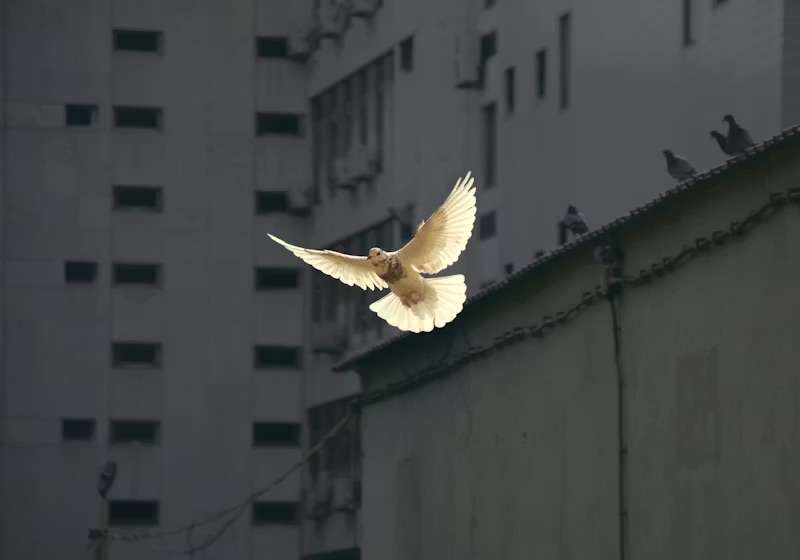
Credit Sunguk Kim for Unsplash
* By Michael Barker, Editor, Fremantle Shipping News
~ If you’d like to COMMENT on this or any of our stories, don’t hesitate to email our Editor.
~ WHILE YOU’RE HERE –
PLEASE HELP US TO GROW FREMANTLE SHIPPING NEWS
FSN is a reader-supported, volunteer-assisted online magazine all about Fremantle. Thanks for helping to keep FSN keeping on!
~ Don’t forget to SUBSCRIBE to receive your free copy of The Weekly Edition of the Shipping News each Friday!