While Christmas bells ring out across much of the Western world each December, this brightest month of the year in Freo has long been a time around the globe when humanity gathers to celebrate light, hope, and renewal. From ancient traditions to modern observances, people of many faiths and philosophies mark this season with their own meaningful celebrations. Here’s a good number of them.
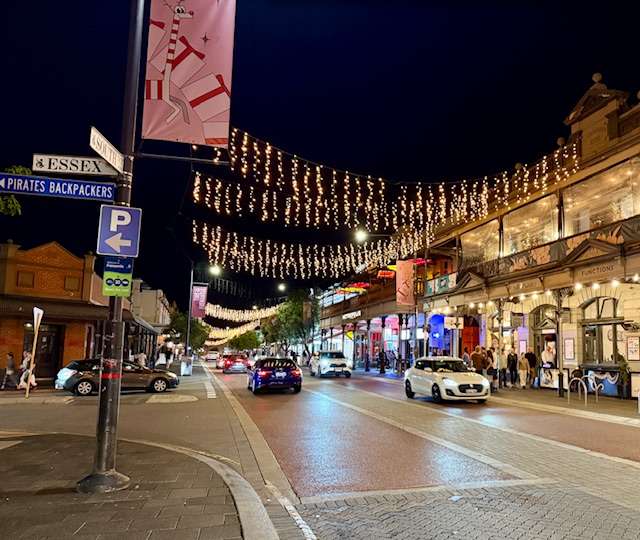
Capuccino Strip, Fremantle, 2025 Christmas lights
Christians: The Birth of Christ
For Christians worldwide, Christmas on 25 December commemorates the birth of Jesus Christ, whom they believe to be the Son of God and saviour of humanity. The celebration encompasses both religious and cultural dimensions: church services featuring carols and nativity plays tell the story of Jesus’s birth in Bethlehem, while families gather to exchange gifts, share meals, and decorate trees and homes. The season of Advent in the four weeks leading up to Christmas is a time of spiritual preparation and anticipation. For many Christians, Christmas represents God’s gift of love to the world, the arrival of hope and redemption, and the promise of peace on earth and goodwill to all people.
Hanukkah: The Festival of Lights
Jewish communities celebrate Hanukkah, typically falling in late November or December, commemorating the rededication of the Second Temple in Jerusalem. The eight-day festival recalls the miracle of a single day’s worth of oil burning for eight days. Each evening, families light another candle on the menorah, play dreidel games, eat foods fried in oil like latkes and sufganiyot, and exchange gifts. The holiday emphasizes religious freedom, perseverance, and the triumph of light over darkness.
Islamic Observances
While Islam follows a lunar calendar meaning major holidays like Ramadan and Eid shift through the seasons, December holds significance for some Muslims. The Islamic New Year sometimes falls in this period, marking the beginning of Muharram and commemorating the Prophet Muhammad’s migration from Mecca to Medina. Some Muslim communities also acknowledge Mawlid al-Nabi, the Prophet’s birthday, which can occur in various months depending on the lunar calendar. Additionally, many Muslims participate in the multicultural spirit of December while maintaining their own distinct religious identity and practices throughout the year.
Baha’i Celebrations
The Baha’i Faith marks several important occasions during this season. Most notably, Baha’is celebrate the birth of the Bab on 20 October and the birth of Baha’u’llah on 12 November by the Gregorian calendar, though these are determined by the lunar calendar in the Baha’i tradition. These holy days commemorate the founders of the Faith and are observed with prayers, readings from sacred texts, and gatherings that emphasize unity, peace, and the oneness of humanity. The Baha’i approach to this season reflects their belief in the harmony of all religions and the progressive revelation of divine truth.
Yule and the Winter Solstice
For pagans, Wiccans, and many with roots in pre-Christian European traditions – of whom there seem to be a growing number here and there around the planet – the Winter Solstice around 21 December marks Yule.
This celebration honors the longest night of the year and the sun’s symbolic rebirth. Traditional observances include lighting fires or candles, decorating with evergreens, feasting, and gathering with loved ones. Many Christmas customs, from decorated trees to wreaths and gift-giving, have origins in these ancient solstice celebrations.
Kwanzaa: Celebrating African Heritage
Created in 1966, Kwanzaa runs from 26 December to 1 January and celebrates African American culture and heritage. Each of the seven days focuses on one of the Nguzo Saba, or seven principles: unity, self-determination, collective work and responsibility, cooperative economics, purpose, creativity, and faith. Families light candles on the kinara, share traditional foods, exchange gifts, and reflect on their community and African roots.
Bodhi Day: Buddha’s Enlightenment
Buddhists observe Bodhi Day on 8 December in many traditions, commemorating the day Siddhartha Gautama achieved enlightenment under the Bodhi tree. Practitioners may spend the day in meditation, studying Buddhist teachings, performing acts of kindness, and some decorate fig trees with lights and ornaments. It’s a day of reflection on the path to awakening and compassion for all beings.
Dongzhi Festival: The Return of Light
In Chinese and East Asian cultures, the Dongzhi Festival celebrates the Winter Solstice and the return of longer days. Families gather to eat tang yuan, sweet rice balls in soup that symbolize reunion and harmony. The celebration emphasizes family togetherness and the cyclical nature of the seasons, marking the transition from yin to yang energy.
Humanist and Secular Celebrations
Many who don’t follow religious traditions still embrace the season’s spirit through HumanLight (23 December), which celebrates humanist values of reason, compassion, and hope. Others simply gather with loved ones to mark the year’s end, exchange gifts, and celebrate human connection, kindness, and the turning of the year without religious context.
The Common Thread
Despite their different origins and practices, these December celebrations share remarkable similarities. Nearly all involve light in darkness, whether literal candles or symbolic hope. They emphasize gathering with community and family, sharing food, giving gifts, and reflecting on values that matter. They mark the darkest time of year with warmth, generosity, and optimism for the future.
This convergence isn’t coincidental. Humanity has always gathered to remember that we’re not alone, and that together we can weather any darkness. Whether we call it Christmas, Hanukkah, Yule, Kwanzaa, or simply the holidays, we’re all participating in an ancient human tradition of finding joy and connection when we need it most.
So as December unfolds, however you celebrate or don’t celebrate, you’re part of a global tapestry of people reaching for light, meaning, and each other. And that, perhaps, is the most universal celebration of all.
* By Michael Barker, Editor, Fremantle Shipping News
~ If you’d like to COMMENT on this or any of our stories, don’t hesitate to email our Editor.
~ WHILE YOU’RE HERE –
PLEASE HELP US TO GROW FREMANTLE SHIPPING NEWS
FSN is a reader-supported, volunteer-assisted online magazine all about Fremantle. Thanks for helping to keep FSN keeping on!
~ Don’t forget to SUBSCRIBE to receive your free copy of The Weekly Edition of the Shipping News each Friday!