Anne-marie Medcalf* likes it and gives it 4 Stars out of 5 – so it must be good!
A little like its own subject, the story of the release of Antonin Baudry’s De Gaulle: Resistance — the first of two three‑hour films on Charles de Gaulle’s role during World War II — is one that moves from disheartening setback to exhilarating success.
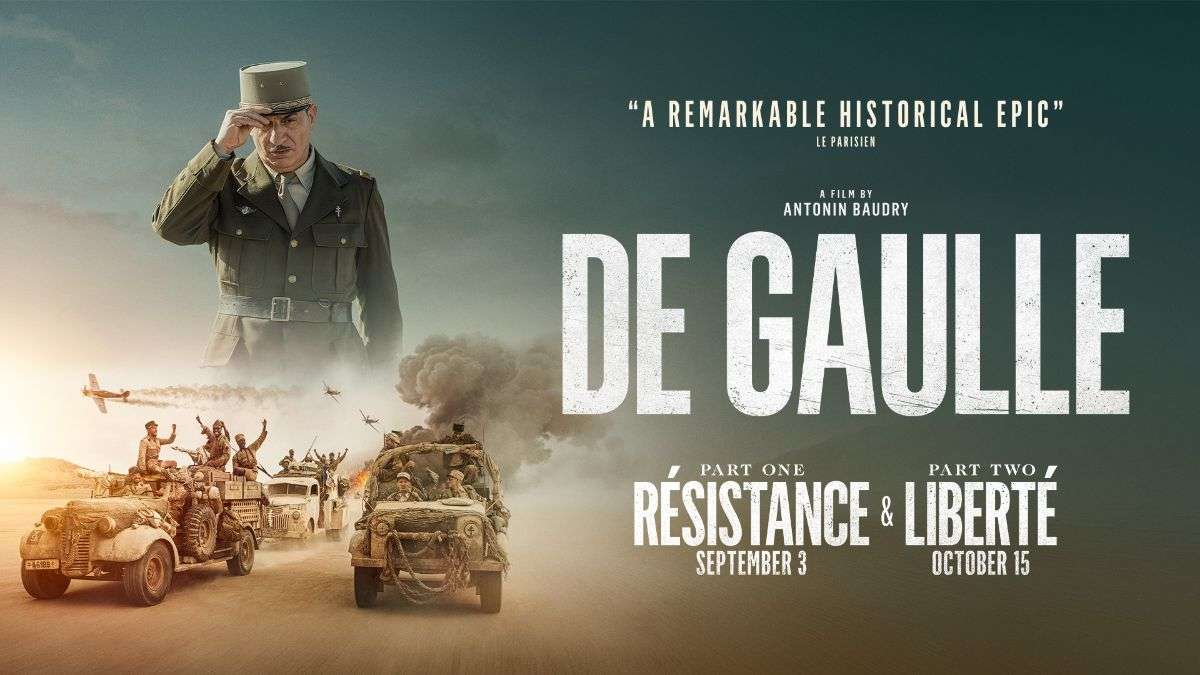
When the film, one of the most expensive ever made in France with a budget of around €100 million, opened in June this year, it initially looked destined to be a box‑office disaster despite excellent reviews. Audiences simply weren’t biting. Three weeks later, however, a succession of heatwaves across Europe sent the French public flocking to air‑conditioned cinemas, and suddenly a three‑hour film sounded divine. Word of mouth from enthusiastic viewers did the rest, and the producers have now celebrated more than five million French attendees with a national “Thank You” advertisement.
De Gaulle: Resistance covers the period from June 1940 to the very beginning of 1943. It opens with Charles de Gaulle — magnificently played by Simon Abkarian — arriving in London, refusing to recognise the new Vichy regime led by Marshal Pétain in the south of France, collaborating with the Germans who had annexed the north. The film therefore spans only a short portion of World War II, but a crucial one: both for the development of the French Resistance and its role in Allied military operations, and for the evolution of de Gaulle’s political thinking and actions. In that sense, it is not a typical biopic. It is a homage to de Gaulle, occasionally tongue‑in‑cheek, and an ode to the French Resistance, warts and all. It is political and historical drama with a penchant for satire, as well as a thumping war and action movie.
There are emotional and nostalgic moments too — including the opening sequence, in which de Gaulle delivers his now‑legendary BBC appeal to resistance on 18 June 1940, one day after arriving in England. From then on, the hours fly.
Antonin Baudry, whose first career was in government policy and diplomacy, is also a renowned graphic novelist under the name Abel Lanzac. FSN readers may remember The French Minister (Quai d’Orsay), drawn from his eponymous graphic novel. Baudry joyously brings this background to the structure and tone of De Gaulle, especially through the sometimes caricatural vignettes of Churchill and de Gaulle’s negotiations — colourful exchanges tinted with respect, irritation and affection. Other examples include early scenes portraying de Gaulle as an inconvenient, even preposterous madman, reflecting how sections of the British cabinet viewed him during negotiations with Germany. Softer moments show glimpses of his family life: Yvonne de Gaulle’s steadfast support, and his tender affection for his daughter with Down syndrome, whom he refused to place in an institution, as was common at the time.
Baudry focuses mainly on the military resistance led by de Gaulle from London, backed — reluctantly — by the British and American governments. The Battle of Bir Hakeim, led by French General Koenig (played by a superb Benoît Magimel), sits at the heart of the film, both for its strategic importance in allowing British troops to regroup before El Alamein and for the sheer military feat it represented. Cinematically, it is magnificent, and the suspense keeps us on edge. Viewed from Australia, this episode — and another earlier in the film — evokes shades of Gallipoli in the heroism and resilience of the combatants, but also in the ruthlessness of the British and, it must be said, of de Gaulle, in their readiness to sacrifice non‑British troops for the ultimate goal.
The place given to the internal resistance — the movements initiated within France — is perhaps the film’s weak point. It is shown symbolically through Fernand Bonnier de La Chapelle, a seemingly lone wolf who changed the course of history in North Africa with a final act, played forcefully by Florian Lesieur. It is also shown through Jean Moulin, hero of the French internal resistance and ally of de Gaulle, who worked to unify the resistance. He appears in only two fleeting scenes; blink and you might miss him.
De Gaulle: Resistance, in a few words, is a film that vividly depicts the madness, arrogance and genius of de Gaulle, as well as the way he established — from the very beginning — the foundations of French foreign policy that endure to this day. It is a policy built on his idea of la grandeur de la France and on non‑alignment with the great powers, whether the United States or the Soviet Union.
I give it 4 out of 5 stars.
Screening at Luna Leederville + Luna on SX, from 3 September.
*By Anne-Marie Medcalf, our Parisian/Fremantle film buff. If you’d like to know more about Anne-Marie’s love of movies look here.
~ If you’d like to COMMENT on this or any of our stories, don’t hesitate to email our Editor.
~ WHILE YOU’RE HERE –
PLEASE HELP US TO GROW FREMANTLE SHIPPING NEWS
FSN is a reader-supported, volunteer-assisted online magazine all about Fremantle. Thanks for helping to keep FSN keeping on!
~ Don’t forget to SUBSCRIBE to receive your free copy of The Weekly Edition of the Shipping News each Friday!