Prof Ray Wills and Prof Peter Newman* say we can replace the chooks but we can’t replace our wildlife — and the bill is overdue
In July, we warned that H5N1 bird flu was a wildlife emergency being managed with a priority for agricultural. Six weeks later, the warning has become documented fact — and the funding gap we pointed to has now been quantified and publicly demanded by wildlife experts.
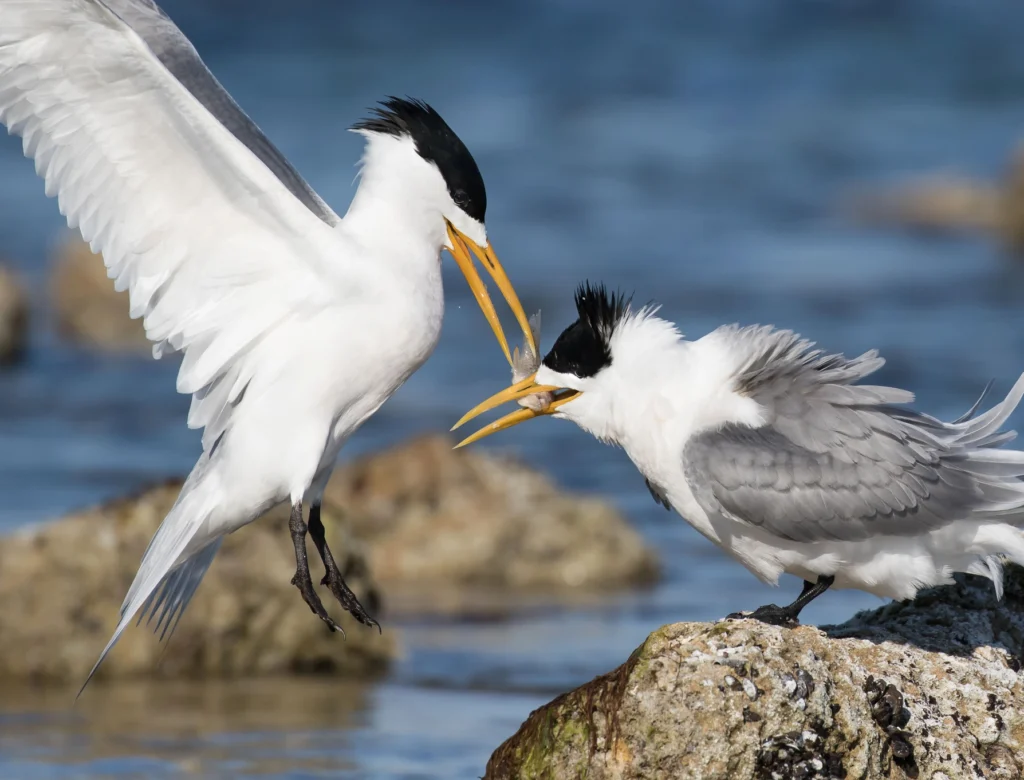
From Bird Life Australia. ‘Greater Crested Terns’ especially vulnerable to H5 bird flu. Photo by Rebecca Harrison.’
Australia has moved from a single sick brown skua on WA’s south coast to 330 H5-positive wildlife events across six jurisdictions.
The virus has not entered poultry or the wider agriculturalsystem. That is good news — and proof that biosecurity matters. But wildlife is already paying the price.
In South Australia, mass deaths of greater crested terns have been recorded on offshore islands. In Victoria, residents around Nelson and Portland have reported large numbers of dead birds in a Ramsar wetland system. Just three kilometres away across the South Australian border, response teams have been collecting carcasses, euthanising suffering birds and installing dedicated composting bins; on the Victorian side, residents have described dead birds left in place. The issue is not that every carcass must always be removed — poorly managed intervention can disperse live birds — but that governments need enough trained people, equipment and local protocols to assess each site and act quickly.
On 23 August, the virus crossed a line many had feared: a long-nosed fur seal was confirmed dead at Beachport, South Australia — Australia’s first mainland mammal case. That matters because it occurred near The Pages Islands, home to an Australian sea lion breeding colony. Australian sea lions occur nowhere else on Earth and have already declined by more than 60% over four decades.
On 28 August, H5N1 was confirmed in a dead dolphin at Goolwa, South Australia — the first known detection in an Australian dolphin. It follows the confirmed infection of a long-nosed fur seal and a red fox, demonstrating that the outbreak is no longer confined to birds but is moving through marine and terrestrial food webs, likely via predation or close contact with infected wildlife.
The highly pathogenic strain of H5N1 bird flu has killed millions of birds globally and crossed over into mammal species, including elephant seals. On Australia’s sub-Antarctic Heard Island, H5N1 was associated with an estimated 13,359 southern elephant seal pup deaths — average mortality of 76%, reaching 97% in some breeding harems.
A welcome package — but not enough
Last week, the Albanese government announced a further $145 million for H5. That is welcome. It brings total government investment above $270 million.
But the distribution matters. Of the new money, $125 million is for the national emergency biosecurity response, shared equally between the Commonwealth, states and territories. Only $20 million is specifically allocated to on-ground action for key native species and locations, wildlife emergency response in Commonwealth-managed national parks, and citizen-science work. The Commonwealth is seeking matching state and territory contributions even for that smaller wildlife allocation.
The package includes threatened-species and conservation initiatives within the $125 million, so it is wrong to suggest wildlife receives nothing. But it remains fair to say that the only clearly identified, wildlife-first funding is $20 million — one-tenth of the $200 million over two years requested by leading science and conservation organisations for wildlife resilience.
That is the central policy failure. Australia has a standing national biosecurity system measured in hundreds of millions annually, primarily designed to defend agricultural production, trade and food supply. Wildlife protection remains a smaller, emergency-driven addition, released after the virus has arrived and populations are already dying.
The vaccine gap
There is a further gap. Australia has approved vaccination for up to 100 captive native birds at Cleland Wildlife Park, including critically endangered orange-bellied parrots and regent honeyeaters. That is a sensible and important safeguard.
But vaccines administered individually by injection cannot protect wild tern colonies, free-ranging sea lions, quolls, devilsor most other vulnerable populations at ecosystem scale. The first fur-seal deaths underline that the challenge is not simply “bird flu” in birds. It is a disease shock moving through food webs, scavengers and marine ecosystems already under severe pressure.
The cost of inaction
This is not an argument against protecting poultry. Poultry producers should have robust biosecurity and, if losses occur, fair compensation. But every chicken can be replaced from global supply chains. Australia’s endemic wildlife cannot.
The government’s own value of a statistical life places a multi-million-dollar value on reducing risks each human life. We use such calculations routinely for roads, hospitals and infrastructure. Yet when wildlife experts ask for $200 million to protect species and populations that exist nowhere else on Earth, the response remains tiny and piecemeal.
The choice is not between “the chooks” and wildlife. It is between recognising that biosecurity must now protect both — or allowing the most irreplaceable part of Australia’s natural inheritance to remain a secondary consideration.
The $145 million package is a start. But with 330 wildlife events, local transmission, mass bird deaths and confirmed spillover into mammals, it is not a conclusion. The bill for meaningful protection remains around $200 million. The cost of refusing to pay it will be measured in losses that no compensation scheme, captive program or global supply chain can ever replace.
This is Covid for Australian wildlife. Everyone agreed to work together on that one.
*Ray Wills is Adjunct Professor at The University of Western Australia and Managing Director of Future Smart Strategies, where he constantly tracks the data on global change – including biodiversity and tech. Peter Newman AO is John Curtin Distinguished Professor of Sustainability at Curtin University.
~ If you’d like to COMMENT on this or any of our stories, don’t hesitate to email our Editor.
~ WHILE YOU’RE HERE –
PLEASE HELP US TO GROW FREMANTLE SHIPPING NEWS
FSN is a reader-supported, volunteer-assisted online magazine all about Fremantle. Thanks for helping to keep FSN keeping on!
~ Don’t forget to SUBSCRIBE to receive your free copy of The Weekly Edition of the Shipping News each Friday!