Our regular contributor, Bruce Menzies* takes us on a meander, but it’s well worth the journey!
You may look at the title of this piece and wonder where it might lead. I’m pondering the same question. So, if you are a leftish-brained reader who would like me to keep on track, to address a specific subject, and not to meander down unconnected detours, you may like to activate your mouse and roam elsewhere. Please excuse my directness. My mind (for want of a better description) is in scrambled egg mode. On the in-breath, it refuses to be reined in; on the out-breath, I’m singing ‘baby please don’t go’. Dear reader, can you tolerate a sense of disturbance, which sums up my present reality – rather than adhering towards ‘concentrate, lad’, as an earnest schoolmaster might once have implored?
Notice I said ‘schoolmaster’ and not schoolteacher. Automatically, without thinking. Of course, I enjoyed or endured school mistresses as well as schoolmasters. No doubt they were just as explicit as their male counterparts in directing wandering minds to focus. Yet I’d like to think the feminine spirit was more attuned to the validity of inattention, the sheer relief in drifting off somewhere, as a counterpoint to observing the universal edict of parent and teacher: Pay attention!
Have I lost you yet? What was that title again? ‘Against the machine’. Well, right now, I’m trying to work with a machine, or a combination of machines if you count computer, monitor, mouse, keyboard, and headphones. In this present moment (is there anything else?) all of these instruments are mercifully in sync. Perhaps something semi-sensible can emerge from my musings. Maybe a shared sense of disturbance will induce you to ride along with me.
On that hopeful note, let’s shift to the bedroom. Not for a bit of hanky-panky or a wee lie down, as either of my grandmothers might’ve said. No, not a literal shift but an imaginary one. A memory of last night, as I lay under the duvet, listening to the glorious rain belting down on the roof. A memory that triggered memories. Sitting on a sandhill at Hungry Hollow in Bunbury, my ten-year-old self enraptured by the surging ocean, oblivious to the prospect of a drenching as a storm swept in.
The forces of Nature, as the expression goes. Untamed, powerful, relegating us humans to our rightful place. Yes, I lay awake and thought about those forces. Wild winds. Sudden deluges. Bombed by hailstones while crouching under the peppermints. Thunder and lightning rippling through a youthful body. Shivering sensations of excitement outranking intermittent flashes of fear. Exposed. Unsheltered. Away from the warm hearth. In Nature. With Nature.
What does it mean, the imprint of those experiences? Does it inculcate a sense of wonder, an affinity for wild places? Not for everyone, I guess. But I think the taste I got as a child informed my later interests and inclinations. Had I been born and raised in a high-rise apartment in a city of many millions, that affinity may never have arisen. In life’s lottery, time and place make up a fair proportion of our basket of influencers. They also limit or enhance the options of our caregivers. It’s the luck of the draw, you could say.
Nature does nurture. Those who study human characteristics and behaviour often try to determine which factors play out in an individual’s development. Nature (referencing genetics and epigenetic effects that we are born with), and Nurture (referencing the effects of our parenting and society) are treated as separate influences. This division may be useful for psychologists and social scientists. But I wonder whether it sidesteps the obvious. Nature, if imbibed and treated with due respect, does nurture. And I’m not the first person to dwell upon the side-effects for millions of predominantly urban dwellers who are increasingly estranged from any meaningful engagement with the natural world.
But does that modern-day phenomenon invoke us to rally ‘against the machine’, whatever that might be? Dispense with our dreams of McMansions, our home theatrettes, our Toyotas and our Teslas, our latest-model Apple or Samsung devices, and our wall-to-wall fridge-freezers filled with enough frozen and packaged food to feed a small army?
Or is the answer to be found in the folksy lyrics of John Prine, who warbled a message reminiscent of a bygone era:
‘Blow up your TV, throw away your paper
Go to the country, build you a home
Plant a little garden, eat a lot of peaches
Try and find Jesus, on your own.’
Good old John Prine. Late and great. Once upon a time, I had his LP. Didn’t induce me to seek Jesus or chuck out the newspaper but the music was part of the 70s zeitgeist that sent me tumbling. And that was well before Tim Berners-Lee had the World Wide Web in his mind’s eye or Steve Jobs was doodling with his Apple. A quick Google search tells me both wunderkinder emerged from different wombs in 1955 but not whether they were already incarnated as fully fledged nerds. Which makes me digress even further and contemplate whether anybody has written a book about the parents of these and other techno-wizards. They – the presumably proud parents – have much to answer for.
Anyway, that’s a PhD thesis for some aspiring scholar at the University of Mars. Vice-Chancellor Elon would be the perfect sponsor.
Back to the present. For the moment.
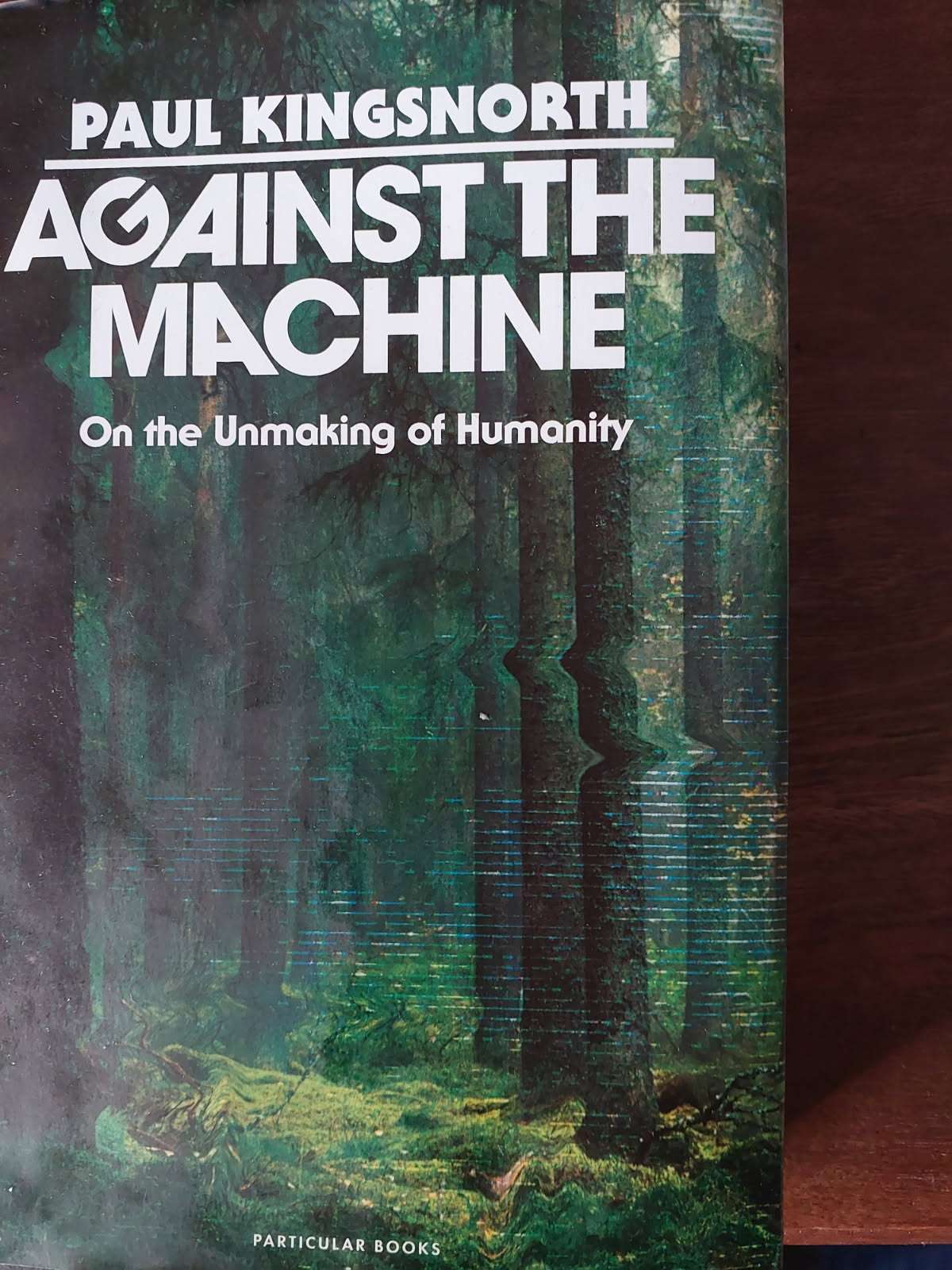
Call it fate, serendipity, or simply the way the dice occasionally fall. Within a few short days, I had separate recommendations to read a 2025 publication by Paul Kingsnorth, an English author who’s taken up residence with his family in the west of Ireland. Some years ago, Kingsnorth was long-listed for the Booker Prize for a work of fiction, The Wake. Readers may know of him. He’s a prolific writer and has spent time at the coalface of environmental activism.
His latest work is entitled – surprise, surprise – Against The Machine. It’s a must-read, I reckon. No way I can do it justice by cherry-picking quotes or attempting a summary. But, in keeping with the haphazard blarney in this article, I’ll give it a go.
The book is sub-titled ‘On the Unmaking of Humanity’. Like others, Kingsnorth casts his net into the past and traces a cultural–economic shift which could be summed up as ‘from farm to factory’. He hones in on the loss of agency for individuals and small communities, brought about as the Industrial Revolution tightened its grip. He extols the courage and virtues of those who attempted to resist. But, as King Canute soon found out as he stood before the oncoming tide, resistance was futile. So-called Luddites were scorned because of their refusal to accept ‘Progress’. Under the guise of ‘consolidation’, small tenancies became large land holdings. New innovations in farming enabled mass food production. The invention of the steam engine shifted goalposts. The countryside emptied as people converged in towns and cities, eking out an existence in factories and living in slums. Organised religion lost its grip. God took a back seat to Capitalism, a recipe for enrichment that sparkled on the bedrock of unending growth. A culture of need became a culture of want.
No country was immune. Kingsnorth recounts the arrival of Commodore Perry and his ‘Black Ships’ in Tokyo harbour in 1853. Under the banner of ‘free trade’, the USA flexed its expansionist muscles, forcing Japan to deal with the wider world and ‘open up’. Like the Luddites, Japan might’ve had the will but not the means or support to push back against what Kingsnorth describes as ‘the pursuit of the cosmopolitan Utopia of openness’. He goes on to say:
‘The flaw in the cosmopolitan dream, now as then, is a simple failure to understand that the world is not ‘rational’, and neither are we. We are crooked timber, and will grow from the ground. Universalist projects ignore that human need for roots, and the attack on culture by commerce fuels destructive want. All of this creates not universal peace but universal upheaval. Like Perry’s arrival in Japan, its effect is to dissolve our previous social bonds, cultural stories, social arrangements and religious commitments in a sea of open, boundless nothing.’
I resonate with Kingsnorth’s commentary about the human need for roots. It’s embedded in indigenous stories of place. It’s embedded in the stories of migrants who leave their homeland and resettle elsewhere. And I suspect it’s a significant driver in the quest for those of us who are motivated to explore our ancestral origins.
Other aspects of the book that spoke to me include discussion of culture and meaning. The author contrasts the values of the pre-technological age with those of modernity. Traditions have been traduced. History largely forgotten. A sense of being ‘a people’ has disappeared. In their place, we have the secular assertions of science – a ‘non-mythic version’ and a claim to the ‘true nature’ of reality. The cult of the self becomes the highest good. The screen becomes our distraction from what is actually going on.
All of this adds up to ‘the unmaking of humanity’. And we are invited to consider where we stand, and what if anything we might do with the rest of our lives.
Kingsnorth is not one for grand solutions. But he does suggest we might need to ‘embrace not a rebellious individualism but a reactionary radicalism: a rejection of Machine values based on an embrace instead of the eternal things. Its heart would be the values of people, place, prayer and the past.’
I wouldn’t argue with any of that.
And I agree with Kingsnorth that the ‘how’ aspect of the equation is up to each of us, incorporating our circumstances, our motivation, and our values. As those who have followed my columns in FSN would probably glean, these are fields of exploration that have both troubled and tantalised me as a blessed baby-boomer.
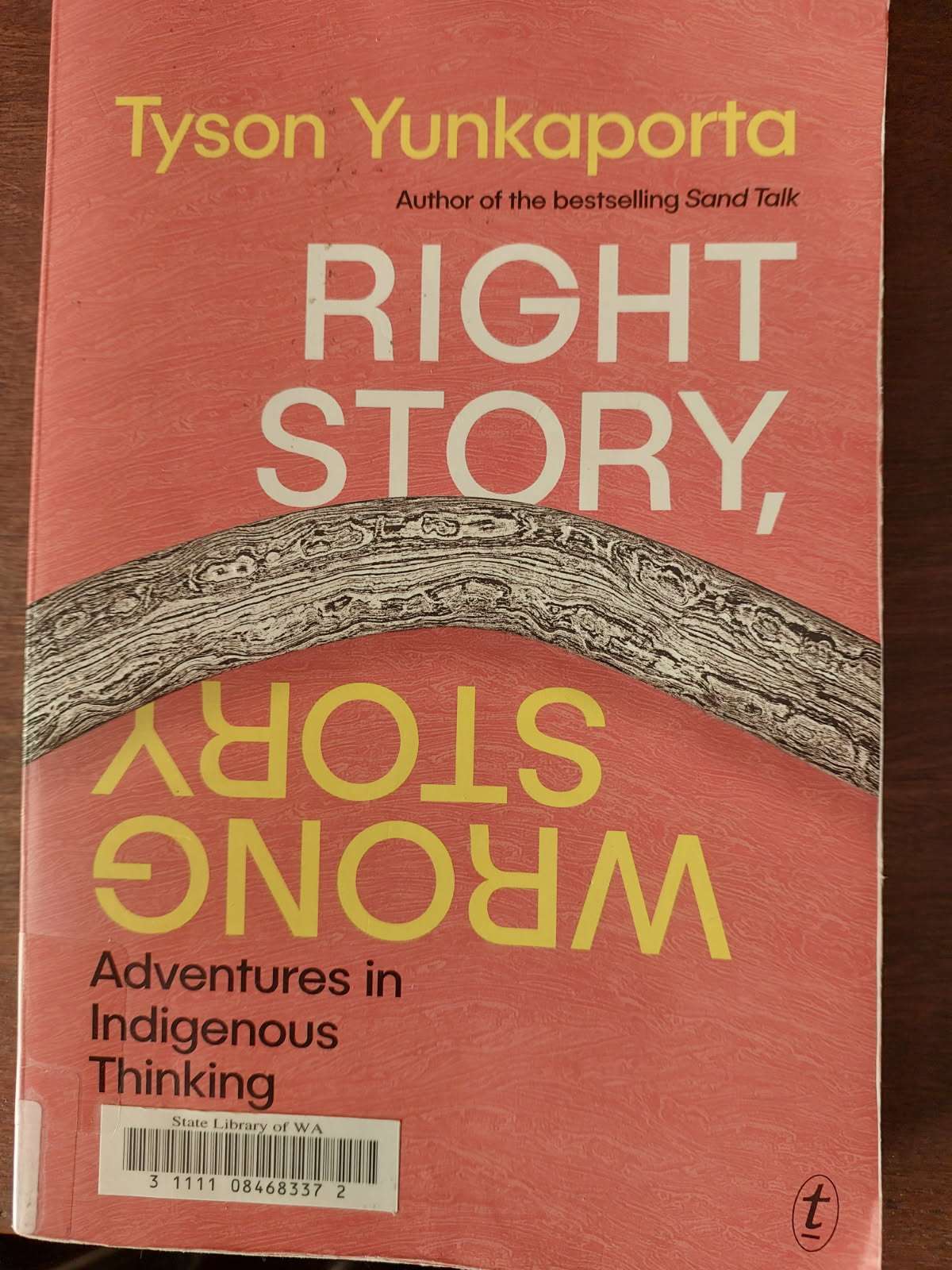
Which, for some obscure reason, reminds me of indigenous academic and author, Tyson Yunkaporta. In Right Story Wrong Story, he assumes the role of Mother Earth, pouring cold water on the idea we simply need to ‘wake up, clean up, grow up, and show up’. It’s a mantra that made sense to me decades ago after I absorbed the conceptual frameworks for human development articulated by Ken Wilber and others. What’s with all these ‘ups’, Mother Earth grumbles. Instead, we should just shut up and listen up.
Yunkaporta doesn’t knock Wilber’s work around integral theory. But he comes down hard on how it’s been adopted by the ‘meta-modernist movement and booming coaching industry, along with every other corporate self-help program and sense-making community in the information ecosystem of Enlightenment 2.0’. Ouch!
Through dear Mother Earth, he flips the script: ‘Down is the way you need to look now. Slow down. Calm down. Scale down. Step down.’
My inclination – my aspiration would be more accurate – is to look up, down, and sideways. Finding harmony and insight within an integration of the horizontal and vertical, is a quasi-esoteric way of putting it. But I get where Yunkaporta sees the emphasis should lie. And it nestles in with Kingsnorth’s notion of finding and understanding our roots.
However, here I am, snug in my Fremantle eyrie, untroubled materially, yet still trying to make sense of the life I’ve been given. Caught in the Machine, while reaping its benefits. Alone, yet stimulated by the company and thoughts of others. Surrounded by four walls and possessions, yet with easy access to oceans and forests. ‘LOL’ an as-yet carefree grandchild will respond. Too right. Cheers amidst tears. Laugh I will.
My Canberra cousin shares a post on Facebook: ‘There are data centres that use minimal electricity and don’t need millions of gallons of water. They’re called libraries.’
Neither Fremantle nor Denmark, where I hang out, have data centres. But they both have libraries.
Whew!
*By Bruce Menzies. Based in Fremantle, most of the time, Bruce Menzies is the author of three novels, a family history, and a recent memoir, as well as be8ng a regular contributor to FSN. Details at BruceJamesMenzies.com If you’d like to read more of Bruce Menzies’ work on Fremantle Shipping News or listen to a fascinating podcast interview with Bruce, look here.
~ If you’d like to COMMENT on this or any of our stories, don’t hesitate to email our Editor.
~ WHILE YOU’RE HERE –
PLEASE HELP US TO GROW FREMANTLE SHIPPING NEWS
FSN is a reader-supported, volunteer-assisted online magazine all about Fremantle. Thanks for helping to keep FSN keeping on!
~ Don’t forget to SUBSCRIBE to receive your free copy of The Weekly Edition of the Shipping News each Friday!