A reflection on the UNRULY WA Right to Protest event from our regular contributor, Bruce Menzies*
‘So Fremantle!’, writes our Editor, in the aftermath of a panel discussion on the right to protest, held at Kidogo Arthouse under the banner of ‘Unruly Voices’.
Yes, very Fremantle, though it did not transport me back to the late 60s/early 70s as the Editor suggests. No, I felt firmly anchored in the second quartile of the 21st century, as I listened to the various presentations, followed by questions from the audience.
What, if anything, has changed in the last sixty years? Put another way, is the vibe the same or somewhat different, given the passage of time?
Well, I guess readers who are old enough to remember the sixties and who were packaged into the Arthouse the other night may have a range of perceptions. Back then, the Vietnam War raged. Conscription for 20-year-old Aussie blokes. Vast crowds taking the streets to protest our involvement. Draft resisters scooting off in a hurry or being locked up. Households divided. While our double-decade conservative government ploughed on regardless, going ‘all the way with LBJ’.
Yes, many voices were ‘unruly’. As one whose name didn’t come out of the barrel (in a lottery you wanted to lose), my protests were confined to the family dinner table or when friends gathered at parties or the pub. As I remember it, while some of us opposed the war, our angst was more around crushing socio-political norms such as censorship, the White Australia policy, and two decades of the so-called Liberals occupying the seats of power in Canberra. Rebellion confined to underage drinking at the hallowed Steves in Nedlands. Perhaps we’d read JK Galbraith and formed opinions about the US military/industrial complex. Perhaps we’d read Silent Spring and gained some understanding of how humans were messing up the environment – and our bodies.
Perhaps we picked up a copy of The Female Eunuch and encountered Germaine Greer, full frontal. Yet the Western suburbs mob I hung out with at university, and later the more worldly collective in Canberra and abroad during my truncated career as a public servant, had much to learn around environmental issues, racism, systemic failures that disadvantaged women and indigenous people, and the impact of vested interests – that largely unquestioned extension of white male power, clinging onto privilege and influence like there was no tomorrow.
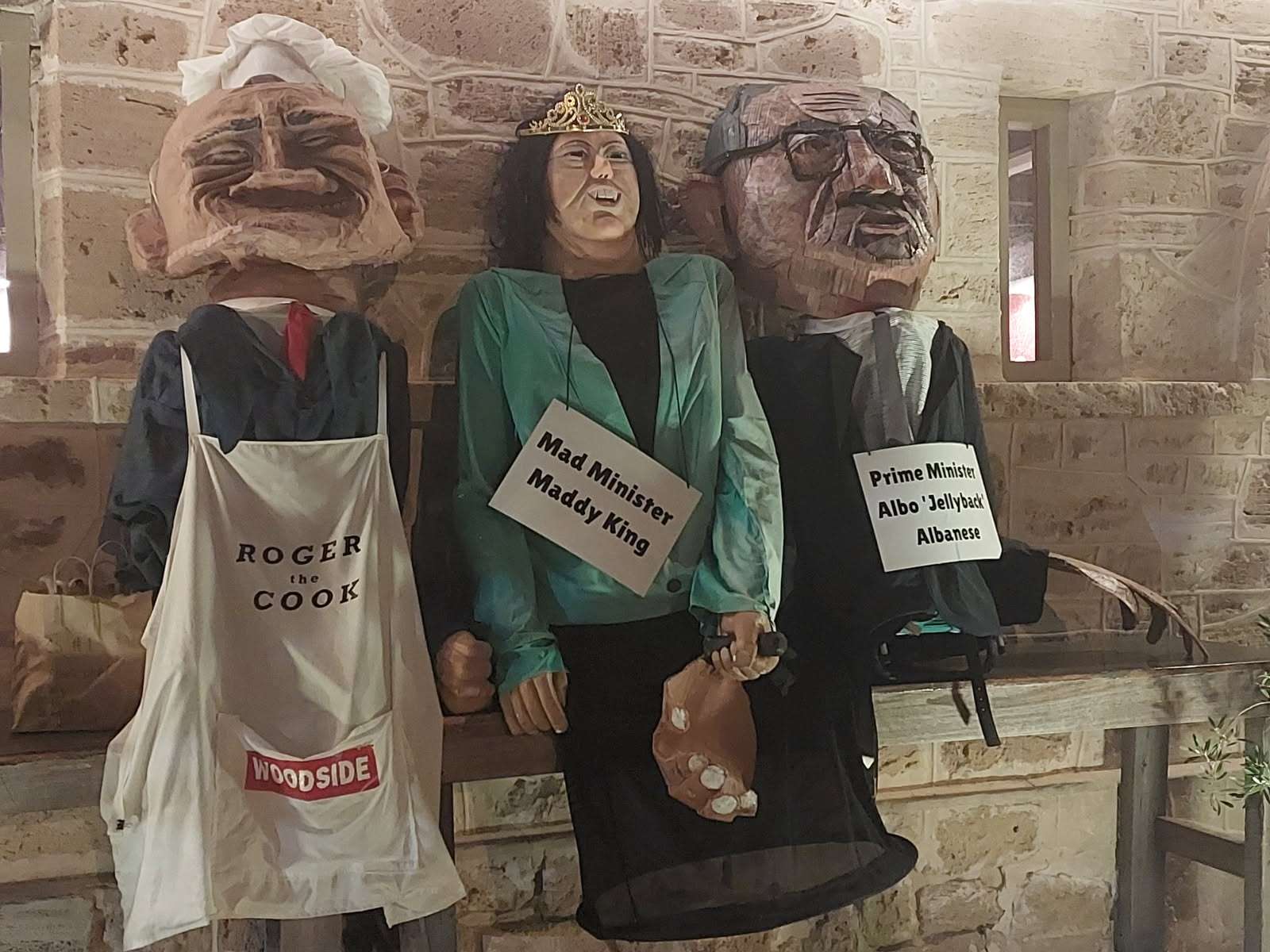
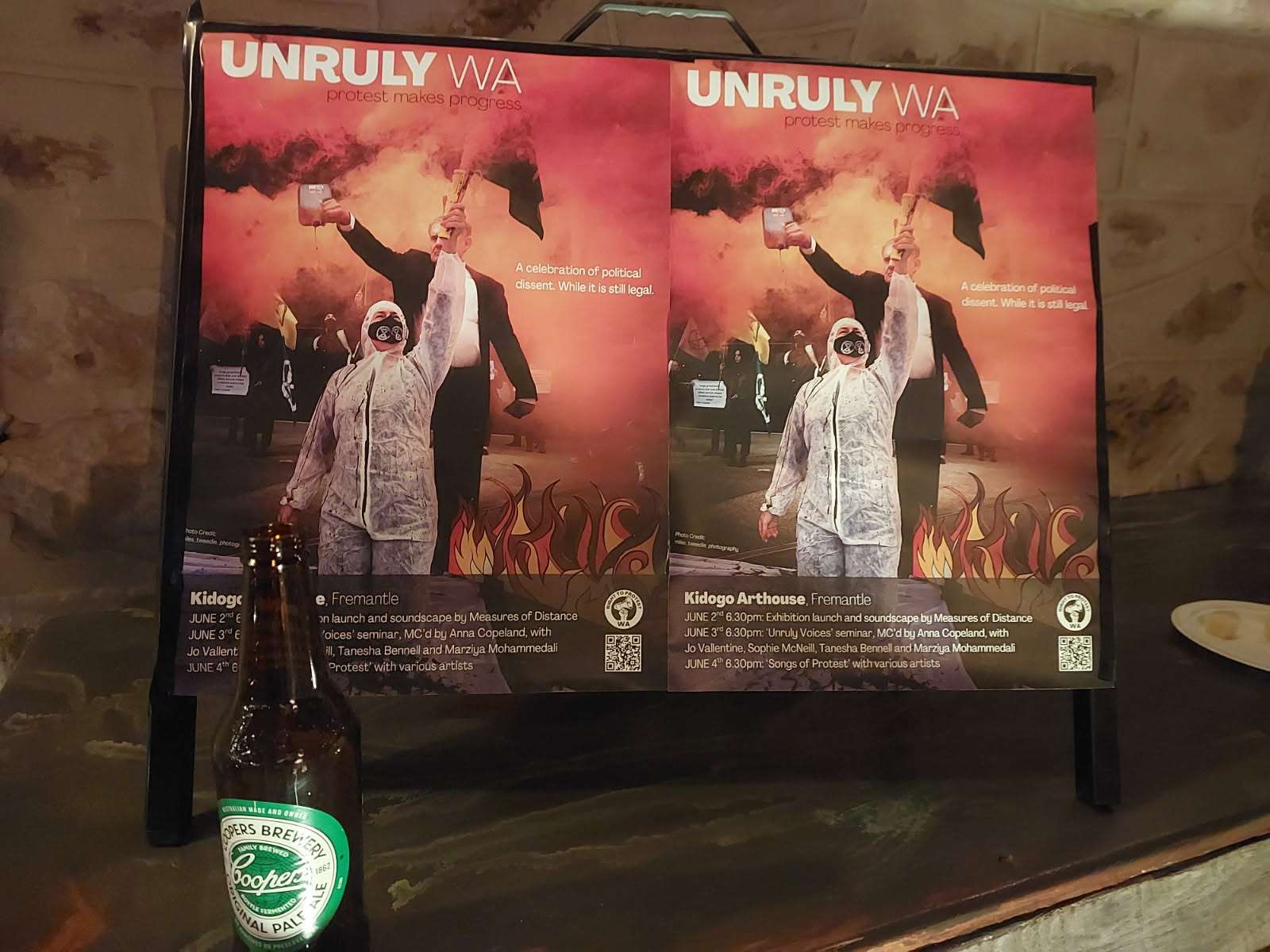
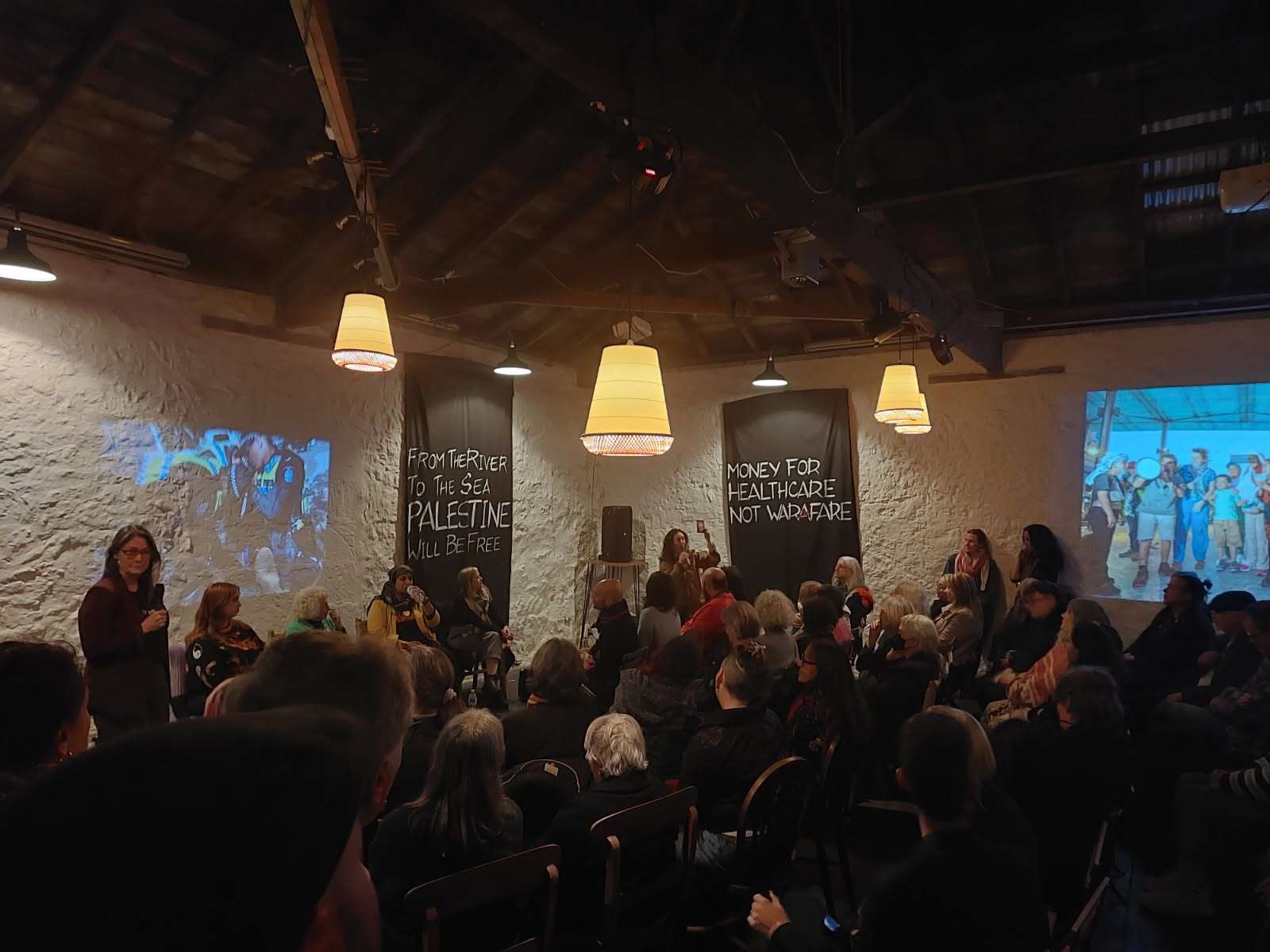
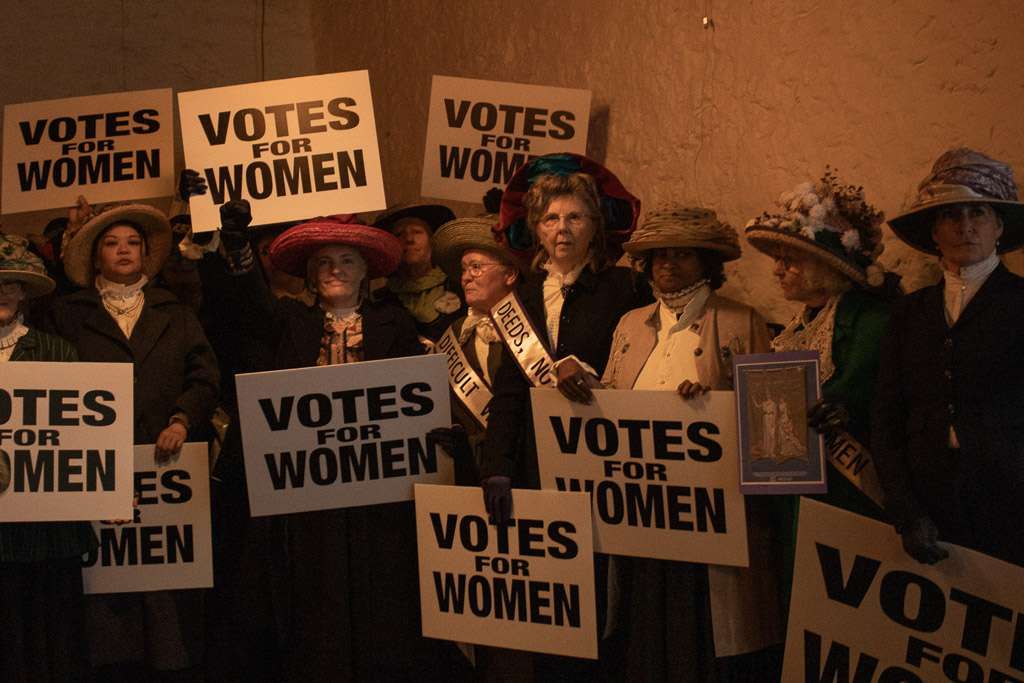
Much, though not everything, has changed. That began to dawn on me as I took in the slides and slogans adorning the walls of the Arthouse.
The MC and the four-person panel came across as articulate women. A First Nations community organiser, a Muslim photographer, writer and researcher, a politician and former journalist, and a long-time anti-nuclear campaigner and environmental advocate. Each spoke powerfully and compellingly.
Germane to the ‘right to protest’ aspect of the evening was the Cook Government’s proposed ‘post and boast’ laws to give police powers to reject protest applications that were misleading or deemed likely to intimidate or threaten others. We were warned that a bystander who posted online after witnessing an unauthorised demo could cop a three-year jail sentence! (Someone pointed out our local Federal member for Fremantle might be snared for sharing a photo on social media.)
Introduced in the aftermath of the Bondi shootings, the legislation has come under severe criticism for being too broad and having the potential to stifle free speech. Greens State MLC Sophie McNeill summarised the changes and the passage of the Bill.
However, anyone present who hoped for an informative discussion around the legislation and related issues may have been disappointed. In the time allotted for questions, we were treated to diatribes about police behaviour. Instead of options and ideas, we were offered certainties. Instead of acknowledgements of complexity, we were delivered simplistic broadsides. Instead of curiosity, we were slam-dunked with opinions.
With an attentive audience, it was a missed opportunity to discuss what a ‘right to protest’ means, theoretically and in practice. Are there parameters or guidelines? If so, what might they be? What is helpful to a particular cause, and what is likely to be counter-productive? Does the ‘right’ to protest come with any responsibilities, and, if so, what are they?
These are a few of the questions that scuttled through my mind in the aftermath. At least one of the speakers has surely reflected on these same concerns in her many years at the coalface of activism. Jo Vallentine, silver-haired and sprightly, struck a chord as she showed off her ‘difficult woman’ sash. At least it struck a chord with me, often labelled both difficult and unruly by various friends and family members. But Ms Vallentine has more runs on the board when it comes to protesting than most of us could ever dream of. As an exponent of nonviolent action, and influenced by Quaker philosophy, she’s accumulated a lifetime of commitment in showing up when a cause demands. She clearly understands that denigrating or ‘othering’ those with whom we disagree, not only undermines our objective but compromises us in more subtle ways. We damage the cause we are fighting for, and we can damage ourselves and others.
Similar concerns have been aired in local activist circles over the years. Certainly, they have been the subject of debate elsewhere. Some time ago I watched Iain McGilchrist in conversation with Anthea Lawson, author of The Entangled Activist. With a middle-class background, the younger Lawson became a journalist before jumping headlong into activist waters, campaigning for the likes of Amnesty International and Extinction Rebellion. After many years of public activism, and much reflection, she came to understand it wasn’t just what she was doing that provoked reactions:
‘It was also the way I spoke about my work, the intensity of my evident passion. I would get so wound up with righteous fury, speaking so fast and sharply about the people who defended or profited from the bad things I wanted to change that colleagues, friends and family would regularly be prompted to ask: ‘are you okay?’ My suspicion is that many of the people I was trying to persuade were switching off rather than having to deal with the frenetic force of my arguments.’
It dawned on Lawson that many of her assumptions were not helpful or accurate. She did not have to be frantic and furious in activist mode. Other people were not necessarily ‘the problem’. Eventual burnout did not have to go with the territory. Nor did hostilities and grievances amongst fellow activists. The status quo itself was flawed:
‘This is just how it is, activists themselves say. We get emotional and shouty and frantic because it is important and urgent, and we care so much. Our campaigning organisations are badly run and under-resourced, they don’t treat staff and volunteers well, lots of people burnout, because we are all so passionate and focused upon our task. And that is just how activists are now, say observers from the outside – they are hypocritical, hysterical, and are often fighting each other, they think they are doing it for love and care but give them any power and they’ll be trying to control us all. The fear that activism will lead us to the Gulag or the guillotine is real: history is full of revolutionaries who become tyrants.’
Indeed. History is a great teacher, if we are attentive. The kind of introspection in which Lawson has clearly engaged not only enriches her on a deep level but also enhances her capacity to write and talk about these issues, not only in activist circles but beyond. In fact, it’s the kind of self-reflection and honesty that can engender stronger connections within groups and organisations. But it takes courage, along with supportive guidance, for those steps to take root and become part and parcel of who we are, both individually and collectively.
Changing hearts and minds is hard yakka. Logic and reason are invariably insufficient. Those of us who are motivated to contribute to ‘a better world’ may have intellectual nous and boatloads of passion. We may be capable and forceful speakers and organisers. We may inspire others to join and be part of whatever we are trying to achieve. We may, as the expression goes ‘show up’, and we might wish that others would join us or find ways to contribute. But, simultaneously, there’s ongoing ‘work’ we need to embrace – the internal stuff.‘Showing up’ may not be enough, unless we’re prepared to address the psychological challenges of ‘growing up’ emotionally, something the mere passage of years won’t guarantee. This invokes a willingness to explore what triggers us and why. It means recognising our beliefs and behavioural patterns, as well as understanding their effect on others. And often it will mean doing far more listening than talking.
What it doesn’t mean is that we stay silent or inactive, withdrawing from, rather than confronting, the realities of the world around us. As Lawson points out, there are many potential arenas of activism, beyond taking to the streets. Like much of life, it’s a journey of learning: stumbling, fumbling, and carrying on regardless – yet always attuned to absorbing and integrating our experiences as our self-awareness develops.
Here in Australia, we are fortunate to have relatively robust institutions and the vestiges of a democracy. We are not yet under an authoritarian regime where there is no legal or implicit right to protest; where attempts to do so may put our lives on the line. Think Tiananmen Square, the Arab Spring, and more recently those in Iran pushing back against a rigid theocracy. To me, that’s courage personified.
Yet, ultimately, change can and will happen, if history is any guide. Belgian author Matthias Desmet, in The Psychology of Totalitarianism, claims there is always a relatively small percentage of the population that instantly responds enthusiastically to a demagogue, while a much larger percentage bury their heads and try to get on with their lives. Meanwhile, between 1% and 10% recognise the dangers ahead and begin to speak up. According to Desmet – and he is not the first to say this – if that percentage withers or dies away, a totalitarian state is inevitable.
In this country, we still have the luxury of participation, a luxury that enables us to argue and debate and oppose and to protest against perceived injustices and poor policies. Though Anthea Lawson’s words primarily reflect her experience in the UK, they are salient to our experience here. She goes on to say:
‘In my experience activists do not claim to be ‘saving’ or ‘changing’ the world as often as other people describe us trying to do so. Nonetheless activists usually share this implicit view that the world is separate to ‘us’ and that what needs changing is something or someone ‘over there’: something that is ‘not us’. To think like this is to share the same deep worldview that created the problems activists are trying to tackle. It is the worldview of separation, dominance and exceptionalism (the latter being the assumption that you, your group, your way of thinking or being is special and therefore superior) that has led to ecological destruction and the subjugation of peoples and other species. However we describe it, this worldview involves a narrowing of perception, a closing down to what we might otherwise see and feel.’
These words resonate with me. Lawson is talking about ‘inner stuff’ to which I’ve been alluding. Unless we attempt to bring this to the surface, within our groups and organisations, we are neglecting something fundamental. And that, I believe, will be to the detriment of what we would like to achieve.
Some of those who attended the Kidogo gathering without raising their voices, unruly or otherwise, are bound to be aware of the issues I’ve raised. Perhaps the format for the evening was more of a clarion call to action than an invitation for thoughtful discussion. And my takeaway, of course, is based on my own expectations and impressions. Yet, while the right to be an activist protester is important, I reckon it’s incumbent on individuals and groups to explore the allied question of how to be an activist. Not only explore – but to learn to value and embody specific ways of acting and being. Something of an integrated modus operandi that, against the odds, may influence others, even those in positions of power, to shed their cloaks of reflexive reactivity and begin easing towards collaboration rather than enduring confrontation.
*By Bruce Menzies. Based in Fremantle, most of the time, Bruce Menzies is the author of three novels, a family history, and a recent memoir. Details at BruceJamesMenzies.com If you’d like to read more of Bruce Menzies’ work on Fremantle Shipping News or listen to a fascinating podcast interview with Bruce, look here.
~ If you’d like to COMMENT on this or any of our stories, don’t hesitate to email our Editor.
~ WHILE YOU’RE HERE –
PLEASE HELP US TO GROW FREMANTLE SHIPPING NEWS
FSN is a reader-supported, volunteer-assisted online magazine all about Fremantle. Thanks for helping to keep FSN keeping on!
~ Don’t forget to SUBSCRIBE to receive your free copy of The Weekly Edition of the Shipping News each Friday!