Yesterday, at a presser at a residential home in the Perth suburb of Gwelup, the Assistant Minister for Climate Change and Energy, Josh Wilson – who is also the federal member for Fremantle – was both pleased and anxious to share the good news that, in just over six months, more than 22,000 Western Australian households and businesses have cut their bills for good by installing a home battery under the Albanese Government’s Cheaper Home Batteries Program. Here’s the story.
In WA, more than 100 batteries have been installed every day since 1 July last year, more than doubling the number of home batteries installed in the State where nearly half of all homes already have rooftop solar.
Six WA postcodes sit in the nation’s top 20 for uptake of home batteries, with families and businesses in the outer metropolitan suburbs of Perth, such as Canning, Armadale and Gosnells among the quickest to take advantage of bill busting batteries.
Overall, the State represents 12 per cent of all installations under the Albanese Government’s home battery program, surpassing the state’s usual 10 per cent uptake for Commonwealth programs.
Nationwide, the Cheaper Home Batteries Program has helped more than 190,000 households and small businesses cut their power bills, with around three-quarters of installations in the suburbs and regions.
Last month, the Albanese Government announced changes to ensure that more Australian households can benefit from the program, with a funding boost to $7.2 billion over four years.
These changes are expected to see more than 2 million Australians install a battery by 2030, delivering around 40 gigawatt hours of capacity, doubling initial estimates of 1 million batteries and increasing the expected capacity by almost four times.
The Albanese Government is keen to make us all aware that it is also supporting Western Australia’s clean energy transition through investment in new renewable energy generation, community and grid-scale batteries, virtual power plant technology, and concessional loans for solar and battery installations.
We are now pleased to bring you a slightly edited account of what was said at yesterday’s presser by Tom French MP, Josh Wilson, the Assistant Minister for Climate Change and Energy, Oceana Pettiment, householder, and Rohan McGlew from battery installers West State Electrics.
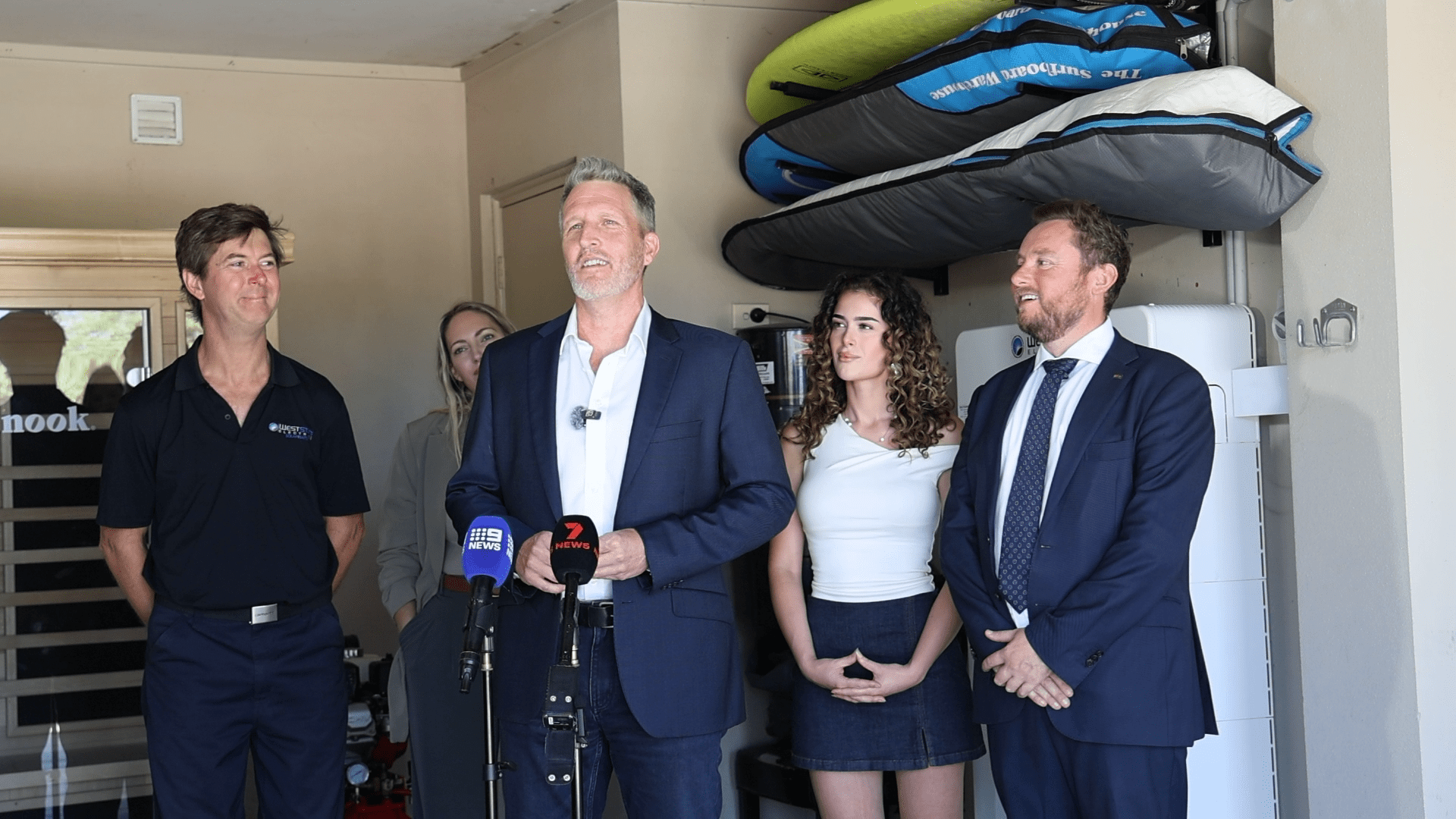
L-R: Rohan McGlew, Charlie Caruso ( from the Smart Energy Council), Josh Wilson MP, Oceana Pettiment, Tom French MP
TOM FRENCH, MEMBER FOR MOORE: Thank you everyone for being here. I’d just like to thank Troy, Jeneen and Oceana for having us in their home today.
I’m Tom French. I’m the Federal Member for Moore and it’s really great to be here. So, in Moore there’s been over 1,200 batteries taken up just locally and what that really shows us is two things – that families really want control of their power bills and secondly that when good policy is executed well it’s taken up really quickly by the general public.
And as a former electrician, we like practical infrastructure. I want to see how policy works. And when you come into a home, you see a battery. You see what batteries actually look like. You can physically see what this policy looks like on the ground. So, I’ll just hand over to Josh to have a broader chat about the national policy battery program.
JOSH WILSON: Thanks, Tom, and good morning, everyone. It’s great to be here at the house of the Melbin family in Gwelup, on the lands of the Whadjuk Noongar people.
And it’s great in the early part of 2026 to reflect on the progress that we’re making in the energy transition that Australia has to be part of, and that the Albanese Government has set this nation towards. We need to make an energy transition that delivers the cheapest energy system in the future and a cleaner energy system as we participate in that global cooperative effort to tackle dangerous climate change. And we’re making really significant progress.
We’ve done it in lots of different ways, and the most recent, significant program has been Cheaper Home Batteries, and it’s a good opportunity as we cross the six-month mark, and as we cross the 20,000 installed battery mark here in Western Australia, just to reflect on how significant that change has been.
It’s been an enormously successful program, and not surprisingly, it’s been really welcomed by Western Australians. Western Australia is the leading jurisdiction when it comes to the deployment of large grid scale batteries, and Western Australian households and businesses have shown a similar appetite when it comes to distributed, smaller scale storage. We are taking up batteries in the household and small businesses at a rate that’s faster than our population proportion would suggest.
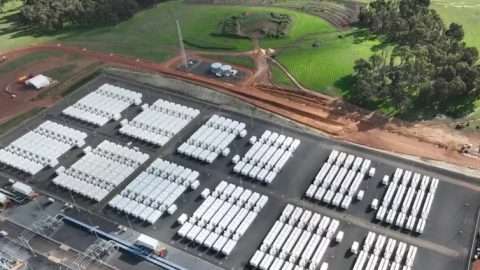
As I say, we’ve gone past the 20,000-battery mark already. That’s more than 400 megawatt hours of battery capacity. That’s basically double the size of the first phase of the Kwinana Big Battery Project.
Six of the 20 leading postcodes in Australia are here in Western Australia, and they are generally outer metro suburbs where people want to reduce their energy prices and reduce emissions by adding to the remarkable progress we’ve made in rooftop solar with the addition of distributed battery storage.
Until recently, the leading postcode in WA was in my electorate of Fremantle, 6164, in Cockburn – it has just been knocked off the top position by a postcode in Trish Cook’s seat of Bullwinkel. I hope that the good people of Cockburn can reclaim top spot before long. But it’s really significant that six of the top 20 postcodes are here in Western Australia. And it’s important that people remember that not only each and every of those small businesses and households see immediate cost reductions when they add battery to solar storage, but it’s delivering systemic benefits as well.
The Australian Energy Market Commission has made it clear that the progress we’ve seen under the Cheaper Home Batteries program, nearly three gigawatt hours now delivered nationwide, is already helping our energy system, bringing down peak demand and putting downward pressure on those systemic costs, which is something we really want to see. Australians should have confidence in the energy transition that we have to make, and that we are making thanks to the policy and program clarity of the Albanese Labor Government.
We set some clear targets when we were first elected, net zero by 2050, 82% renewable energy by 2030, and we’re on track to meet those targets. We have made remarkable progress after a decade of waste and neglect and a decade in which the coalition saw power generation actually exit the system, while they let ageing, unreliable and expensive coal-fired power limp closer to the end with no solution for our energy system. We were never going to allow that to be the case. We’ve put Australia on a really significant path, and we’re starting to see those benefits in no uncertain terms.
Last year, in September and then October in consecutive months, for the first time, we saw more than 50% of renewable energy in the national grid. And here in WA in one of those months, it was more than 55% renewable energy. Renewable energy out-generated coal for the first time for an entire month in consecutive months. That’s a really significant milestone.
And of course, in the most recent reporting period, we saw the largest decrease in annual greenhouse gas emissions that Australia has ever achieved outside of a COVID lockdown. That is progress. That is what Australia should seek to achieve, and is on the path to achieve – our destiny to be a renewable energy superpower and a clean industry powerhouse taking advantage of the best solar and wind resources in the world, taking advantage of our investment, stability, our technological know-how and that appetite in our communities, in our streets and suburbs around the country, particularly in outer metro suburbs, where Australians are taking up not just rooftop solar, but now distributed battery storage, home batteries, so that we can be the leader in distributed energy and storage the world over, and we can continue to be a leader when it comes to both clean energy and emissions reduction.
WILSON: I’m happy to take questions on the program and then do questions of the day.
REPORTER: Was it the decline in the cost, or the continuing climb of the cost of the battery key, or was it the subsidy that came in and just made it even cheaper for people that was the key?
WILSON: Well, it’s a combination of those things, and the subsidy from 1 July has really kicked off a home storage revolution, just as the decisive policy action of the Rudd Gillard Government kicked off the home solar revolution. If you go back to 2007 before the Rudd Gillard Government was elected, one in 1,000 households had rooftop solar through those smart subsidy programs, which decreased over time as scale improved and solar prices came down. We’ve now got to the point where it’s one in three households that have solar, and in jurisdictions like WA, it’s two in five. The principle is the same. You know, we’ve made a significant decrease in the upfront cost of batteries, about 30% in some jurisdictions like WA, there’s also an additional state-based rebate program, and that has driven this really, significant uptake of home batteries.
REPORTER: You’re obviously finding a lot more interest from homeowners to get these things in. Is there a wait now?
ROHAN MCGLEW, WEST STATE ELECTRICS: Yeah, we’ve got a four-to-six-week lead time, depending on the size of jobs, and obviously people are attracted by the by the cost coming down all the time.
REPORTER: Do you sell as well? You retail, as well? How low do you expect the cost to come down without the rebate?
MCGLEW: So West State Electric sells and installs solar and battery systems. In terms of the cost of the batteries, yeah, look, we’re always seeing tech become cheaper. That’s a given. We’ll see it get smaller and cheaper over time.
REPORTER: And are homeowners generally, obviously they’d be pleased with if they’re saving money.
MCGLEW: Yeah, absolutely, But with the combination of the rebates the pricing of batteries, it used to be a future decision for people that they just couldn’t invest in, and now that the reality is here – that they can make a really well informed decision – because there’s not pressure on them to make the decision, the policy that’s been being rolled out with Cheaper Home Batteries enables consumers to make a really good decision, and it gives us installers [inaudible] to invest in our people and our systems for a longer term.
REPORTER: There was, I think this is going back with my memory. There was concern amongst installers that there was a delay, I think, in the rebates coming into effect, and so they were concerned that people were cancelling their orders. Did that happen? Was there much disruption of the industry because of those concerns?
MCGLEW: There was a little bit of disruption in the beginning, but like any scheme coming through it takes a little bit time to get through it, but it’s rolling beautifully. The Federal scheme is, without a doubt, the best scheme of a rebate that I’ve seen in 20 years.
REPORTER: Oceana, if you don’t mind, can you just explain your situation here with your bills and the decision? Why did you go ahead with the decision on battery power?
OCEANA PETTIMENT (HOUSEHOLDER): So before the battery got put in, bills were coming around $1,600 and now they’re around $200 and that’s when we’ve got the aircon running on, like in summer. So come winter, it will probably be nothing, which is great, especially when the pool’s always running. The kids have always got the light switches on, and they don’t turn anything off. It’s really good for reducing your bills with the app as well. It tells you all the environmental contributions that you’re doing. So that’s great. So yeah, all around it just makes it really easy. It’s good to see that you save money as well every single day.
REPORTER: Is it important to know the sorts of savings that you are making and how the system is actually working? Does that govern how you use electricity?
PETTIMENT: It doesn’t govern how the kids do but, yeah, it does. On the app, you can actually see what’s actually happening, which is really cool for a visualisation, but yeah, it’s just good at the end of the day, you know that something’s working for you. And then, you can go on a holiday now because you save this much money, and it’s renewable.
REPORTER: And how big of a family are you guys?
PETTIMENT: Six. Yeah, six of us in one household.
REPORTER: So that’s two adults and four kids?
PETTIMENT: Yeah. It’s really good. I just can’t believe how much money we’ve saved, really, like $1,600 down to $200. That’s huge.
REPORTER: Why did you get it in the beginning? Was it the rebate that enticed you, or what was the change to solar for?
PETTIMENT: Well, one, it’s renewable. And also, why wouldn’t you want to save money. If it’s good for the environment and it’s good for your pocket, why wouldn’t you? So that’s why we did it. Now, yeah, that money saved can be better spent on family. Now we can go to Rotto a bit more, the family can go to Bali.
REPORTER: Are you more relaxed when the kids leave the air conditioner on?
PETTIMENT: Absolutely, absolutely. We’d always say, turn the air con off. No one’s in the house. You’re not using it. But now we can live in a bit more luxury, I would say. Now we can have the air con running and, yeah, not really feel too bad about it, because, yeah, it’s all run from the solar panels and the battery.
REPORTER: And you’ve got a pool. What are some of the things that normally would churn up the bills.
PETTIMENT: Running a pool is quite costly, especially when you’ve got filters running, the cleaner running. If you’re in a house of teenagers as well, you always want to make sure that that pool is clean, because they’ve always got their friends over. So yeah, it is quite costly with the pool, but also with teenagers, they’ve always got everything turned on or got their friends over. You’re spending extra time cleaning, you know. So, it just helps with that way, like helps with that too. So pretty much everyday life, it just minimises your costs, and it’s renewable, and it’s good for the planet, so I love it because of that as well.
REPORTER: And your system cost you? What was your cost to install? That’s a new system on old solar panels isn’t it, so what did this one cost you?
MCGLEW: Around $10,000.
REPORTER: And that’s pretty normal now for a battery this size?
MCGLEW: Yes.
PETTIMENT: I think it will save us around, just roughly already about over three grand a year, than what we would usually spend.
REPORTER: You got the rebate as well on that? So, did that come off the 10 grand? So, what was the total?
MCGLEW: No, no that is the total. With the rebate, yeah.
WILSON: This is a large-ish battery.
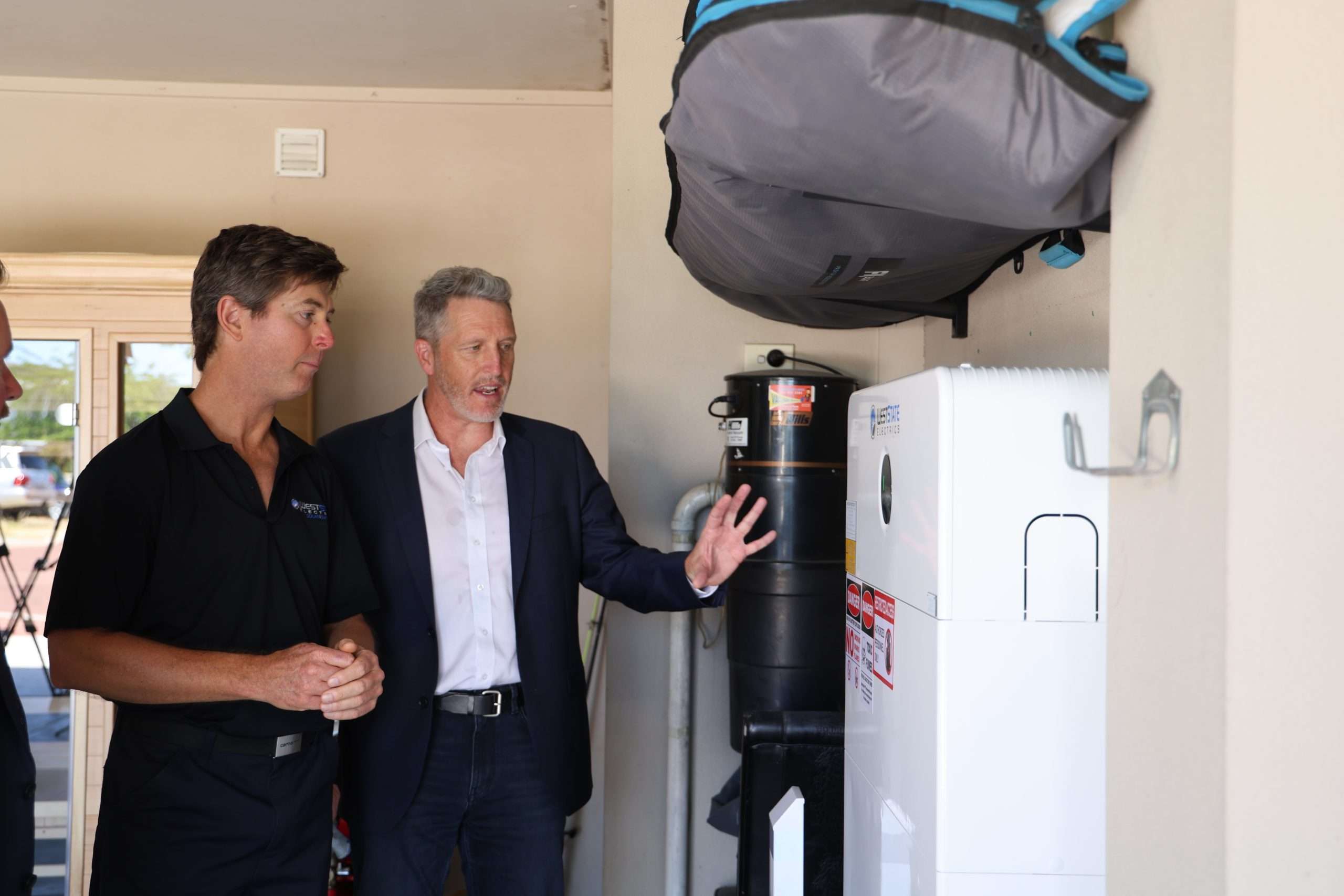
MCGLEW: Yes, this is a very large battery. So, this has state and federal rebate attached to it, as well as being part of the VPP.
By Michael Barker, Editor, Fremantle Shipping News
~ If you’d like to COMMENT on this or any of our stories, don’t hesitate to email our Editor.
~ WHILE YOU’RE HERE –
PLEASE HELP US TO GROW FREMANTLE SHIPPING NEWS
FSN is a reader-supported, volunteer-assisted online magazine all about Fremantle. Thanks for helping to keep FSN keeping on!
~ Don’t forget to SUBSCRIBE to receive your free copy of The Weekly Edition of the Shipping News each Friday!